


A report that OpenAI’s sales pace was about $50 billion a year, not $70 billion, knocked chip stocks last Thursday. On Friday 9 October, the company gave investors a new target. Here is what “annualized revenue” really means, and what the episode tells investors.
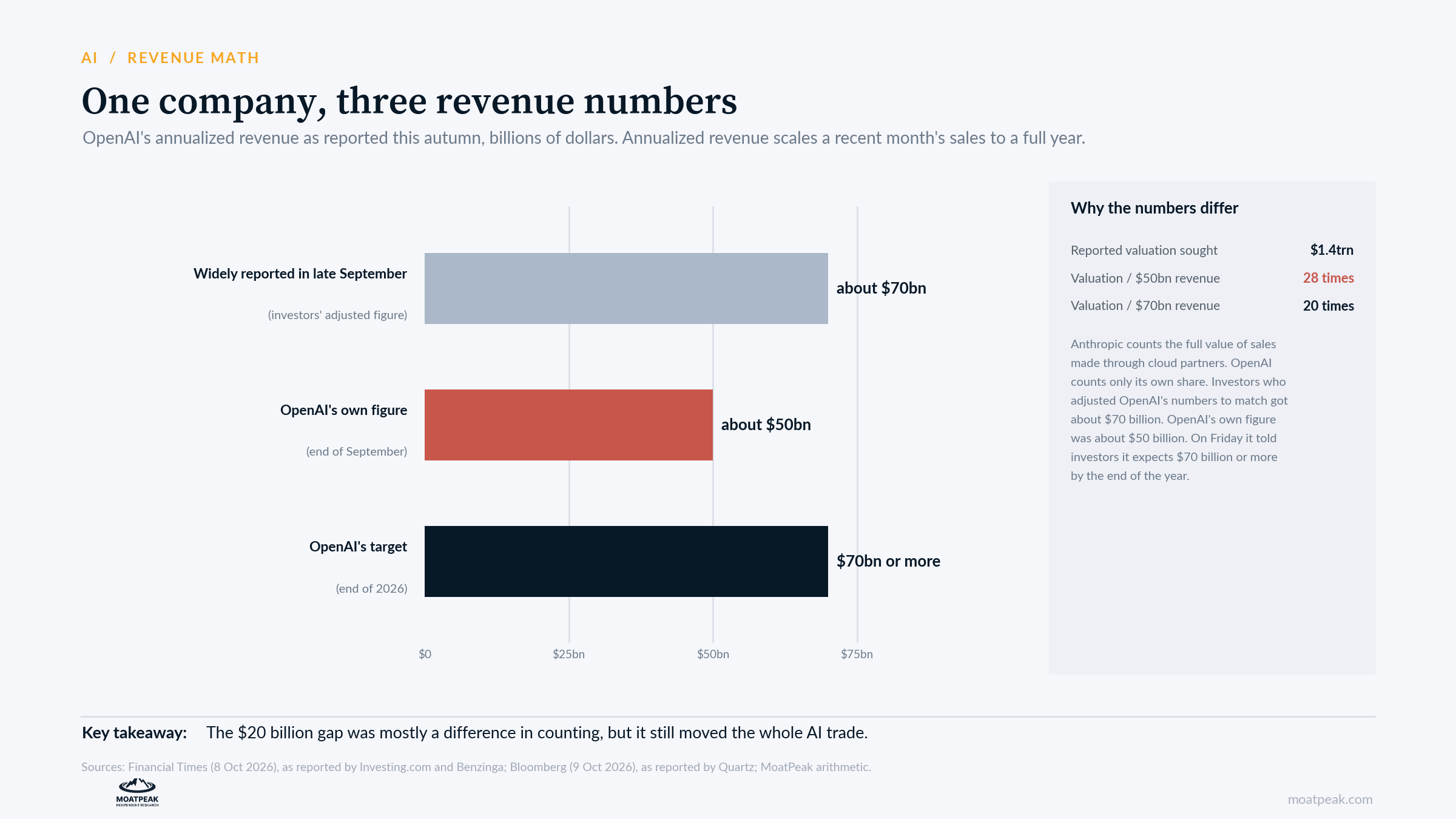
Last Thursday, the Financial Times reported that OpenAI had told investors its annualized revenue was approaching $50 billion at the end of September. Only weeks earlier, many outlets had reported a figure close to $70 billion.
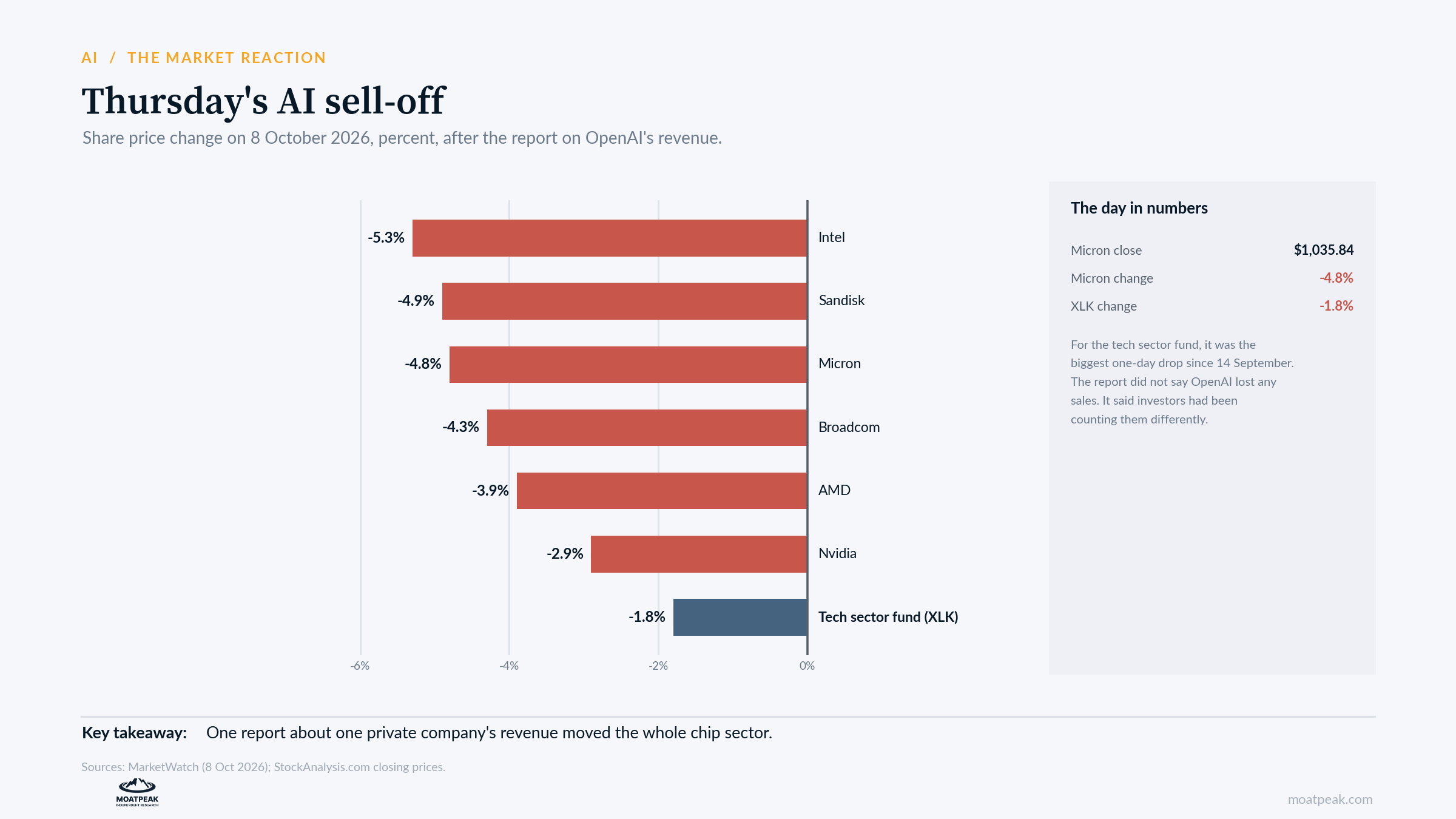
Chip stocks fell hard. Intel lost 5.3 percent, Micron 4.8 percent, Broadcom 4.3 percent, AMD 3.9 percent and Nvidia 2.9 percent, according to MarketWatch. The main tech sector fund, XLK, fell 1.8 percent, its biggest one-day drop since 14 September.
On Friday 9 October, Bloomberg reported that OpenAI told investors it expects annualized revenue to reach or exceed $70 billion by the end of the year.
What “annualized revenue” means
Annualized revenue, also called a run-rate, takes recent sales, usually one month, and scales them up to a full year. If a company sells $4 billion in a month, its run-rate is $48 billion.
It is not revenue in the accounting sense. It is a snapshot of speed, and companies do not all calculate it the same way.
Why the numbers differed
According to the FT, the gap came from the way two rivals count. Anthropic includes the full value of sales made through cloud partners such as Amazon and Google. OpenAI counts only its own share of sales made through partners such as Microsoft.
To compare the two, some of OpenAI’s investors adjusted its numbers upward. That produced reports of $40 billion in August. When OpenAI later told investors that its revenue had grown more than 70 percent, the adjusted starting point turned into reports of about $70 billion. OpenAI’s own figure was closer to $50 billion. OpenAI declined to comment to the FT.
Why a definition moved the market
No sales disappeared. But OpenAI is one of the largest buyers of computing power in the world, and much of the AI supply chain is valued on how fast companies like it grow. When that growth looked smaller, investors sold the suppliers first and asked questions later.
It also shows how concentrated the AI trade has become. One number about one private company moved Intel, Micron, Broadcom, AMD and Nvidia on the same day.
The valuation math
OpenAI is reported to be seeking at least $30 billion of new funding at a valuation of about $1.4 trillion. That is about 28 times a $50 billion run-rate, or 20 times a $70 billion one. Either way, investors are paying for growth that has not happened yet. That is why a single figure can swing the mood so much.
The case against us
The AI build-out does not hang on one number. OpenAI’s own figure still points to very fast growth, and it now tells investors to expect $70 billion or more by the end of the year. If it gets there, Thursday’s drop will look like an overreaction.
What it means for your money
Read the definition. Run-rates, bookings and backlogs are not revenue. Check what is being counted before you compare two companies.
Watch the audited numbers. Public chipmakers report actual sales and cash flow every quarter. Those figures tell you more than a private run-rate.
Know your concentration. If you own chip stocks, part of your return depends on how fast a handful of AI labs grow.
What we are watching
15 October: TSMC’s third-quarter results, the first big read on chip demand this earnings season.
Late October: quarterly results from the largest cloud companies, which show how much they are spending on AI.
Any update from OpenAI on its progress toward $70 billion.
Educational research only. Not personalized investment advice. MB “MoatPeak Group”.