


This is a question worth thinking about.
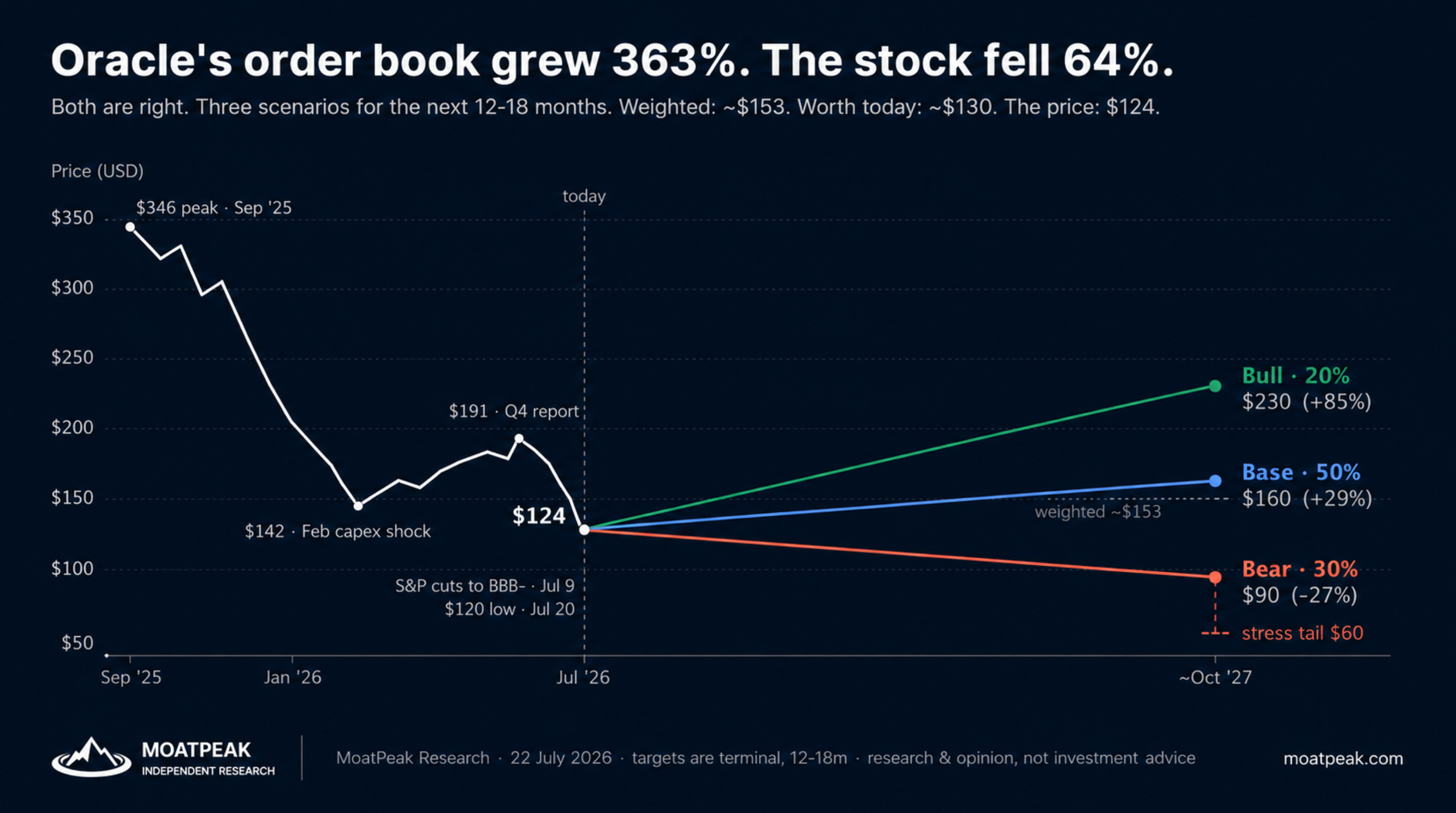
Over the past year, Oracle signed more future contracts than ever. Its order book, called RPO, jumped 363% to $638 billion. The cloud infrastructure business grew 93% last quarter, and Oracle expects $90 billion in revenue next year.
But during that same year, Oracle’s stock fell from $346 to $124, a 64% drop, even though the market stayed near record highs.
At first, it seems like these facts can’t both be true. But after months of analyzing the company, we found that they are, even if it feels odd.
What the market actually figured out
A backlog is just a promise. Only 12% of Oracle’s backlog will turn into real revenue in the next year. The rest depends on building new data centers, which cost $56 billion last year, or 83% of total revenue. Free cash flow was negative $24 billion. Borrowing to fill the gap got more expensive at the worst time. In July, S&P cut Oracle’s credit rating to BBB minus, just above junk status.
The stock didn’t drop because investors missed the good news. Instead, the market started seeing Oracle differently. It used to be valued as a software company with steady revenue, high profits, and low spending. Now, it’s seen as an infrastructure developer, which means big upfront costs, more debt, higher risks, and a longer wait for returns. It’s the same stock symbol, but a very different business.
The one-customer problem
There’s another key point. S&P says about half of the $638 billion backlog comes from just one customer: OpenAI.
OpenAI is an impressive company, but it expects to stay unprofitable until about 2029. Starting in 2027, it will owe Oracle about $60 billion a year. So, the real question for Oracle’s stock isn’t about databases or even AI demand. It’s whether one unprofitable customer can keep paying such large bills. S&P made this clear when explaining the downgrade.
That’s why we focus on ways to lower risk, not just the headlines. We look for things like upfront cash payments, money in escrow, guarantees, and whether the new capacity is actually being used. Even if OpenAI goes public, it wouldn’t solve Oracle’s heavy reliance on one customer. It might give OpenAI more money for a while, but Oracle would still depend on them.
Three scenarios, then the honest part
We crunched the numbers for the next 12 to 18 months.
Bull case, 20% chance: new capacity comes online, cash flow gets better, credit stabilizes, and OpenAI backs its commitment with real cash. The target price is about $230, or an 85% gain.
Base case, 50% chance: Oracle hits its guidance and revenue moves toward $90 billion, but negative cash flow, debt, and dilution keep the valuation low. The target price is about $160, or a 29% gain.
Bear case, 30% chance: OpenAI has trouble paying, or Oracle gets downgraded to junk. The target is about $90, with a possible drop to $60 if a real counterparty problem hits earnings.
If you average these scenarios, you get a value of about $153. With the current price at $124, that suggests a 26% upside. So, is now the time to buy?
Not really. That $153 is more than a year away. If you adjust for the 12 to 15% return this risk should earn, you get about $130. With the stock at $124, there’s barely any upside left. The market already knows this.
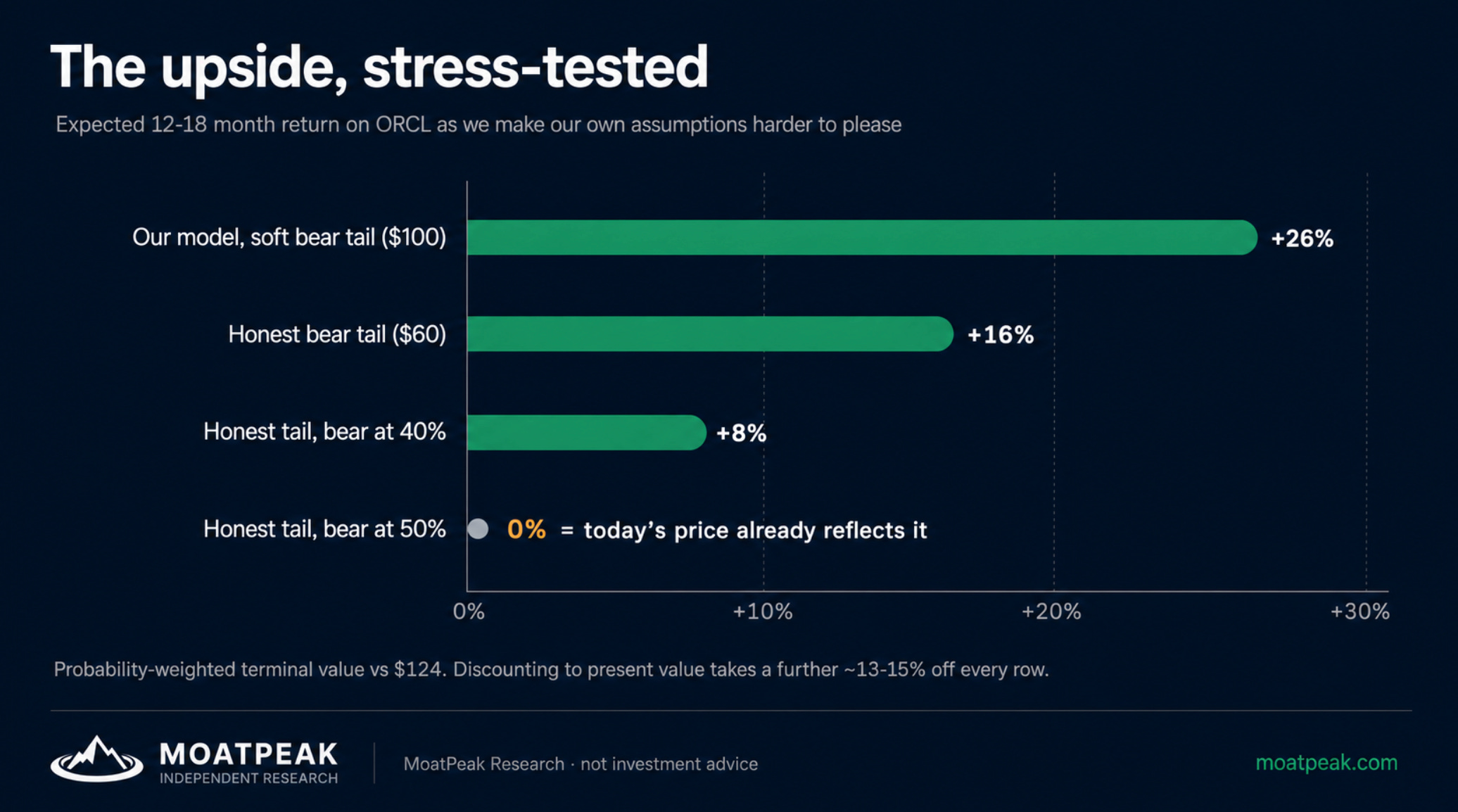
Then we did what we always do: we challenged our own model. If we make the worst-case scenario more realistic by using $60 instead of a safer $100, the expected upside drops to 16%. If we raise the chance of the bear case to 40%, the upside falls to 8%. At 50%, it’s zero, which matches today’s price. If you work the numbers backward, the market is basically assuming the bear case is 50% likely, while we think it’s 30%. That’s the main debate, and it could go either way.
Who blinks first
Let’s look at it another way. Wall Street’s average target price is $249, with estimates ranging from $145 to $400. But today’s price is only about eight times what analysts expect Oracle to earn in 2029. This means the market is putting a low value on those predictions. Either the estimates will drop, or the stock price will rise. In the end, our three scenarios boil down to one question: which will change first, the forecasts or the price? It’s not the amazing bargain a 64% drop might suggest, but it’s not a clear short either. It’s more like a coin toss on whether one customer can keep paying, so we keep our position small and stick to a checklist. On the positive side, we’re watching for real cash commitments from OpenAI, tighter credit spreads after results, and better free cash flow as more capacity comes online. On the negative side, we’re alert for another downgrade, delays in energy permits, or any changes to OpenAI’s payment schedule.
The next key update is around September 9, when Oracle reports results. We’ll compare our analysis to what happens and share the outcome publicly, as always.
If you want to get that follow-up straight to your inbox, just subscribe.
moatpeak.com
Nice one and “hidden gem” insights on OpenAI