


We gave the reasons six days ago and the real issue is not whether the backlog exists.
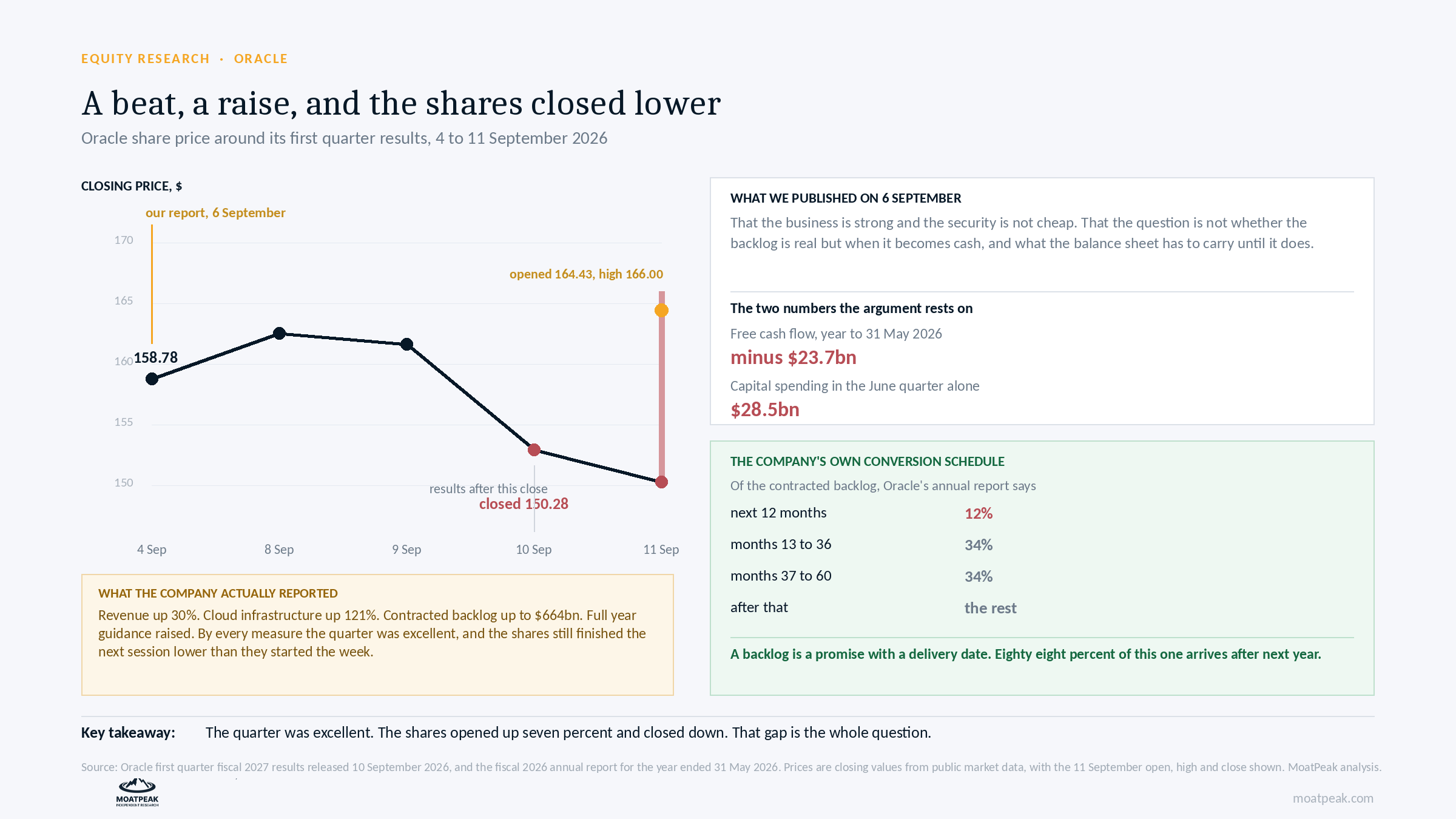
On Thursday evening, Oracle released the results that most companies would use in their advertisements, with revenue increasing by 30 percent, cloud infrastructure growing by 121 percent, contracted future business amounting to $664 billion, and full-year guidance being raised.
On Friday morning, the shares opened at $164.43, a rise of more than seven per cent, and temporarily hit $166.00.
At the end of the day, the share price was $150.28, a figure lower than the one it had when the week began.
Why there’s a gap
The fact that the share price has fallen following the good news shows that the news is not in doubt. There is no question about Oracle winning contracts. The real issue is the cost of fulfilling those contracts before they produce revenue, and as to who should pay that cost in the meantime.
The figures are from Oracle’s own reports.
For the year ending May 31, 2026, Oracle had operating cash flow of $31.98 billion and allocated $55.66 billion to capital projects; its free cash flow was therefore -$23.69 billion.
Oracle then spent $28.5 billion in the quarter that ended August 31; that amounts to more than half of what it had spent in the whole of the previous year in just one quarter.
The backlog also has a schedule
The figure in question is the one that we would give to anyone thinking of buying the shares, and it is directly taken from Oracle’s annual report.
From the reduced backlog, Oracle anticipates that 12 percent will be recognized as revenue over the next twelve months, 34 percent will occur between the thirteenth and thirty-sixth month, 34 percent will be realized between the thirty-seventh and sixtieth month, and the remainder will come afterward.
Around 88% of the backlog will be recognized after next year, but all the capital required to support it has to be spent in advance.
A backlog involves a promise accompanied by a delivery date; the amount of the promise and the time of delivery are separate matters, although typically only the amount is given attention.
The best case for the other side
We won’t include this analysis without also including it.
The fact that expenditure occurs before revenue may be a sign of genuine growth, but it can also indicate the presence of a bubble. This demand is not merely anticipated but is actually contracted, and $664 billion is a sum much greater than Oracle could have secured five years ago. Should all the arrangements go according to plan, Oracle will have obtained a decade of growth that was previously possible, and worries regarding free cash flow will appear excessive when looked back on.
The true issue is not whether that result can be achieved, but rather what you are paying now in order to have that opportunity, and what impact that will have on the balance sheet during the interim period.
Our approach
We created a model, carried out some tests using three different scenarios, and determined the price at which the risk becomes worthwhile. The note sets out the fair value, the range surrounding it, the point at which we would begin looking, when we would buy, the three things that have to happen, and the one thing that could bring the case to an end.
To make it clear, when we looked at the reference price we did not recommend buying the stock, and we set out that position on September 6 at $158.78, prior to the results released on Thursday. It has not been easy to maintain this stance over the course of a year during which the share price had risen considerably, but it is the kind of decision we would rather be assessed on than one that we try to avoid.
For more information, see moatpeak.com.
This content is based solely on educational research and does not provide personalized investment advice. MB “MoatPeak Group”.