


The figures, however, change if the starting point is altered to the end of the month and if you take January as the starting point the trend is completely reversed.
The bold assertion is currently circulating: the artificial intelligence sector has split into two camps. Since late June the software sector has risen by around 25% while the semiconductor index has fallen by about 20%, resulting in a 45-point difference among a sector that most people still regard as a single entity.
While there is some truth to this, the figures being used have been carefully chosen.
What the two funds actually did
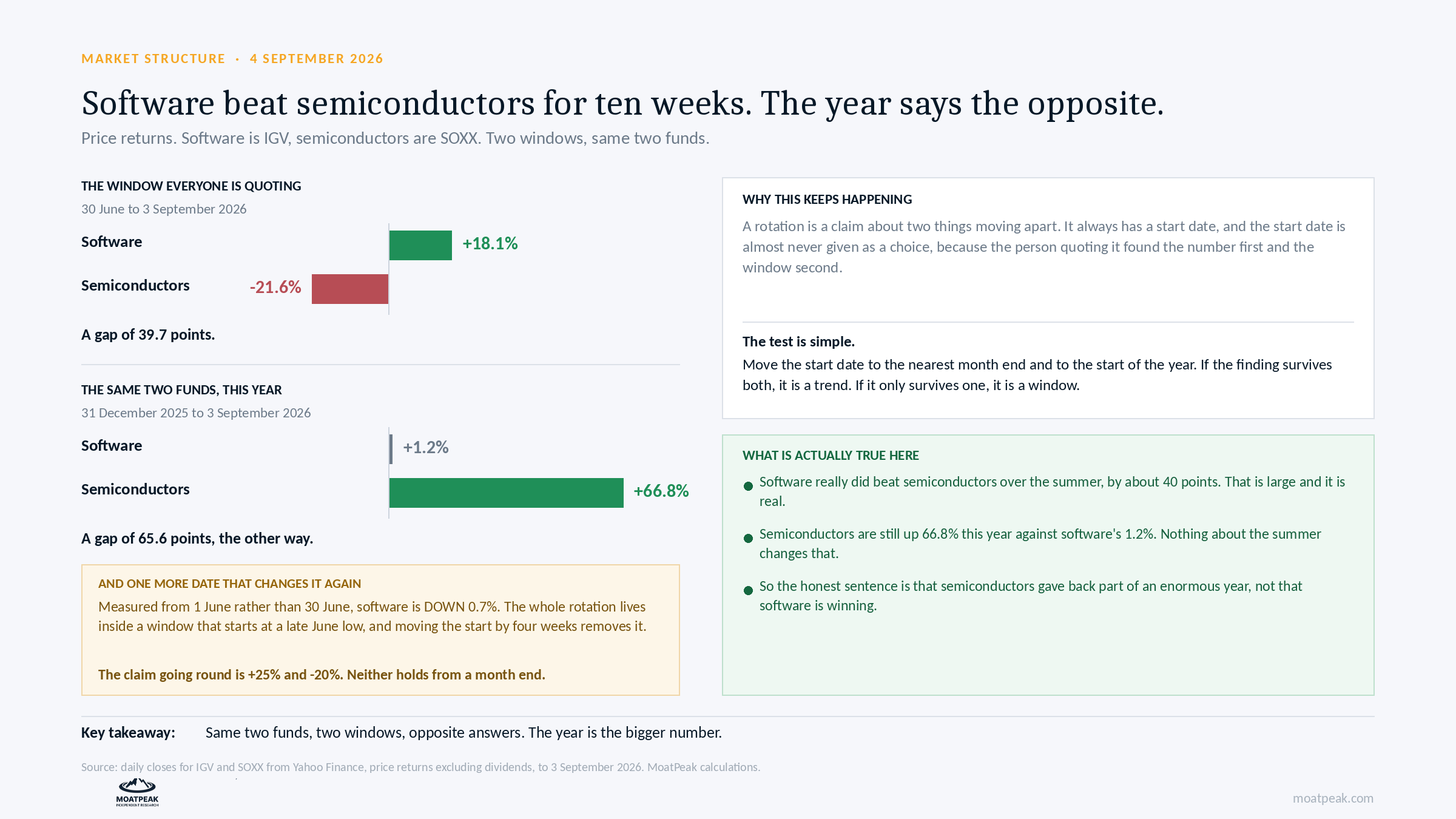
Look at the two most commonly held types of shares, those in software (IGV) and those in semiconductors (SOXX), in terms of price returns.
From June 30th to September 3rd, the software market returned 18.1 percent while semiconductors decreased by 21.6 percent; the difference between the two figures is 39.7 points.
That represents a large divergence and we won’t deny it. It’s not 45 points, and software isn’t up 25%. The figures cited only come out when you set the clock beginning at the exact low point around 22 to 25 June.
Let us go back four weeks from the starting point.
Between June 1st and September 3rd, software actually declined by 0.7 percent; all of the outperformance occurred during the period beginning at the low in late June. If the period is started one month earlier, then the software has not moved at all.
Let’s consider the most important time frame now.
From the start of the year up to September 3rd, semiconductors have increased by 66.8%, whereas software has risen by only 1.2%.
It’s a 65.6-point gap in the other direction and considerably larger than the one being discussed.
The truth is that it’s not the case that software is overtaking semiconductors; rather, semiconductors stopped some of their major gains during the summer, and software, which had remained level for eight months, did the same during that time.
The two statements are based on the same price data, but one of them gives a correct representation of the entire year.
Why this keeps happening, and how to check it in thirty seconds
When we talk about a rotation, we mean that two things are moving apart, and the result always depends on the point from which the measurement begins. The starting date is generally not offered as an option because people tend to identify the number first and then select the time period. This is not dishonest; it’s simply what occurs when you’re looking for a difference and stop as soon as you come across one that stands out.
We have a test which is simple enough to carry out on your phone.
If you change the starting point to the nearest month end and then to the start of the year, and the result is valid in both cases, then you have a real trend; if it is only valid in one case, it is a pattern worth mentioning; and if it doesn’t hold in any case, it is merely a fluke.
The claim passes the first test, but only to a lesser extent, and it completely fails the second test.
What we think is actually going on
Several factors are involved and they may all occur simultaneously.
Semiconductors performed well in the past but have lost some of their advantage as interest rates have risen, since long-term assets are most affected by such increases. Software did badly in the first half of the year but has since begun to recover. There is also a valid point, one that we take seriously, that the economics of using artificial intelligence are improving for companies that make use of computing power but are deteriorating for some companies that provide it.
That particular point is particularly interesting, but it would need more substantial evidence than merely looking at the price change over a ten-week period. Although some data is now becoming available, we won’t say any more about it until we have been able to measure it over a longer period. In previous instances we have had to revise our views when it turned out that the price claims were less important than they had first seemed.
What would change our mind
If the semiconductors fall behind software once more in the fourth quarter when the period starts from the end of the month rather than from a date that has been selected in advance, then we will regard it as a real trend.
We currently regard the summer as only a short setback in light of the strong performance throughout the year if the semiconductors do recover from this point.
The habit
If anybody states that two things have moved apart, you should first consider when they began taking measurements and then attempt to start from a different date to check whether the assertion still stands.
The test can be applied to a fund’s performance, a company’s growth rate, or a country’s inflation rate. Most misleading comparisons in finance are simply actual figures selected on a particular date.
For more information about our research, visit moatpeak.com.
Educational research only. Not personalized investment advice. MB “MoatPeak Group”.