


Palantir’s third quarter, reported on 2 November, had everything a growth investor wants. Revenue rose 96 percent from a year earlier to $2.31 billion, its first quarter above $2 billion. US commercial revenue rose 148 percent to $984 million and passed US government revenue for the first time. Adjusted free cash flow was $1.22 billion, 53 percent of revenue. The company raised its 2026 revenue forecast to $8.53 billion, which would be 91 percent growth.
One number went the other way, and it is the one that leads.
The number that slowed
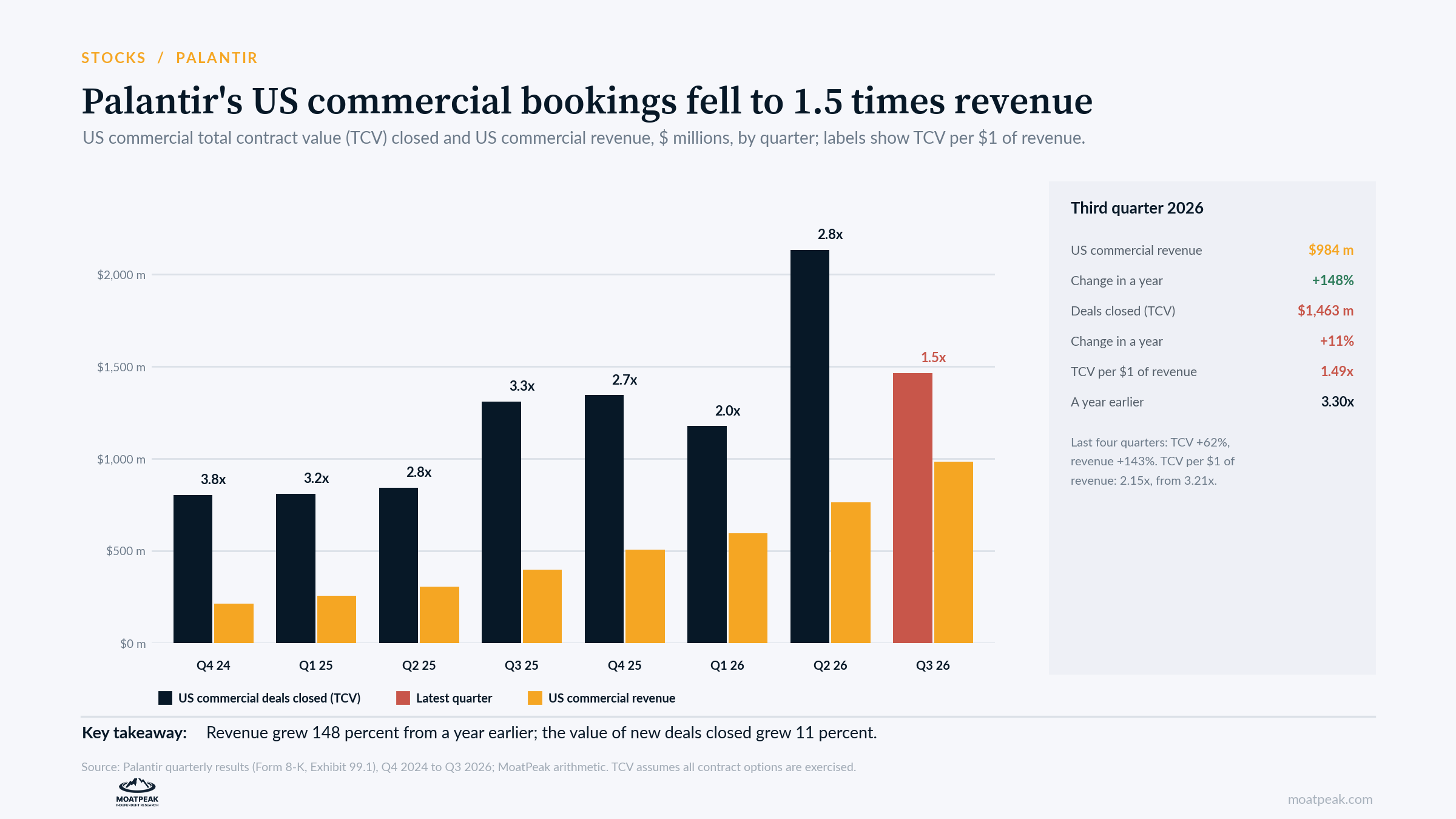
Palantir reports the total contract value (TCV) of the deals it closes each quarter, assuming customers exercise every option. In the third quarter, US commercial TCV was $1.46 billion, up 11 percent from a year earlier. In the second quarter, it had grown 153 percent. Total TCV across all customers rose 6 percent.
Set against revenue, the slowdown is sharper. Palantir closed $1.49 of US commercial deals for every $1 of US commercial revenue it booked in the quarter. A year earlier, the ratio was $3.30. The latest figure is the lowest of the past eight quarters. Over the past four quarters together, US commercial TCV grew 62 percent while US commercial revenue grew 143 percent.
The backlog is running down
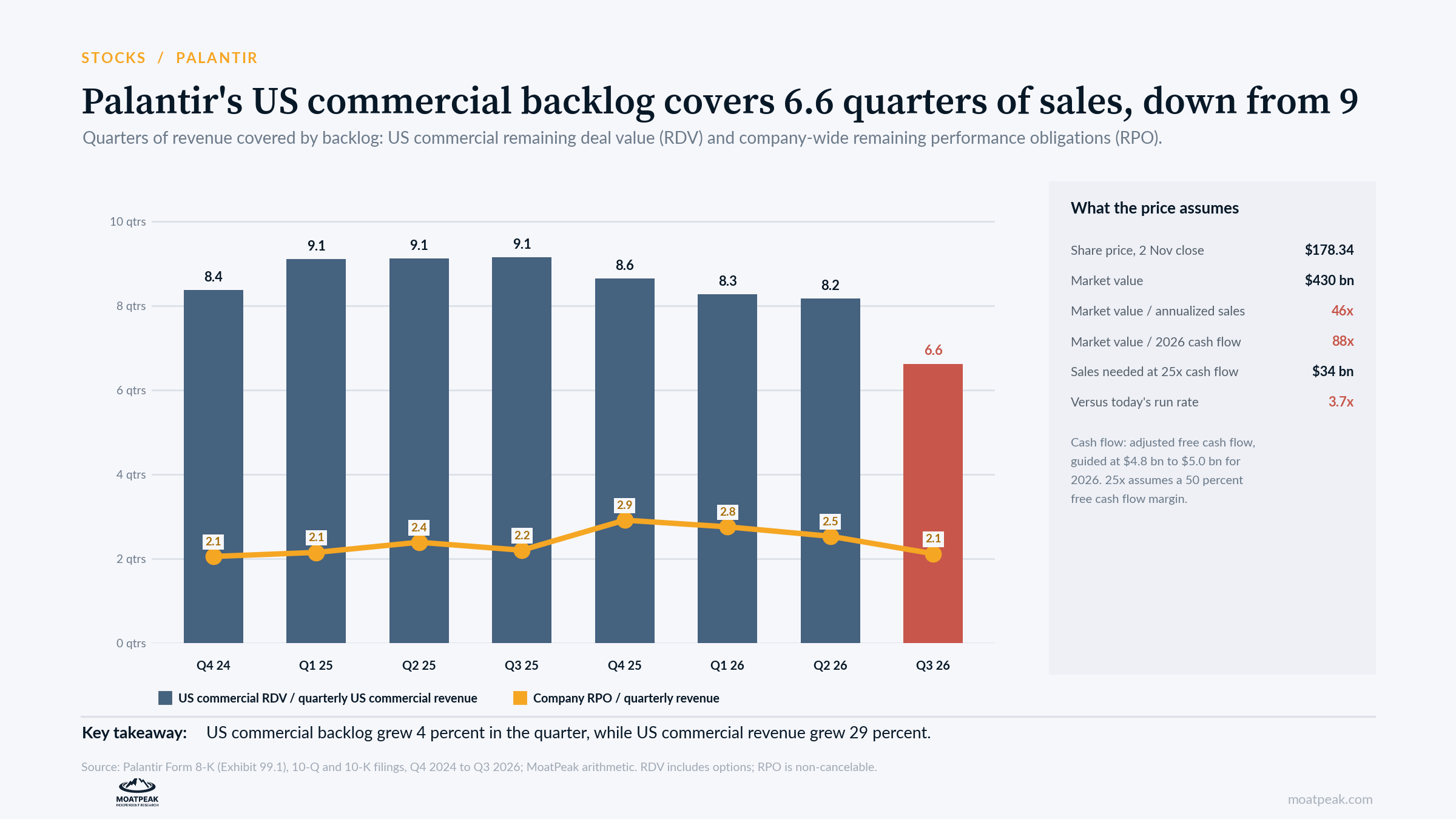
The backlog tells the same story. Palantir’s US commercial remaining deal value, the total left to run on its signed contracts, rose 4 percent in the quarter to $6.52 billion. US commercial revenue rose 29 percent. The backlog now covers 6.6 quarters of US commercial revenue at the current pace. In each of the previous seven quarters, it covered between 8.2 and 9.1 quarters.
The stricter measure agrees. Remaining performance obligations, the non-cancelable contracts in the 10-Q filed on 3 November, were unchanged at $4.9 billion. That is the first quarter without growth since the first quarter of 2023. About 44 percent, or $2.2 billion, is expected to be recognized as revenue in the next 12 months. Palantir has guided to $2.65 billion of revenue in the fourth quarter alone.
What the price assumes
Palantir closed at $178.34 on 2 November, before the report. With 2.41 billion shares outstanding, that is a market value of $430 billion, or 46 times annualized third-quarter revenue and 88 times the company’s 2026 adjusted free cash flow guidance of $4.8 billion to $5.0 billion. Each $10 move in the share price changes the market value by about $24 billion.
Suppose the market will one day pay 25 times free cash flow, a rich multiple for a mature software company, and Palantir keeps a 50 percent free cash flow margin. To justify $430 billion, revenue would have to reach about $34 billion, 3.7 times the current annualized $9.25 billion. At 40 percent annual growth, that takes almost four years. At 30 percent, five.
Our read
The business is exceptional. Adjusted operating margin was 62 percent, and GAAP net income was $1.13 billion. The company holds $10.4 billion of cash and Treasury securities, with no debt on its balance sheet.
The price is the problem. It assumes years of very fast growth, and the measures that lead revenue have slowed while revenue is still accelerating. Revenue catches up with bookings over several quarters. If US commercial bookings grow 10 to 60 percent from here, revenue growth will converge toward that range. At 46 times sales, there is little room for error.
Stock-based compensation also deserves a look. It was $319 million in the quarter, 14 percent of revenue and up 85 percent from a year earlier. The adjusted figures exclude it. GAAP operating margin was 47 percent.
The case against us
TCV is lumpy. The second quarter set a record of $2.13 billion, which makes any comparison look weak. One quarter is not a trend.
Contract value can understate usage. Customers often expand beyond the contracts they sign, which can cause revenue to outrun bookings. And many contracts can be canceled for convenience, so they count in remaining performance obligations only in part.
Management raised its US commercial revenue forecast to at least $3.56 billion for 2026, growth of at least 143 percent, which suggests it sees demand that TCV does not capture.
What it means for your money
Track two ratios. Each quarter, divide US commercial TCV by US commercial revenue and backlog by quarterly revenue. The inputs are in the press release.
Size for multiple compression. At 46 times sales, a move to 30 times, still high for software, would cut the share price by about 35 percent with revenue unchanged.
Use the fourth quarter as the test. US commercial TCV back above $2 billion would reverse the signal. Another quarter near $1.5 billion would confirm it.
What we are watching
Early February: fourth-quarter results, with US commercial TCV and remaining deal value.
The 10-K: full-year remaining performance obligations and their timing.
Stock-based compensation: whether its growth slows toward revenue growth.
Educational research only. Not personalized investment advice. MB “MoatPeak Group”.
The backlog cover dropping from nine quarters to 6.6 is the number I keep coming back to, because revenue can stay hot for a while even as the refil slows. The RPO being flat at $4.9 billion for the first time since early 2023 makes that harder to wave away. At $430 billion, do you think the market is simply betting the TCV slowdown is a one quarter air pocket, or has it just stopped pricing the leading indicators at all?