


October has been a month for hiding. From the end of September to 20 October, the Consumer Staples Select Sector SPDR fund (XLP) rose 8.9 percent, while the Technology Select Sector SPDR fund (XLK) fell 5.3 percent. The S&P 500 rose 0.8 percent. Worried about AI spending, credit stress and tech valuations, investors have moved into the companies that sell everyday items like groceries, toothpaste and detergent.
The move has flipped a long-standing order. On 16 October, FactSet put the consumer staples sector at 22.4 times forward 12-month earnings and information technology at 20.4. Over the past ten years, it has been the other way round: tech has averaged 23.1 and staples 20.1.
We understand the impulse, and we think the price is now the problem. A defensive stock protects you through its earnings, which tend to hold up in a slowdown. Its valuation offers no such protection. At today’s prices, investors in staples are taking on valuation risk in exchange for earnings safety.
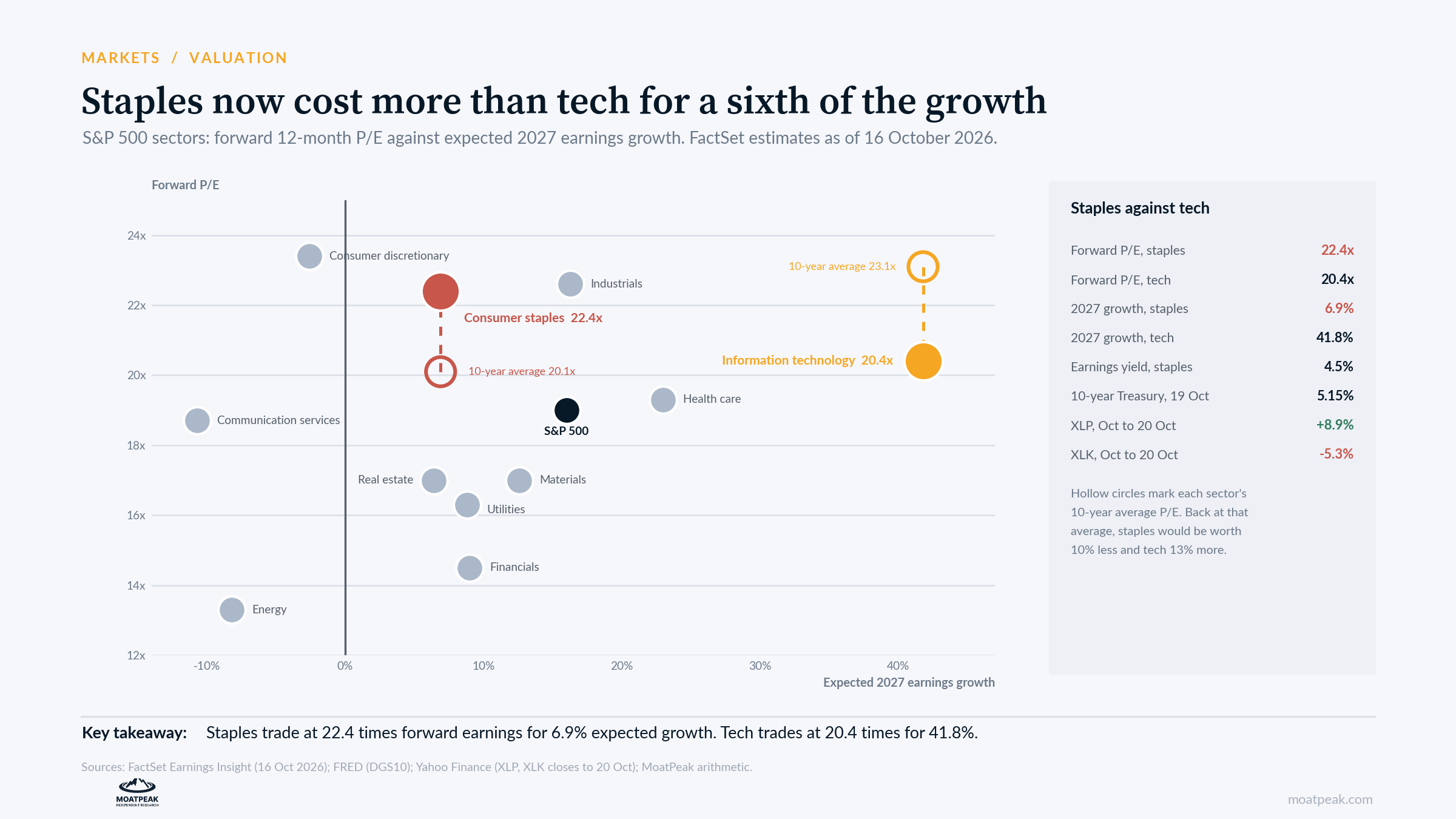
What a point of growth costs
FactSet’s consensus expects staples earnings to grow 6.9 percent in 2027 and tech earnings 41.8 percent. Divide each forward P/E by that growth rate, and staples cost almost seven times as much as tech for every point of expected growth. It’s a rough measure, but the gap is too big to ignore.
Bond yields make the same point. At 22.4 times earnings, the staples sector’s earnings yield is about 4.5 percent, below the 10-year Treasury yield of about 5.1 percent. Tech’s earnings yield, 4.9 percent, is also below it. Both sectors now earn less per dollar of share price than a risk-free bond pays. Only one of them is expected to grow its earnings by more than 40 percent.
The giants are the most expensive part
The premium is largest in the biggest names. On 20 October, Costco traded at 47.9 times its earnings over the last four reported quarters and Walmart at 42.7 times. Nvidia traded at 27.4 times, Microsoft at 29.6 and Apple at 38.9. Over the same period, Costco’s earnings per share grew 14 percent and Walmart’s 4 percent, while Nvidia’s more than doubled and Microsoft’s and Apple’s each rose 32 percent.
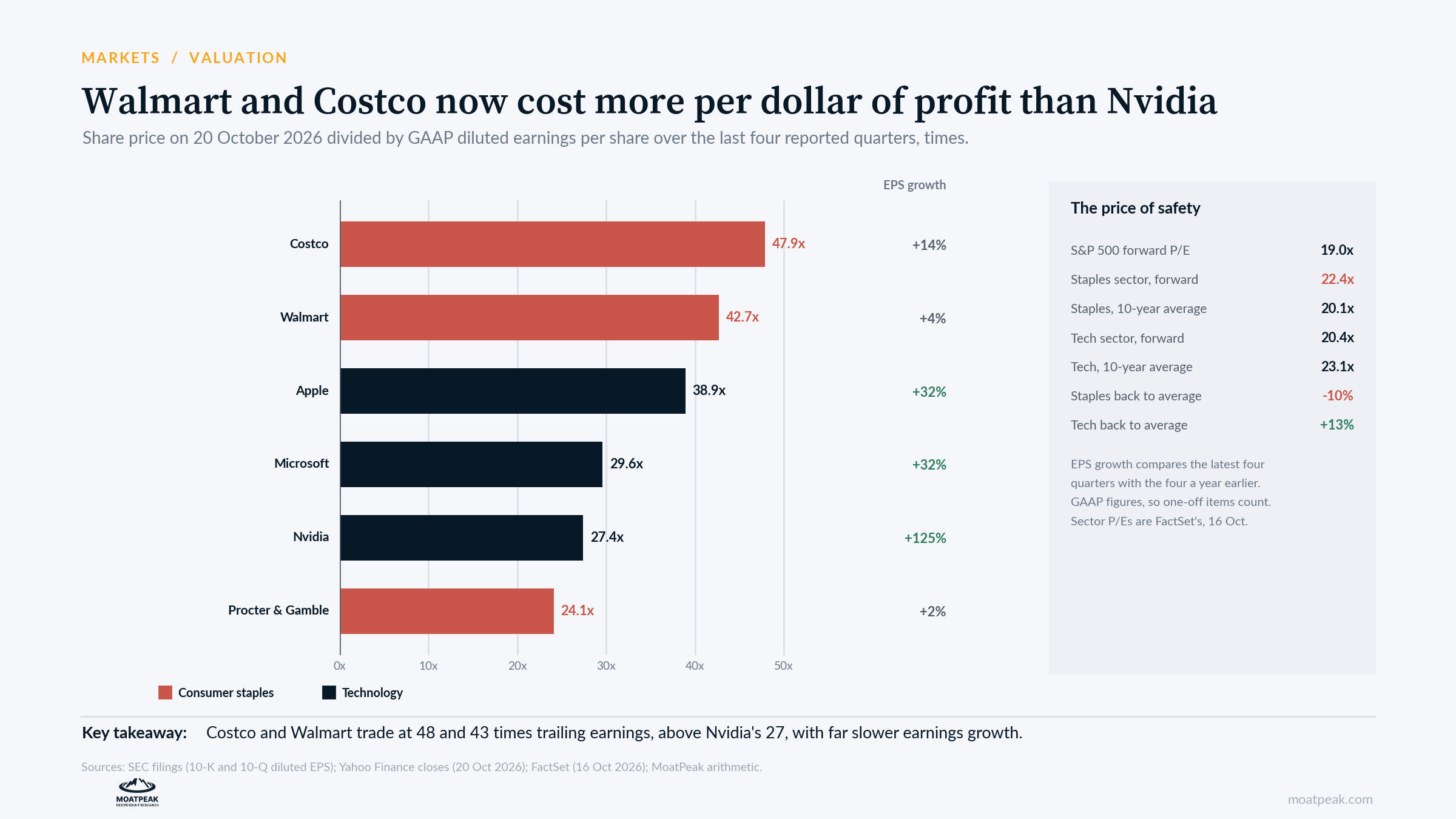
Walmart and Costco have real moats: scale, membership fees and buying power that few rivals can match. We would pay a premium for them. But a moat protects a company’s earnings. It does nothing for the price you pay for those earnings.
The arithmetic of a return to normal is simple. If the staples sector’s forward P/E went back to its 10-year average of 20.1 with earnings unchanged, the sector would be worth about 10 percent less. If tech returned to its average of 23.1, it would be worth about 13 percent more. Neither has to happen soon. But when the place you hide is priced above its own history, the starting point matters.
The case against us
Tech’s growth isn’t as broad as it looks. Most of it comes from chipmakers. Excluding semiconductors, FactSet’s estimate of tech’s third-quarter earnings growth falls from 65.1 percent to 24.4 percent. If the chip cycle turns, the 41.8 percent forecast for 2027 will shrink, and tech’s lower multiple will look less like a bargain.
Staples’ earnings are also steadier, and steadiness pays off in a recession. A reliable 7 percent can beat a 40 percent forecast that gets cut in half. And if Treasury yields fall, investors usually pay more for bond-like stocks.
What it means for your money
Check the price of safety, not just the label. A defensive stock at 45 times earnings can lose a lot of value even if nothing goes wrong in its business.
Compare earnings yields with Treasury yields. When a stock earns less per dollar of price than a 10-year Treasury pays, you are paying for growth or for safety. Make sure you are getting one of them.
Look inside the sector. Among the staples we checked, trailing P/Es range from 24 times at Procter & Gamble to 48 times at Costco.
What we are watching
Friday 23 October: FactSet’s next Earnings Insight, and whether staples stay more expensive than tech.
Wednesday 28 October, after the close: Microsoft’s results, the next test of tech’s earnings growth.
The 10-year Treasury yield, now about 5.1 percent. A fall would support bond-like stocks, and a rise would hurt them.
Educational research only. Not personalized investment advice. MB “MoatPeak Group”.