


For several weeks we have argued that the most under-priced risk in the AI trade was not a demand cliff. It was a price war. This week the market began to agree, and it did so in a single number. Deutsche Bank put a figure on the Chinese open-weight threat: roughly $60 billion knocked off Nvidia’s valuation, on the read that freely downloadable models are “undermining the hyperscaler-capex justification.” On Friday, Apple briefly passed Nvidia as the most valuable company in the world. A defensive cash machine overtook the AI-capex bellwether. That is not a headline. It is a tell.
Here is what changed between Friday and Monday. Moonshot’s new Kimi K3 model debuted at claimed parity with OpenAI and Anthropic. It joins DeepSeek-R1 as an open-weight system, which means the model itself can be downloaded and run by anyone, at a fraction of the cost of calling a closed model through an API. Deutsche Bank’s primer, “Open Source AI 101,” pulls these threads together: the Epoch Capabilities Index, which tracks how far open models trail the closed leaders, shows the gap closing, and the market has started to price what that implies. Semiconductors bounced on Monday, the SOX up 0.6 percent, but the broad market could not hold it, with the S&P down 0.2 percent. The bounce did not lead anywhere. The repricing did.
The mechanism is simple, which is why it is dangerous for the names it touches. If an open-weight model anyone can run, at a fraction of the cost, matches the frontier, then three things follow in order. Closed-model pricing power erodes, because customers route the cheap work to whatever costs the least. The return on the roughly $5.8 trillion of planned hyperscaler capital spending gets harder to defend, because the thing being bought just became cheap and copyable. And Nvidia’s demand, which is levered to ever-larger training runs, meets a ceiling the bulls have no clean answer to: good enough, cheaper. Notice what none of that requires. AI demand does not have to fall. The damage is to price.
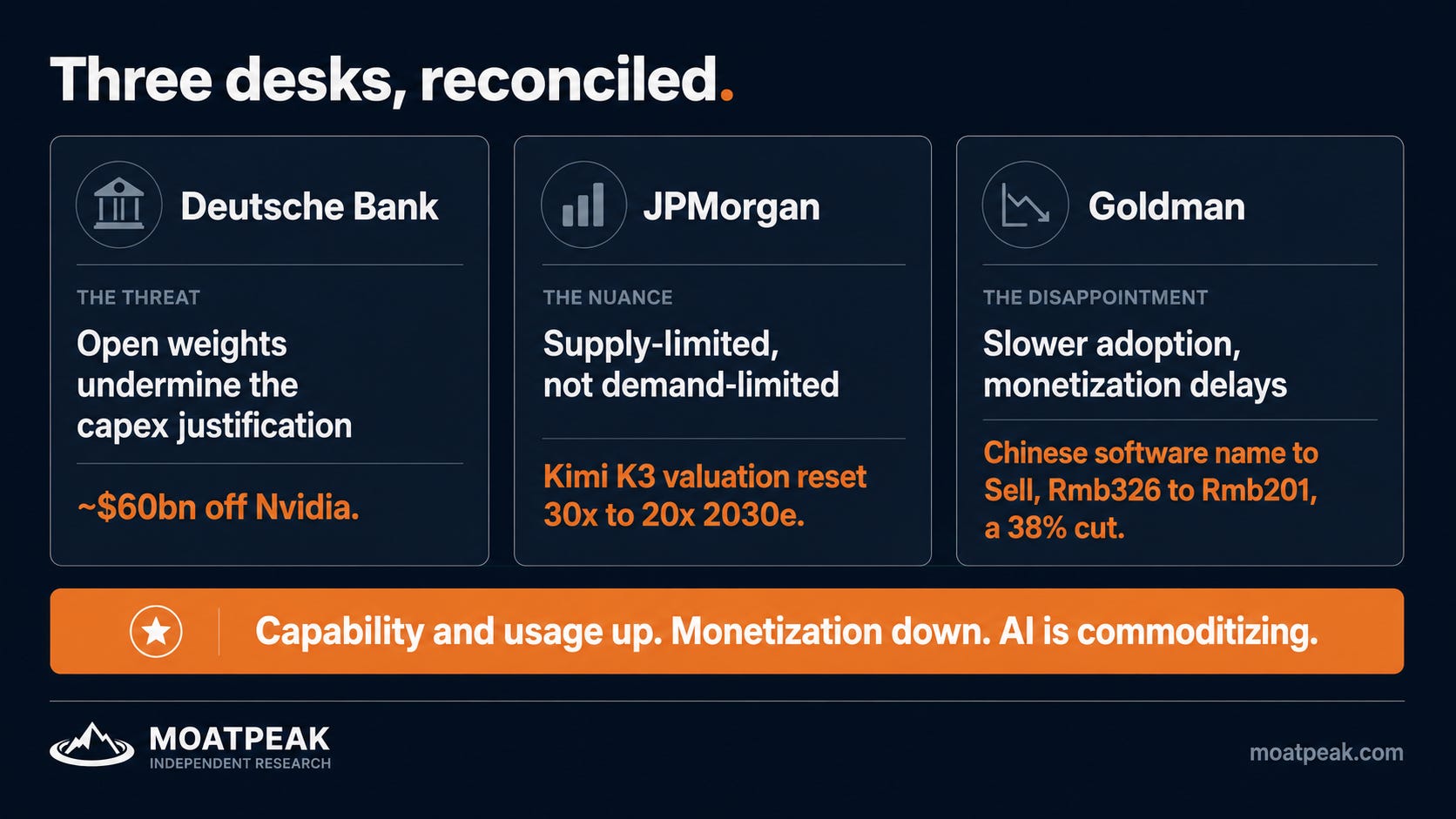
The strongest objection to our read deserves stating in full, because on its own terms it is right. JPMorgan looks at the same Chinese surge and insists it is not a demand story at all. The US-China arena, in their words, is “supply-limited, not demand-limited.” Kimi K3 is gaining real usage even as its valuation resets, to 20x its 2030 earnings estimate from 30x, a discount JPMorgan reads as the market overpricing commercial-trajectory concerns. So demand is not collapsing. Usage is rising. Now hold that against the third desk in the room. On the same day, Goldman Sachs downgraded a Chinese software name to Sell, cutting its 2026 to 2028 earnings estimates by 2 to 10 percent on “slower AI adoption” and monetization delays, and taking its price target to Rmb201 from Rmb326, a 38 percent cut. Three desks, three angles, and holding them together is the whole point.
Reconcile them and the picture is coherent. Capability and usage are rising, per JPMorgan. Monetization is disappointing on both sides of the Pacific, per Goldman’s downgrade and the valuation reset on the Chinese leaders. And the capability spread is eroding Western pricing power, per Deutsche Bank. In one line: AI is being commoditized. That is a gift to users and adopters and a threat to the margins, the pricing power, and the capex return that the entire AI equity and credit complex is priced on. The trade the tape keeps reaching for, short AI, is the wrong one, because usage and capability are not falling. The real move is quieter, and it is already underway.
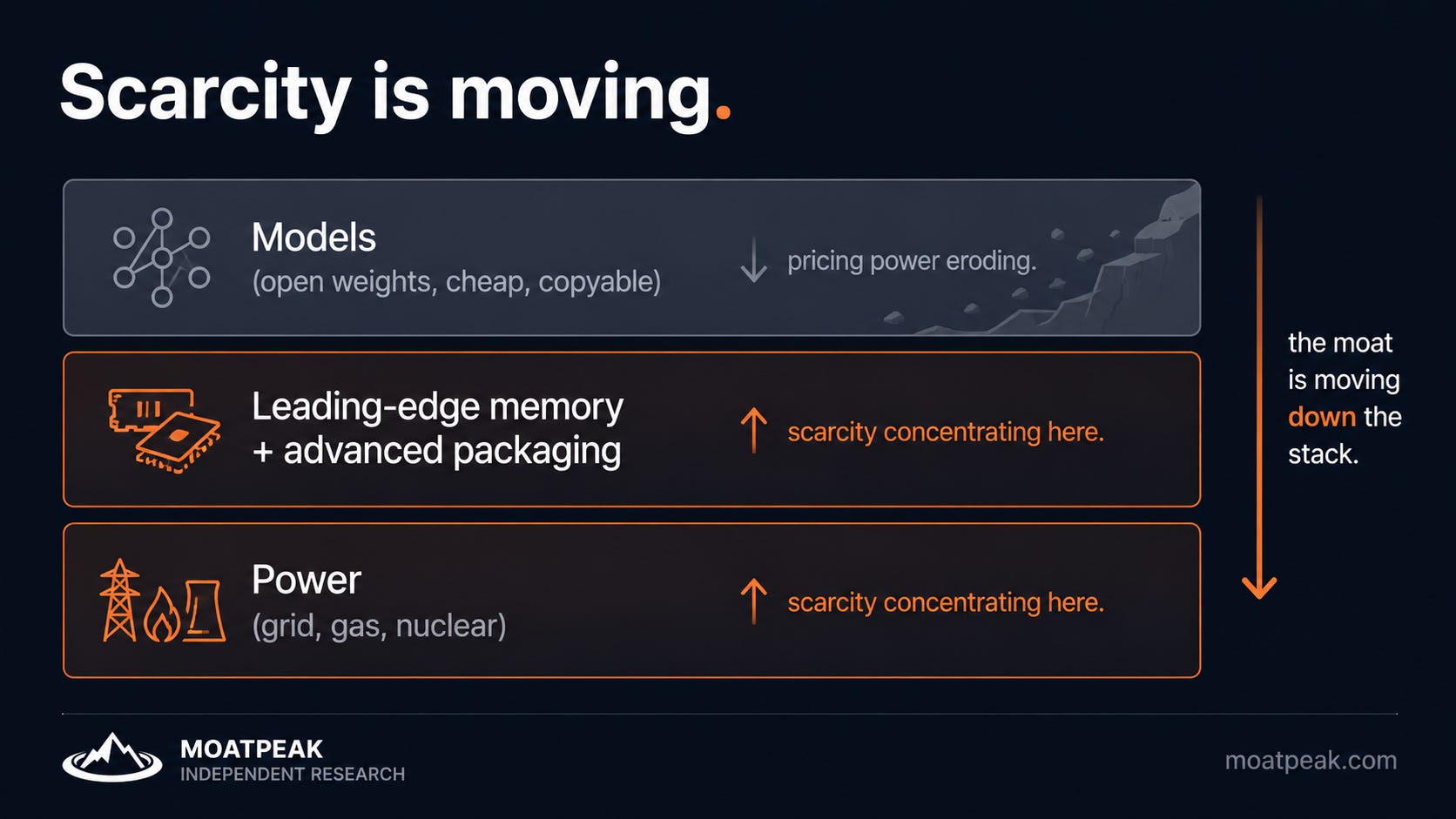
When the model layer commoditizes, the economics do not vanish. They migrate, to the parts of the stack that China cannot copy and open weights cannot reproduce. That is leading-edge memory, the high-bandwidth memory that trains and serves these models, reported sold out through year-end. It is the advanced packaging only a handful of fabs can do at scale. And it is the physical deliverable-power layer, the electricity, grid, gas and nuclear generation the buildout runs on. The businesses that sell something genuinely scarce keep their pricing power. The businesses that sell something China can now match, closed-model API pricing and merchant compute, lose it. The moat is not gone. It has moved.
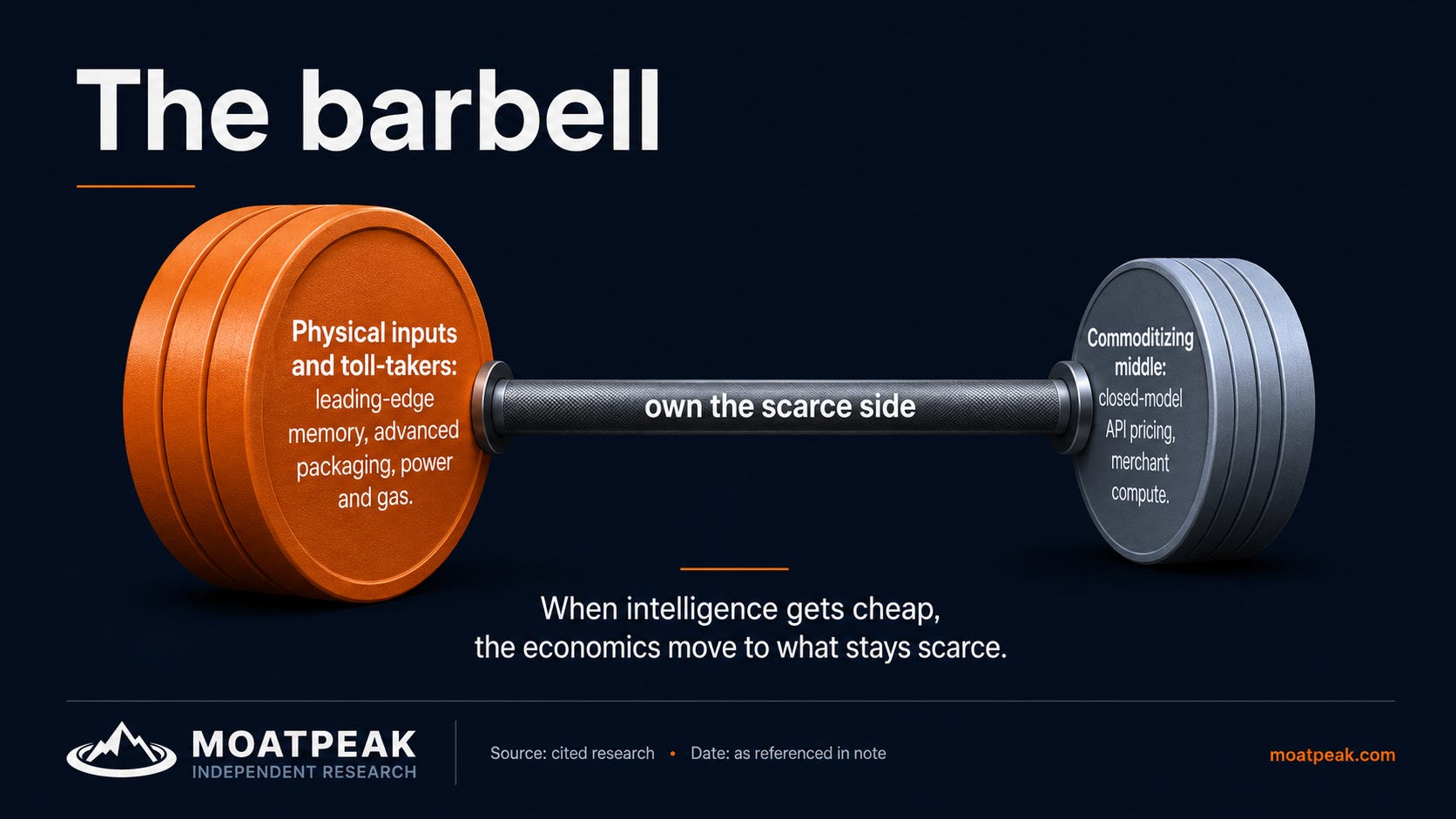
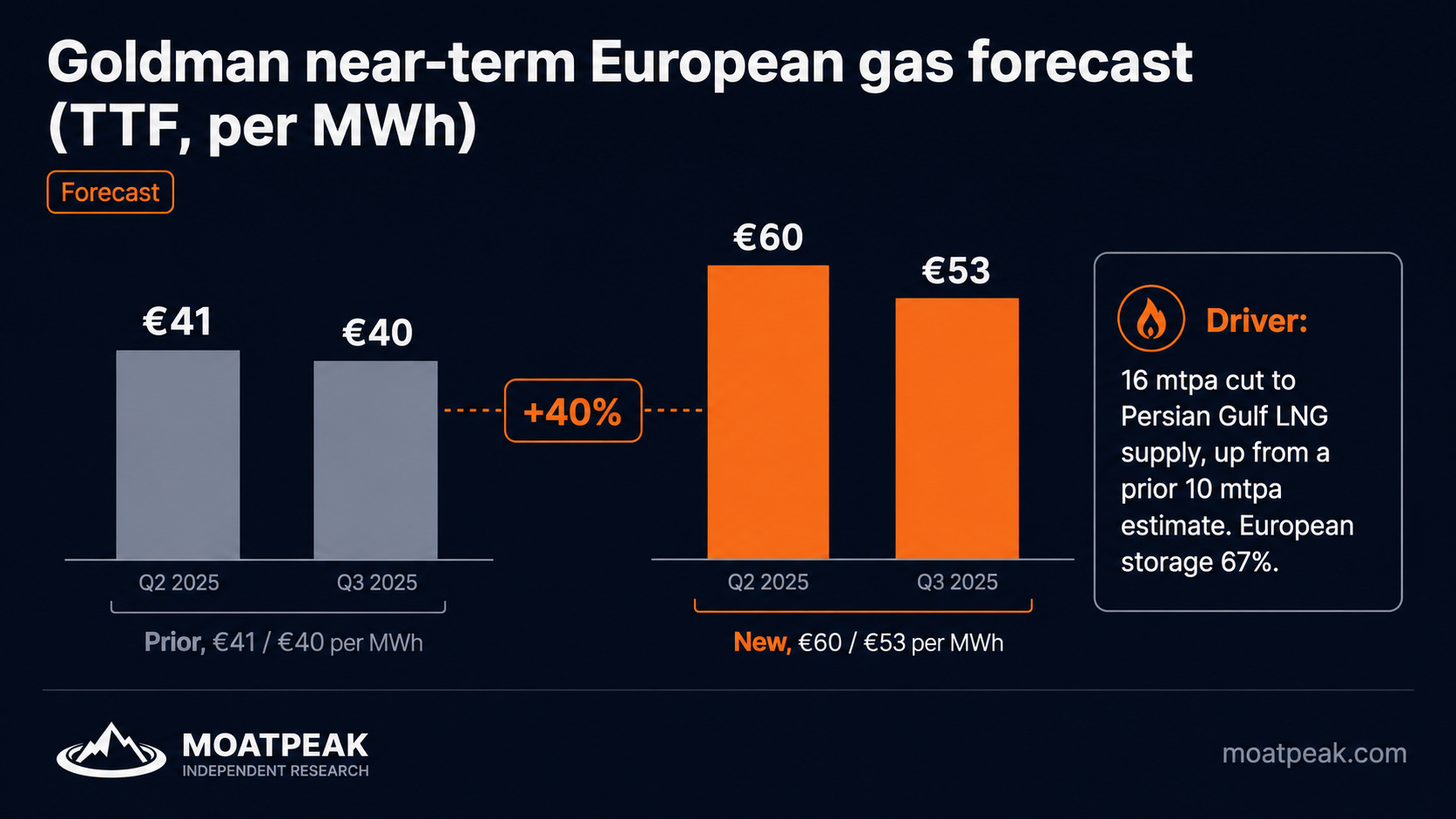
Which brings us to the quietest important number of the week. While the tape watched the AI drama, Goldman raised its near-term European gas forecast, the TTF benchmark, to €60 and €53 per megawatt hour from €41 and €40, roughly 40 percent, on a 16 million tonne per year reduction in liquefied natural gas supply from delayed Persian Gulf exports, an upgrade from a prior 10 million tonne estimate, with European storage at 67 percent. This looks like a separate story. It is the same one, seen from the physical side. The energy rotation is not only a flow into a crowded trade. It is a supply shock, and the tightness binds in gas, which has no strategic-reserve valve and inelastic winter demand, rather than in crude. Power is the one input the AI buildout cannot run without, and gas is the least-crowded leg of the very same barbell: own the physical inputs, fade the commoditizing digital middle. On the brief’s read, the economics accrue to European utilities with regas and import exposure, US LNG exporters, and gas-weighted energy rather than pure crude.
Next week settles a great deal of this. From July 27 to 31, mega-cap earnings covering around 34 percent of the S&P arrive, and they now carry a double load. They have to justify capex return, and they have to answer the question the week just made concrete: China’s open-weight models match us, cheaper, so what is the spending for? A confident capex guide the market rewards would refute the Deutsche Bank thesis and re-establish the moat. A trim, or a defensive tone, confirms the crack. Layer on Goldman’s crowding work, which flags reversal-risk hotspots from concentrated positioning, European Healthcare with an implied move near 10.2 percent, Materials near 8 percent, and US momentum sitting at the 95th percentile, and the read is that positioning, not fundamentals, will drive the moves. Beats into crowded longs get sold. Misses into crowded shorts get squeezed.
We hold views the way we ask our readers to: with the conditions that would prove us wrong written down first. This one inverts on a frontier capability leap that open models cannot follow, something that restores the closed moat and its pricing power. The place to watch for it is the Epoch Capabilities Index, the same gauge now showing the gap closing. The gas leg inverts on a resumption of Persian Gulf LNG flows, which would unwind the supply shock. Between now and then, the variables that matter are few and specific: the mega-cap capex guides against the open-weight threat, the memory and packaging tightness that tells you whether physical scarcity is holding, European storage and Gulf export headlines, and the Nvidia versus Apple leadership question, which is really a vote on whether the market keeps paying for certainty of cash flow over optionality on AI spending.
The one-line version: the Chinese open-weight threat went mainstream, and it is a margin and pricing-power story rather than a demand collapse, while a real supply shock reprices European gas. Scarcity is moving from the model layer to the physical layers no one can copy. Own that distinction and the week reads as a map. Miss it and it reads as noise.
This is one day of how we read the tape. What holds it together is the method underneath: every MoatPeak view states its evidence and the date through which that evidence runs, the strongest case against itself, and the exact conditions that would invalidate it, and we keep that record in public so you can check our work rather than take our word for it. The full framework, the scenario paths, the monitoring levels, and the thesis ledger where we grade ourselves over time live at moatpeak.com. If you run your own concentrated book and want a process rather than another feed, start with a free sample there.
MoatPeak publishes research and education, not personalized investment advice. Figures are as reported by the cited institutions as of July 21, 2026.