


SpaceX’s third-quarter results, released on 20 October, read like an AI growth story. Revenue rose 161 percent from a year earlier to $14.6 billion. The Super Intelligence segment, SpaceX’s AI business, became its largest, with $7.6 billion of revenue, and the company expects revenue of $33 billion to $37 billion in the first quarter of 2027.
We read the quarter as two companies under one roof. One is a proven moat. The Connectivity segment, which is mostly Starlink, earned $2.4 billion from operations, 85 percent of the group’s $2.8 billion. Its EBITDA, a rough measure of operating cash earnings, was $3.5 billion, covering its own $1.5 billion of capital spending with $2.0 billion to spare.
The other is a capital race. Super Intelligence spent $16.4 billion on capital projects in the quarter, 84 percent of the group total, against $5.0 billion of EBITDA. That left an $11.5 billion hole in one quarter.
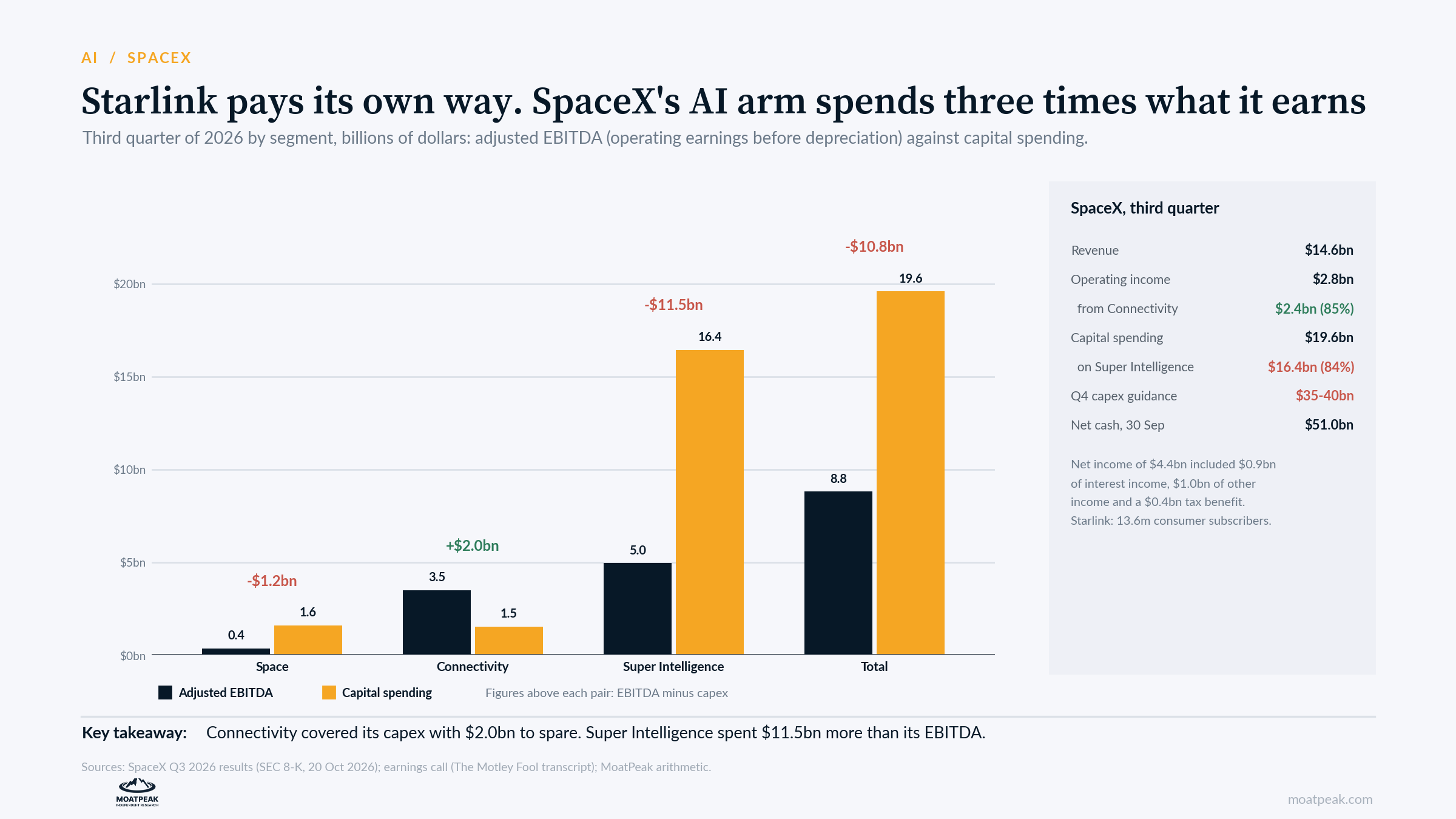
The moat is doing its job
Starlink ended September with 13.6 million consumer subscribers, up 1.6 million in the quarter and from 7.2 million a year earlier. Average revenue per subscriber rose 5 percent from the second quarter to $69 a month, though it remains below last year’s $83. Connectivity revenue grew 69 percent from a year earlier, and its operating income nearly doubled, up 99 percent.
This is the kind of business we look for: a network that is hard to copy, with costs that grow more slowly than revenue. Starlink now generates most of SpaceX’s operating profit.
The bet keeps getting bigger
Capital spending was $10.1 billion in the first quarter, $18.4 billion in the second and $19.6 billion in the third. On the earnings call, SpaceX guided fourth-quarter capital spending to $35 billion to $40 billion as more computing capacity comes online. Its data centers had 1.7 gigawatts of nameplate compute at the end of September, and management expects 2.5 to 3 gigawatts by the end of the year.
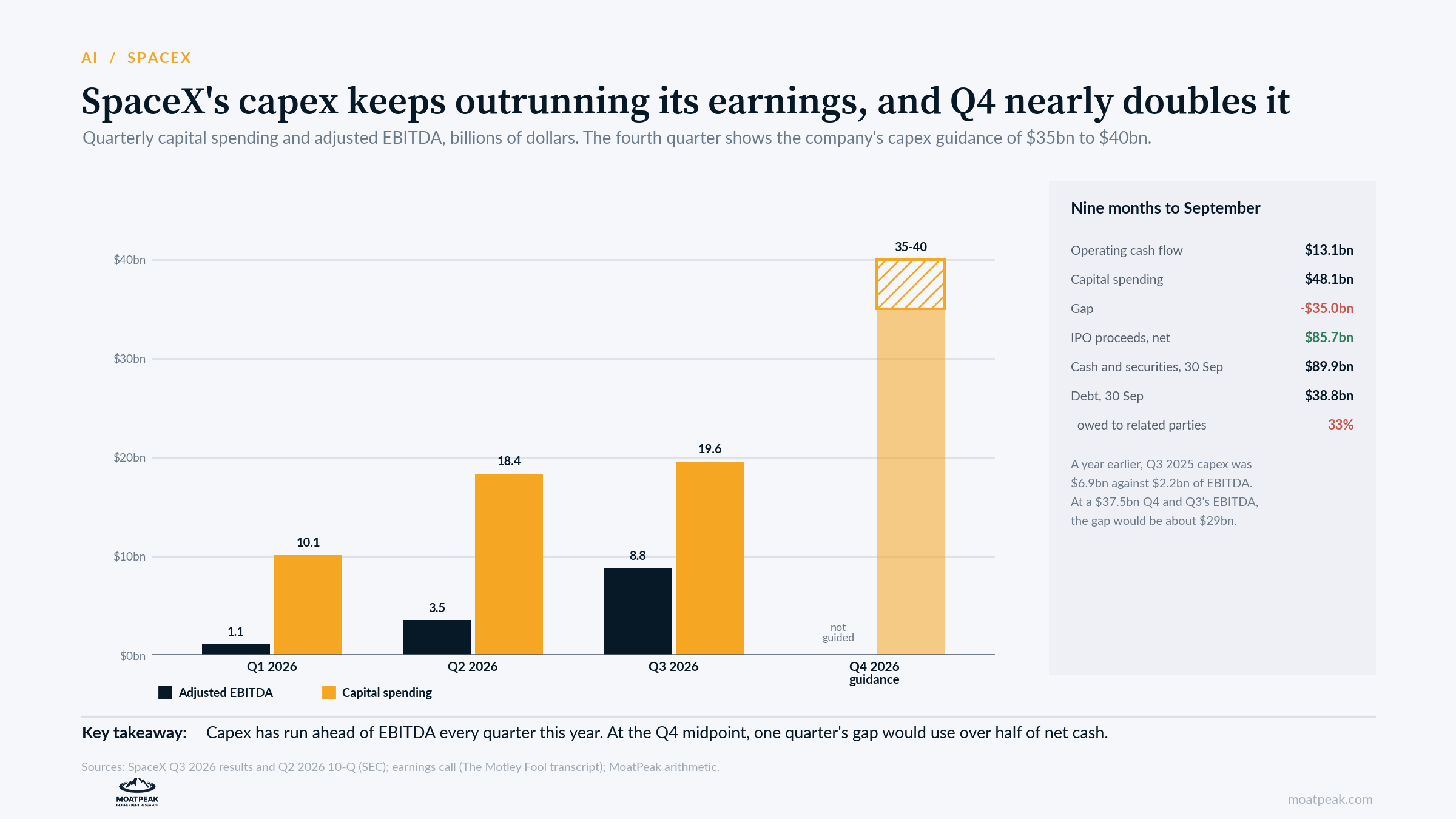
So far, the money has come mostly from the June IPO. In the first nine months of the year, operating cash flow was $13.1 billion and capital spending was $48.1 billion, a $35.0 billion gap. The IPO raised $85.7 billion. At the end of September, SpaceX held $89.9 billion of cash and securities against $38.8 billion of debt, about a third of it owed to related parties.
That cushion is large, but it is being spent quickly. If fourth-quarter capex lands at the $37.5 billion midpoint and EBITDA stays at the third quarter’s $8.8 billion, the gap in that one quarter would be about $29 billion, more than half of September’s $51.0 billion of net cash.
Read the profit line carefully
Net income was $4.4 billion, well above operating income of $2.8 billion. Below the operating line, SpaceX booked $873 million in interest income on a much larger cash pile, a $390 million tax benefit and $1.0 billion of other income, more than half of it from related parties, partly offset by $675 million of interest expense. We would not value those items as if they will repeat.
The Super Intelligence numbers also need a footnote. Its $7.6 billion of revenue includes $608 million from Cursor, the AI coding company SpaceX bought in August. Without it, the segment’s revenue still grew 171 percent from the second quarter.
The case against us
Management’s guidance points to very fast monetization. First-quarter 2027 revenue of $33 billion to $37 billion would be more than double the third quarter’s, and SpaceX reported a $63 billion backlog, with $42 billion expected to turn into revenue within 12 months. If that happens, Super Intelligence’s EBITDA could catch up with its spending faster than our arithmetic implies.
The segment’s EBITDA margin was already 66 percent in the third quarter. The company still has a large cash buffer, and its finance chief describes the balance sheet as investment grade. Large platforms have used one cash engine to fund long build-outs before, and some of those bets paid off handsomely.
What it means for your money
Value the two businesses separately. Starlink is a growing network that funds itself. Super Intelligence is a capital-hungry compute business whose returns are not yet visible. One valuation multiple for both hides the difference.
Watch cash, not just revenue. The test is whether Super Intelligence’s EBITDA grows faster than its capital spending.
Treat merger talk as a separate risk. On the call, Elon Musk said the special committees at SpaceX and Tesla have not agreed on terms and may never do so. Any deal would change who pays for the build-out.
What we are watching
Fourth-quarter capital spending against the $35 billion to $40 billion guidance, and EBITDA as nameplate compute rises toward 3 gigawatts.
Backlog conversion: $42 billion of the $63 billion is due within 12 months.
Related-party items, which account for a third of debt and more than half of third-quarter other income.
The Tesla committees and any proposed terms.
Educational research only. Not personalized investment advice. MB “MoatPeak Group”.