


Gold.com used to be called A-Mark Precious Metals. On 2 December 2025 it took the new name, moved from Nasdaq to the New York Stock Exchange and took the ticker GOLD. On 25 September it closed at $43.95, up 29 percent this year.
At first sight, fiscal 2026, the year to 30 June, was extraordinary. Revenue rose 132 percent to $25.5bn. Income before tax rose from $21.3m to $109.5m. Operating cash flow was $1.22bn, against $152m the year before.
We read the filings behind each of those numbers, and each one needs a second line.
Revenue isn’t the best measure here
A bullion dealer’s revenue is mostly the price of the metal passing through its hands. A better measure is how much metal it sold. Gold ounces sold rose 23.8 percent, from 1.64 million to 2.03 million. Silver ounces were flat.
The rest of the revenue jump comes from higher prices, acquisitions, and one accounting feature worth knowing. Gold.com hedges its inventory by selling metal forward, and those forward sales are booked as revenue even though they earn almost no gross profit. The 10-K says that, excluding an $8.3bn increase in forward sales, revenue rose $6.2bn. On our arithmetic from the same filing, about half of fiscal 2026 revenue was forward sales.
One quarter made the year
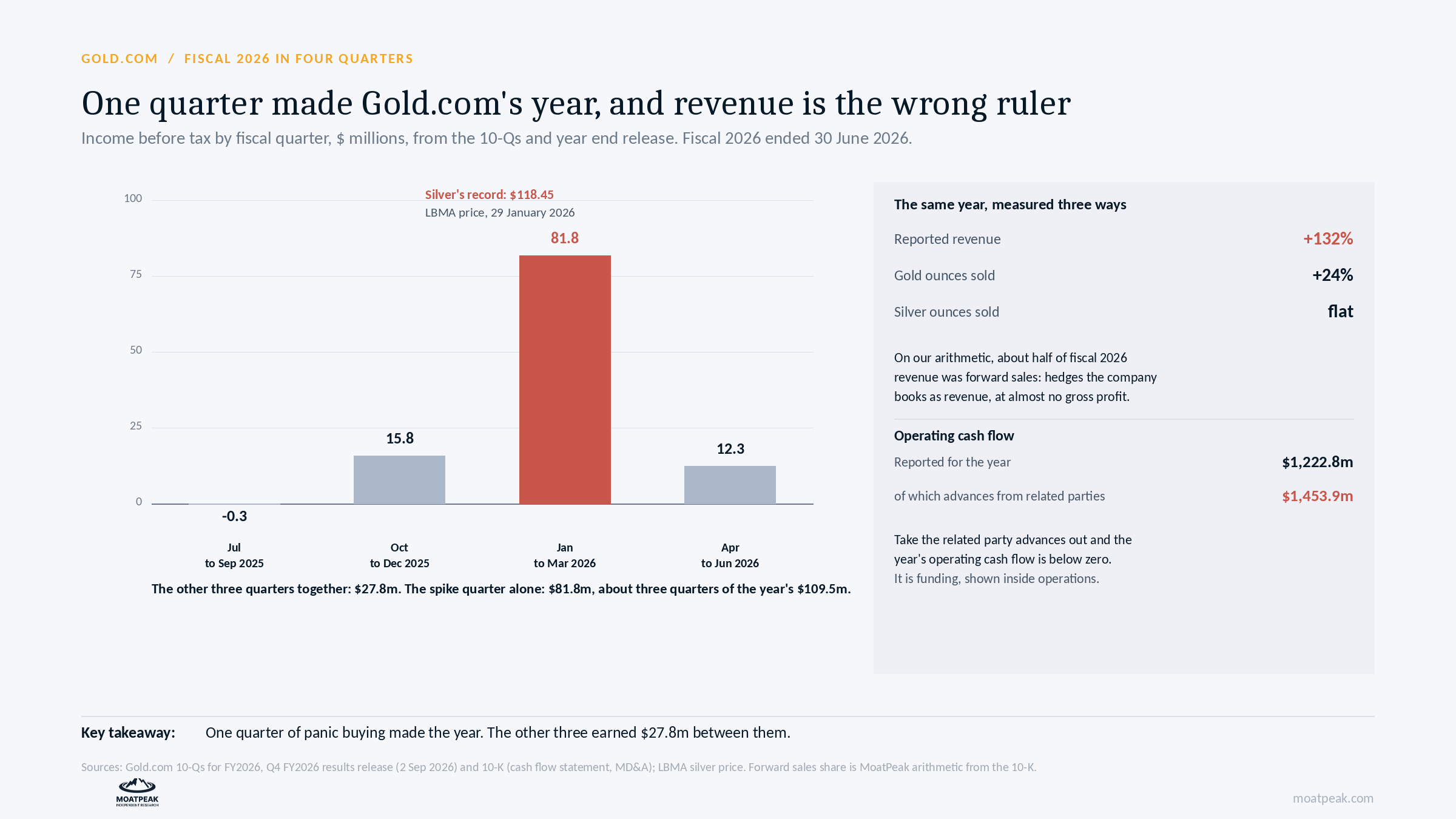
Look at income before tax quarter by quarter and you can see where the year came from. July to September 2025: a loss of $0.3m. October to December: $15.8m. January to March 2026: $81.8m. April to June: $12.3m, a little below the $13.0m of the same quarter a year earlier, after a $6.3m charge for contingent acquisition payments. On the company’s adjusted measure, that quarter was up 29 percent.
January to March was the quarter in which silver hit a record $118.45 on the LBMA benchmark, on 29 January. Frightened and excited buyers are this business’s best customers, and in that quarter they arrived all at once. It was also the first quarter to include Monex, which Gold.com bought in January. The other three quarters earned $27.8m between them.
The cash flow that came mostly from Tether
Operating cash flow of $1.22bn gives the impression of a business throwing off cash. The cash flow statement itself shows where it came from: an increase of $1.58bn in deferred revenue and other advances, of which $1.45bn came from related parties. Take the related-party advances out and the year’s operating cash flow is below zero.
Nothing about this breaks an accounting rule. It does mean the headline number is mostly advances from a related party, not cash the business earned.
One counterparty, four roles
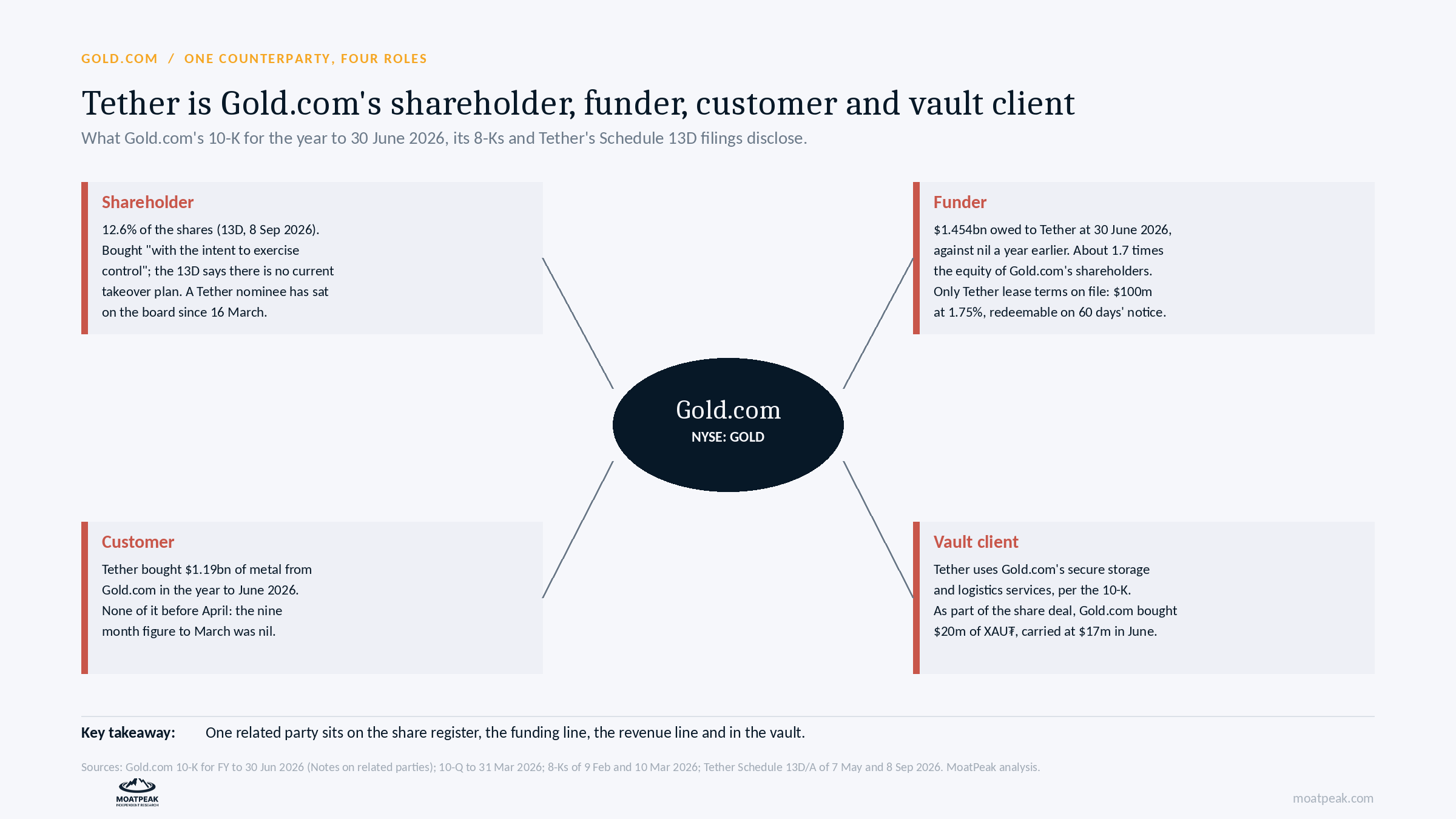
That related party is Tether, the firm behind the largest dollar stablecoin. Its relationship with Gold.com has four parts, and all four are set out in the filings.
It is a shareholder. Tether holds a 12.6 percent stake. Its Schedule 13D says it acquired the shares “with the intent to exercise control” of the company. The same filing says it has no current plans or proposals for a takeover or similar steps beyond what it describes, though it may form one. Tether paid $44.50 a share for $150m of new stock in February and May, a Tether nominee joined the board on 16 March, and on 3 September Tether bought another 100,000 shares at about $39.
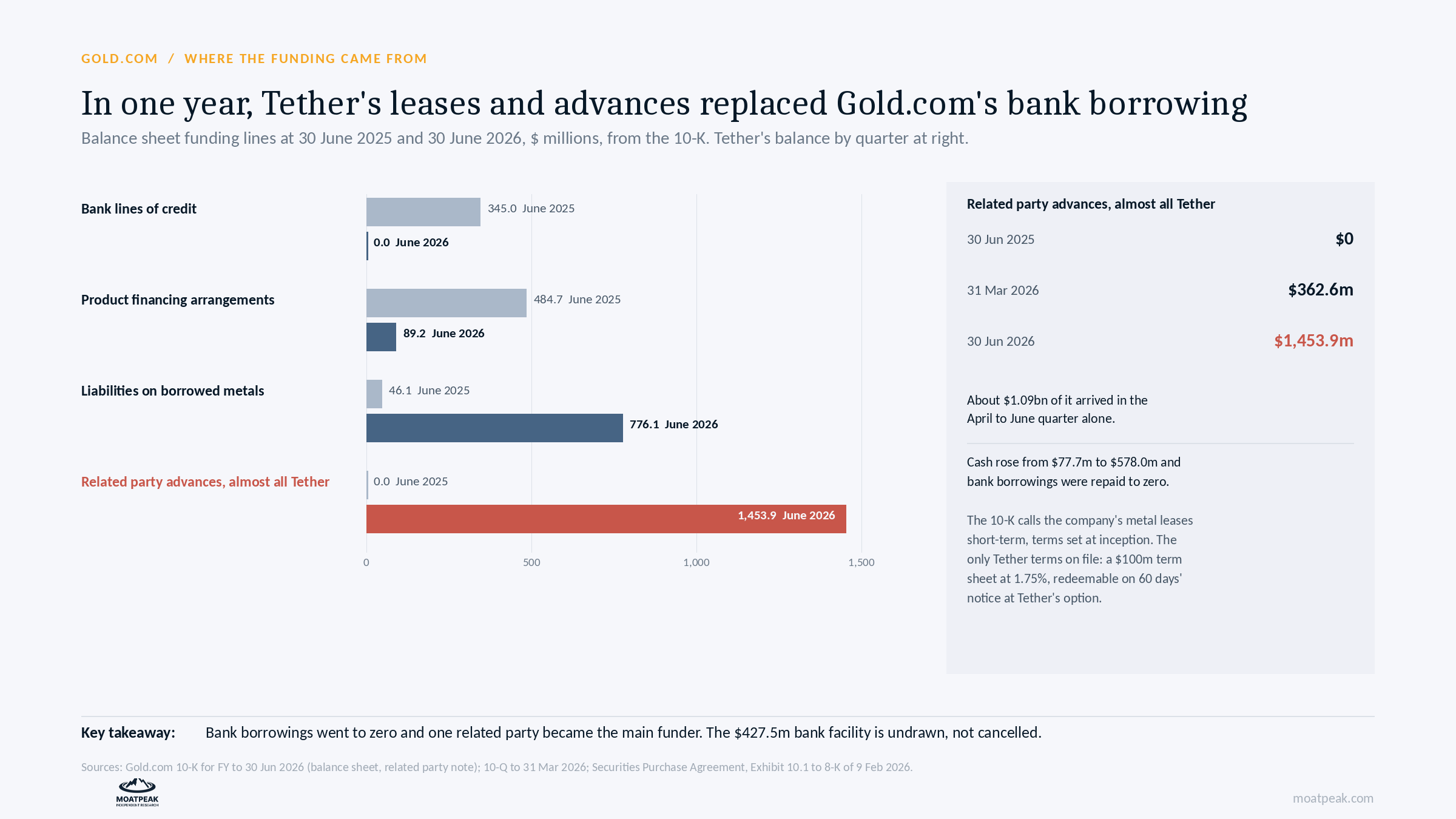
It is the main funder. At 30 June Gold.com owed Tether $1.454bn in payables and advances, against nothing a year earlier. That is about 1.7 times the equity that belongs to Gold.com’s shareholders. Over the same year, bank borrowings went from $345m to zero, though the bank facility of up to $427.5m is still in place, undrawn.
It is a customer. Tether bought $1.19bn of metal from Gold.com during the year, all of it after March.
It is a vault client. The 10-K says Tether uses Gold.com’s secure storage and logistics services. As part of the share deal, Gold.com used $20m of the proceeds to buy Tether’s XAU₮ gold token, in April. At 30 June it was carried at $17m.
The one set of terms on file
The only Tether lease terms Gold.com has filed sit in an appendix to its February share purchase agreement with Tether. They describe a gold lease facility of $100m at 1.75 percent a year, with draws of up to 18 months. One line is headed “Lessee Redemption Right”. It reads: “Upon 60 days prior notice at the option of Tether.”
That was a term sheet, conditional on a definitive agreement. Tether’s May 13D says the two sides have since entered into metals leasing arrangements, but no definitive lease agreement has been filed. The 10-K describes the company’s metal leases in general as short-term arrangements, with terms set when each lease starts and settled in metal or cash. It doesn’t say how quickly the $1.45bn owed to Tether at 30 June could be recalled. For a holder, that’s one of the most important terms to know, and it isn’t in the filings.
The week in September
On 9 September Grant Thornton signed a clean audit opinion on the fiscal 2026 accounts, as it had every year since 2015. On 14 September the audit committee dismissed it and appointed KPMG for the new year. The filing reports no disagreements.
The same day, the chief financial officer handed in his resignation, effective 18 September. The company calls it a planned retirement, and he will stay on as a consultant for a year. The controller took over. She spent twenty years at Grant Thornton, including as an audit partner, and has since been an audit partner at RSM and a chief financial officer elsewhere.
None of this is evidence of a problem, but all of it is a reason to read the next 10-Q closely.
Why the stock can fall when gold rises
This is the part that’s easy to miss. A dealer is not a gold fund. In our reading, when prices climb steadily, customers who bought coins and bars start selling them back. That is volume the dealer has to take at thin margins. Meanwhile the cost of carrying and financing inventory rises with the price of the metal. The best quarters come from fear and spikes. A gold price that just keeps rising can be bad news for the stock.
The customer numbers are worth watching. Direct-to-consumer active customers were 160,700 in the April to June quarter, against 170,600 a year earlier. The 2026 figure includes Monex, which Gold.com bought in January.
The case for the stock, from the same filings
The same filings also make the case for the stock.
Rising prices didn’t hurt every quarter. Between October and December 2025, when the LBMA gold price rose about 14 percent, income before tax nearly doubled to $15.8m from $8.0m a year earlier.
The spike quarter came before most of the Tether money. At 31 March the company owed Tether $362.6m; the big step up came between April and June.
Leasing is cheap on paper. Borrowed metal and leases, with most of the leases coming from Tether, cost a weighted 2.2 percent last year, against an effective 8.4 percent on the bank facility.
There’s a backstop. Gold.com ended June with $578m of cash and an undrawn bank facility of up to $427.5m running to September 2027. It also held $2.36bn of inventory, and leased metal can be returned as metal.
Tether keeps buying shares. A bid at a premium would reward holders, though its 13D says no such plan exists today. The board also declared a $1.00 special dividend alongside the regular 20 cents, payable on 28 September to holders of record on 16 September.
What the full report adds
The report rebuilds owner cash flow line by line. It values the company on four scenarios, including one where gold wins and the stock loses and one where Tether’s funding pulls back. It also names the levels of quarterly profit and Tether balance we are watching. Those stay in the report.
What to keep an eye on next
The next 10-Q. Income before tax in a quarter without a price spike, and the first numbers under a new CFO and a new auditor.
The Tether balance. Whether it grows or shrinks, and whether a definitive lease agreement, with its recall terms, is ever filed.
Retail customers. Active customer counts, now that a record silver quarter is in the past.
Educational research only. Not personalized investment advice. MB “MoatPeak Group”.