


Of the two figures mentioned, only one is legally binding and it might not be the one you think it is.
Two weeks ago we looked at the lease footnotes of Microsoft, Alphabet, Amazon, and Meta. By June 30 they had entered into $830 billion in leases which had not yet started, with no payment having been made, nothing showing up on their balance sheets, and this figure having increased three times over nine months.
The other side of the equation has the number.
Four hundred sixteen
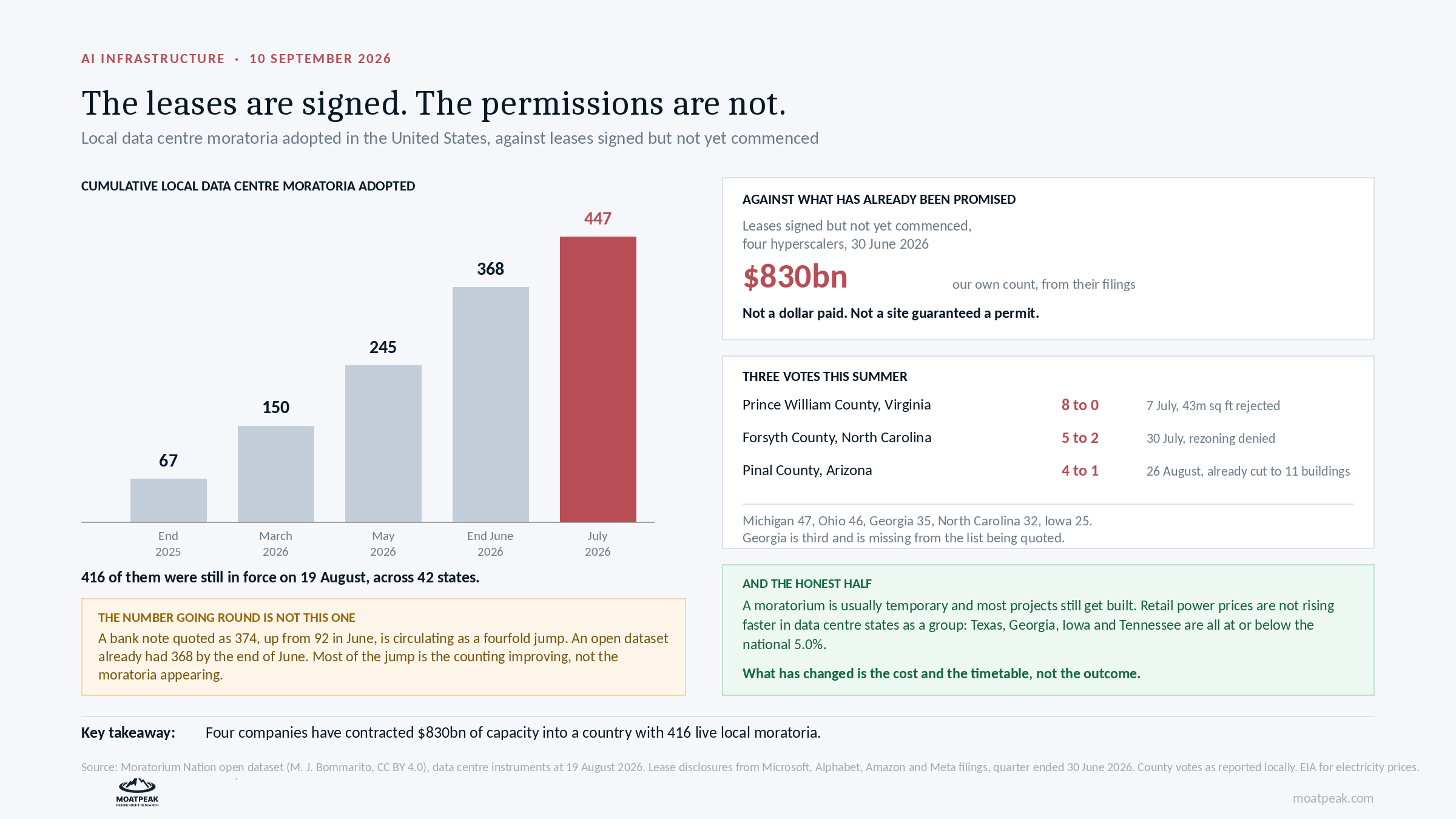
On August 19 there were 416 moratoria on local data centres in force in 42 states. This data has been obtained from an open dataset which is available under a Creative Commons licence and with all the records published for public inspection.
The figures have increased throughout the period: there were 67 by the end of 2025, 150 in March, 245 in May, 368 at the end of June, and 447 by July.
But the figure in question is not the one that most people are referring to.
The figure 374 – having risen from 92 in June – has been referred to as a fourfold increase and is derived from a bank note; it is currently being widely repeated.
By the end of June the open dataset already contained 368 figures, as compared to the 92 stated in that note. The two figures do not represent the same thing, and most of the apparent fourfold increase is due to the counting catching up rather than to the moratoria appearing.
It is important to make this distinction since the true trend provides more useful information than the one which is misleading. The rise from 67 to 447 over a period of seven months indicates a steady and well-documented increase. On the other hand, the account of a sudden fourfold jump will probably disappear when it is looked into carefully.
This is the situation that actually occurs.
Public and officially recorded votes were held in three counties this summer.
In Prince William County, Virginia on July 7 the vote was 8 to 0 against rezoning for a campus covering about 43 million square feet; this decision followed less than a week after developers had dropped a lawsuit concerning a separate 1,760-acre project in the same county.
In North Carolina’s Forsyth County on July 30 the vote was 5 to 2 opposed to re zoning around 129 acres.
In Pinal County, Arizona on August 26 the vote was 4 to 1 opposed to a project which had already been reduced from 59 buildings to 11.
Michigan has the highest number of moratoria at 47, then comes Ohio with 46, Georgia with 35, North Carolina with 32, and Iowa with 25. Although it ranks third, Georgia is frequently omitted from the list of states mentioned in this article.
The matter has also gotten to Congress, although only recently.
Two bills have been presented: S.4214 in March and H.R.9442 in June. They were both forwarded to committee and have not moved since.
The extent to which these bills apply is frequently overstated. They do not call for a moratorium to be imposed on all new data centres. Rather, they target artificial intelligence data centres, which are understood to be those operating AI models on a large scale or those using more than twenty megawatts. The bills also include provisions for upgrades to existing sites, not just those involving new builds. As a result, their scope is narrower in certain respects and wider in others, which in turn influences the companies that will be affected.
The midterm elections will take place in 54 days.
That is our interpretation of what this situation means.
It by no means implies that construction will come to a halt; we would like to make this point clear since someone might expect a collapse on seeing a figure such as 416.
A moratorium typically continues for six or twelve months, providing a county with the time needed to draw up new rules. Most of the projects which satisfy these new requirements are ultimately constructed. The main effect is to increase the cost and delay the schedule, not to prevent the addition of capacity in the end.
It is precisely cost and schedule that a lease agreement takes account of. If a company has entered into a contract for capacity starting in 2028 but does not receive its permit until 2029, it has to pay for the period in between. Moreover, the amounts concerned are far from negligible; the free tracker which records projects that have been blocked or delayed shows that there were about $130 billion of such projects in the first quarter of this year alone.
In short, the demand has already been contracted, but the supply is conditional upon approval; one side has signed the agreement while the other has the power to approve it.
A strong counterpoint
Opposition to infrastructure projects is a thing that has always existed and generally fails to materialise. The same thing happened with gas pipelines, although most of them were finally constructed.
The primary objection to data centres relates to electricity, but the data does not support this claim. Nationally, residential electricity prices rose by 5.0% over the year up to June; in Texas they went up by 4.5%, in Iowa by 3.9%, in Georgia by 2.5%, in Tennessee by 1.8%, and in Arizona they actually decreased. Some states which have a large number of data centres, such as Virginia at 13.1%, are above the average, but as a group they are not. Therefore, the assertion that data centres are clearly increasing your electricity bill is not supported by the evidence.
What could change our view
If the number of ongoing moratoria falls below 350 by the end of the year, since the temporary pauses expire without being renewed, this would indicate that the period had been one of new rulemaking rather than one of widespread rejection. Our assessment would then be updated accordingly.
The political risk will cease to be merely a local issue if either of the bills gets a committee markup before the midterms.
A useful habit
If a company makes public the arrangements it has entered into, it is worth considering whether anyone else has to give their approval. A signed lease is an agreement between two parties, but a permit is a commitment coming from a third party who was not part of the original arrangement, and at 416 locations that third party has now decided to examine it.
For more information about our research, visit moatpeak.com.
Educational research only. Not personalized investment advice. MB “MoatPeak Group”.