


The most significant development in the AI industry doesn’t consist simply in smarter models; rather, useful intelligence is now cheaper, more readily available, and easier to replace. While this is positive news for users who are adopting the technology, it means that investors will only see benefits from certain companies. The technology can spread throughout the market even though some suppliers find their profits decreasing.
The kind of advantage we should look at now is the one that could be held by a company which does not necessarily have the highest benchmark score, but rather the one that chooses which model to use, provides the proprietary data, controls the permissions, checks the output and incorporates the answer into a workflow that customers cannot easily take out.
The model layer is becoming liquid
It has been found that there is no one model that is best suited for all tasks. It is worthwhile to use advanced models whenever reliability or complex reasoning is required. In cases where speed and cost are the most important factors, smaller or open models tend to perform better. For instance, one company found that by using an open model which cost only a fraction and was considerably faster than the top-tier models, it was able to improve quality.
AT&T is also exhibiting the same trend on a big scale. At the moment, open models account for about a quarter of its use of AI and the company anticipates this figure rising to between 70 and 80 percent. There have been instances where switching from closed to open models has already reduced costs by 80 to 90 percent.
It by no means implies that advanced models will disappear; on the contrary, access to them will take on a character similar to that of a marketplace. Once customers are able to compare for each task the quality, cost, and speed offered, they will have greater bargaining power and it will become more difficult for the companies providing the models to maintain general pricing.
Orchestration becomes the control point
When organisations employ a number of different models, orchestration becomes the essential ability. Palantir refers to this as ‘model liquidity’, which involves testing various models depending on the requirement, sending each task to the most appropriate one, making the necessary adjustments to the prompts and replacing any additional calls to models with predefined code. It is then possible for customers to switch models without being forced to rebuild their entire system.
Snowflake is adopting a similar strategy with its AI tools and dynamic routing; the true value lies not merely in selling tokens but in providing a range of model options, managing the company’s data, monitoring performance, and integrating with the workflows that customers currently use. The orchestration layer can in fact benefit from lower costs rather than suffer from them.
Proprietary data may become more valuable, not less
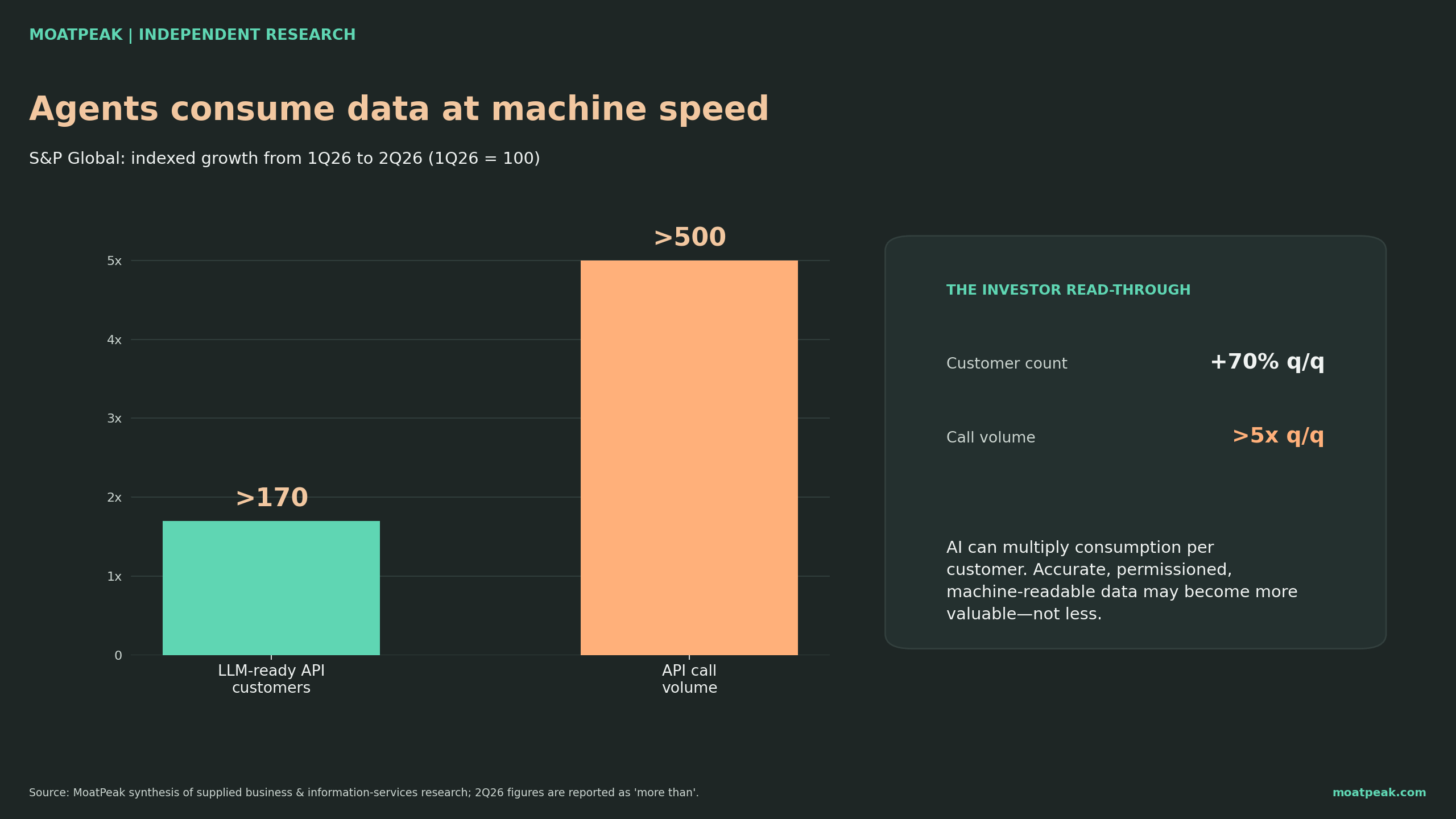
The most convincing evidence is found in the way the data is being used. At S&P Global the number of customers who were using APIs that are connected to MCP and ready for use with LLMs increased by more than 70 percent within a single quarter, hitting over 500. The number of API calls also rose by more than five times, reaching over 1.1 billion.
The distinction between customer growth and call growth is significant because although people may use a data product from time to time, an AI agent checks it each time a workflow is run. As a result, AI can greatly increase the amount of usage per customer even if the number of customers is growing slowly.
It isn’t true that all data providers will gain from this. The data in question has to be accurate, unique, capable of being read by machines, legally usable, and must be included in decisions where errors are significant. Although general content is easy to replace, verified data with the appropriate permissions is a lot more difficult to substitute.
The investable framework
Six questions will help you assess any AI business: Does the company possess unique data? Does it manage a standard workflow? Is it possible to verify the results? Does the product handle permissions and accountability? Can customers switch between models without having to leave the platform? And does the company already have a position in existing budgets?
This method provides a broader range of companies to keep an eye on than just the typical semiconductor businesses. Palantir and Snowflake are particularly strong in the area of orchestration. S&P Global, Moody’s, MSCI, and Thomson Reuters all possess special information assets. Alibaba serves as a good example of whether cloud infrastructure can earn a profit above its costs. While none of these companies can be considered a certain investment at any price, the key point is that the location of value is evolving.
The key point we can draw is simple: lower costs for intelligence can increase the use of AI but at the same time disadvantage certain elements of the AI supply chain. Investors should concentrate on controlling the key points, not merely the most obvious models.
MoatPeak Team