


AI stocks struggled in October. The VanEck semiconductor ETF (SMH) lost 14.2 percent. Nvidia fell 10.4 percent, Alphabet 18.7 percent and Meta 15.2 percent. The common explanation is that growth in AI spending has peaked and that chipmakers will feel the slowdown first.
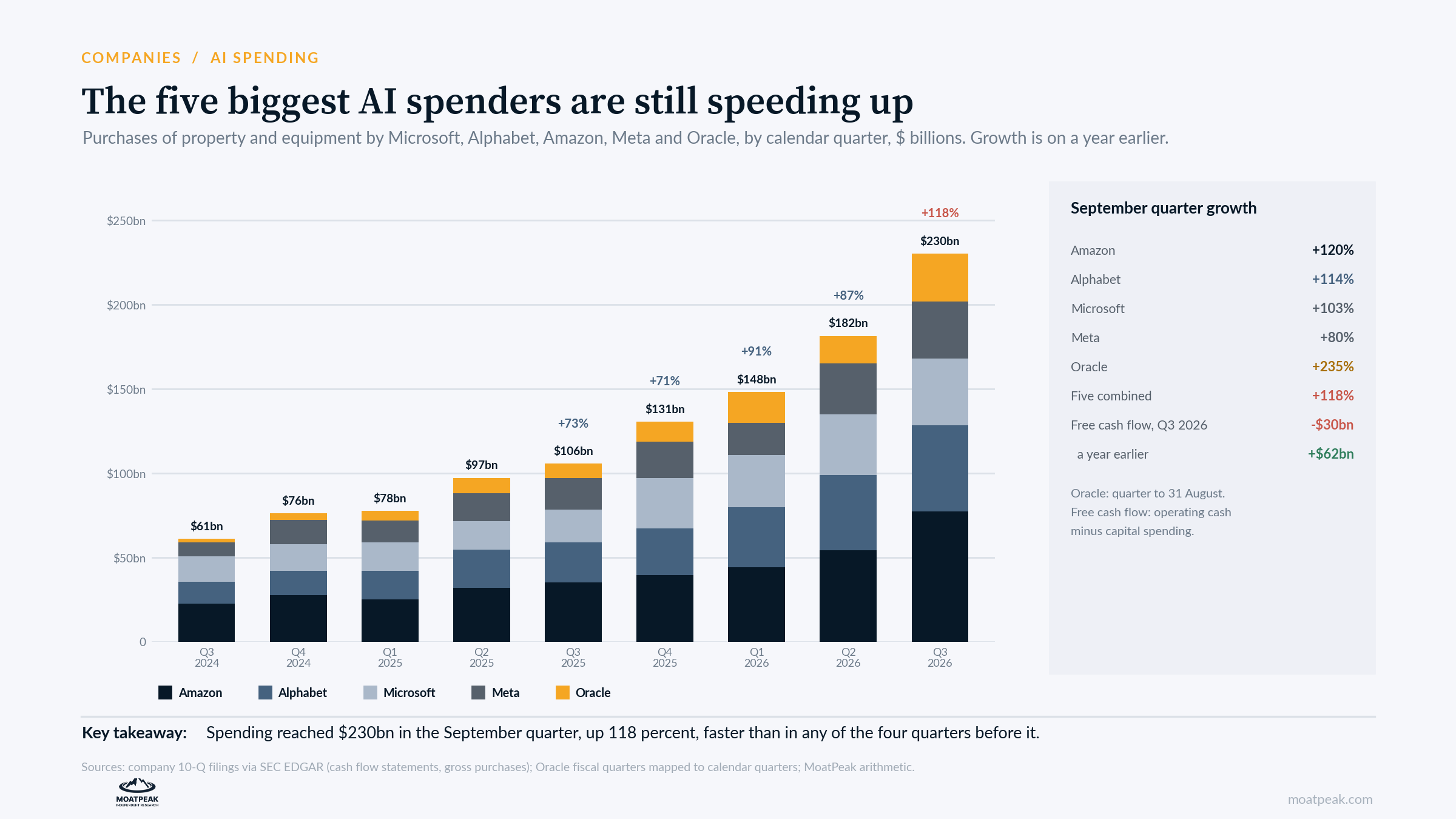
The quarterly filings released in late October show no slowdown yet. By our count, Microsoft, Alphabet, Amazon, Meta and Oracle spent $230 billion on property and equipment in the September quarter, 118 percent more than a year earlier. Growth was 73 percent a year ago, 91 percent in the March quarter and 87 percent in the June quarter. Spending rose by $49 billion from the June quarter alone.
All five companies increased their spending. Amazon spent $77.3 billion, up 120 percent. Alphabet spent $51.4 billion (up 114 percent) and Microsoft $39.4 billion (up 103 percent). Meta spent $33.9 billion (up 80 percent) and Oracle $28.5 billion in its quarter to 31 August (up 235 percent). In the first nine months of 2026, the five spent $560 billion, 36 percent more than in all of 2025.
The bill arrives first
At this level of spending, the group’s free cash flow has turned negative. In the quarter, the five spent about $30 billion more on property and equipment than their operations brought in. A year earlier, they generated about $62 billion of free cash. Meta’s free cash flow fell to minus $1.2 billion from plus $11.2 billion, and Oracle’s was minus $5.4 billion.
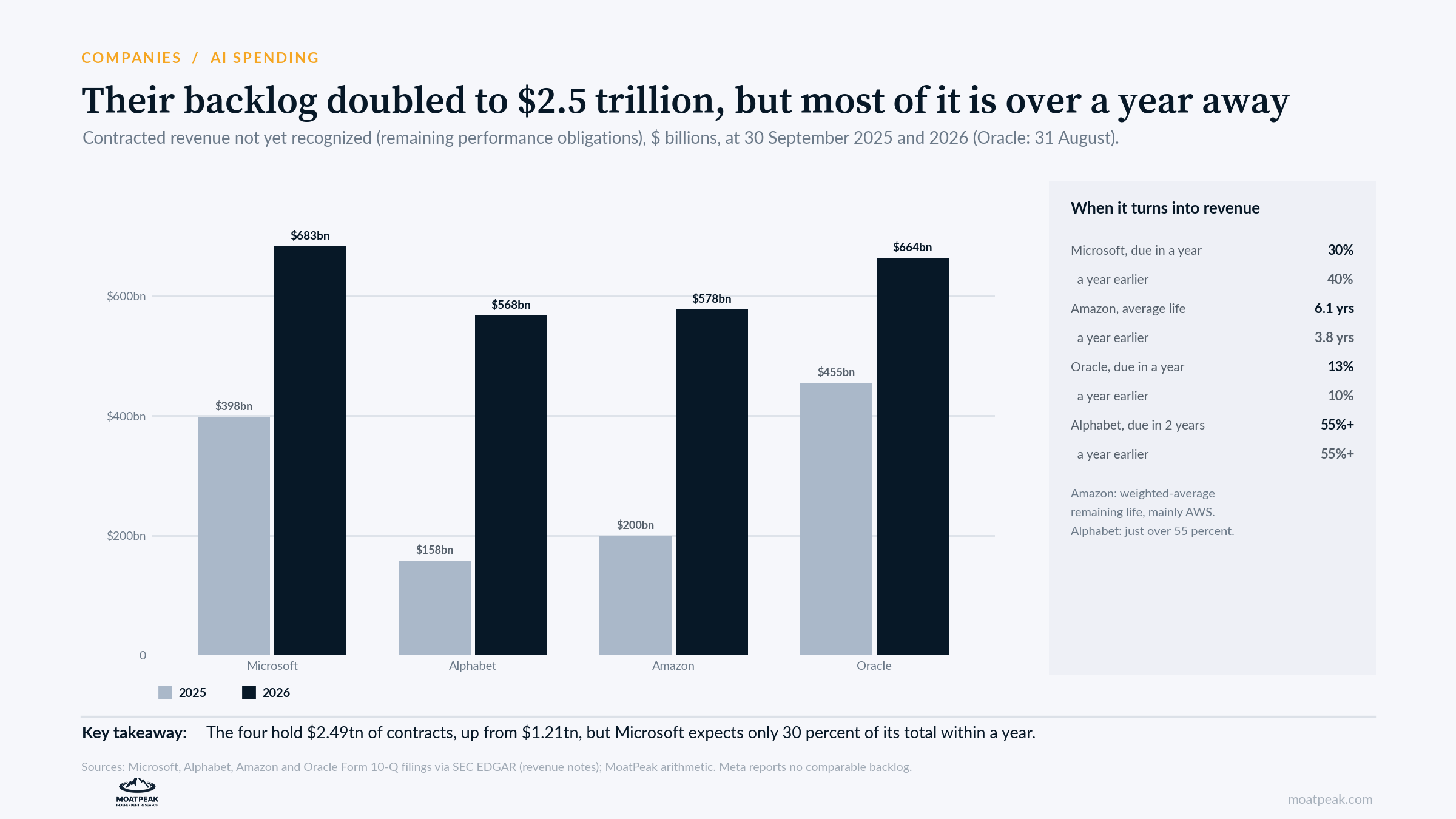
The companies point to their backlogs, the contracted revenue they have yet to recognize, as the reason to keep building. Across Microsoft, Alphabet, Amazon and Oracle, backlogs more than doubled, to about $2.49 trillion from about $1.21 trillion a year ago. Meta, which buys computing capacity instead of selling it, reports no comparable figure.
Bigger, and further out
The timing has moved. Microsoft expects to recognize about 30 percent of its $683 billion backlog over the next 12 months, down from about 40 percent a year ago. At Amazon, whose $578 billion is mainly AWS, the weighted-average remaining life has stretched to 6.1 years from 3.8. Oracle expects 13 percent of its $664 billion within 12 months, up from 10 percent, with half due after three years. Alphabet expects just over 55 percent of its $568 billion within 24 months, the same share as a year ago.
The customer base has also become more concentrated. Amazon’s filing notes that two AI developers expanded their AWS commitments this year: OpenAI by $100 billion over eight years and a second lab by more than $100 billion over ten years. Those two expansions alone add up to more than $200 billion, against a $378 billion increase in Amazon’s backlog. Microsoft, which owns about 24 percent of OpenAI, reported $10.0 billion of revenue from it in the quarter, about 11 percent of its total.
Our read
The market is pricing a slowdown that has yet to appear in the spending numbers. Spending accelerated last quarter, and with $2.5 trillion of contracts to deliver, the builders have little reason to slow down soon.
What has slowed is the payback. New backlog takes longer to turn into revenue. More of it rests on a few AI labs that must keep raising money to pay their bills. The five now spend more cash than they bring in. That pressure hits the spenders first. On the numbers so far, suppliers look better positioned for next year than October’s selloff suggested.
The case against us
Growth rates will fall even if spending holds. If the five repeated their September-quarter spending for every quarter of 2027, the year would come in about 17 percent above a 2026 that ended at the same pace. Supplier stocks trade on growth, and growth has to slow from 118 percent.
A longer backlog can be good news. Customers locking in capacity for eight or ten years signal durable demand, and Alphabet’s timing has not changed.
The cash drain is a choice. These companies have the balance sheets to carry a few years of heavy spending, and they can cut it quickly if demand fades.
What it means for your money
Separate the spenders from the suppliers. The spending numbers support supplier revenue into 2027. The payback question sits with the spenders, whose free cash flow has turned negative.
Read the backlog footnotes. The share due within a year, the average remaining life and the named customers say more about near-term revenue than the headline total.
Treat customer concentration as a risk. A multi-year commitment from an AI lab is only as good as that lab’s access to capital.
What we are watching
17 November: Nvidia’s results for the quarter to 25 October, the first big read from the supply side.
Mid-December: Oracle’s next quarterly report, and whether the share of its backlog due within a year keeps rising.
Late January and early February: the spenders’ fourth-quarter results and their first spending plans for 2027.
Educational research only. Not personalized investment advice. MB “MoatPeak Group”.
The concentration point is the one that worries me most. Amazon's filing says two AI developers each account for more than 10 percent of its revenue backlog, and those developers rely on outside capital to keep spending. So the $683 billion backlog number at Microsoft, with only about 30 percent due within a year, is doing a lot of work. In my view, the November 17 Nvidia print will tell us more about the supply side than the spenders' earnings will. If suppliers keep growing while the spenders' backlogs stretch further out, the payback problem gets worse, not better.