


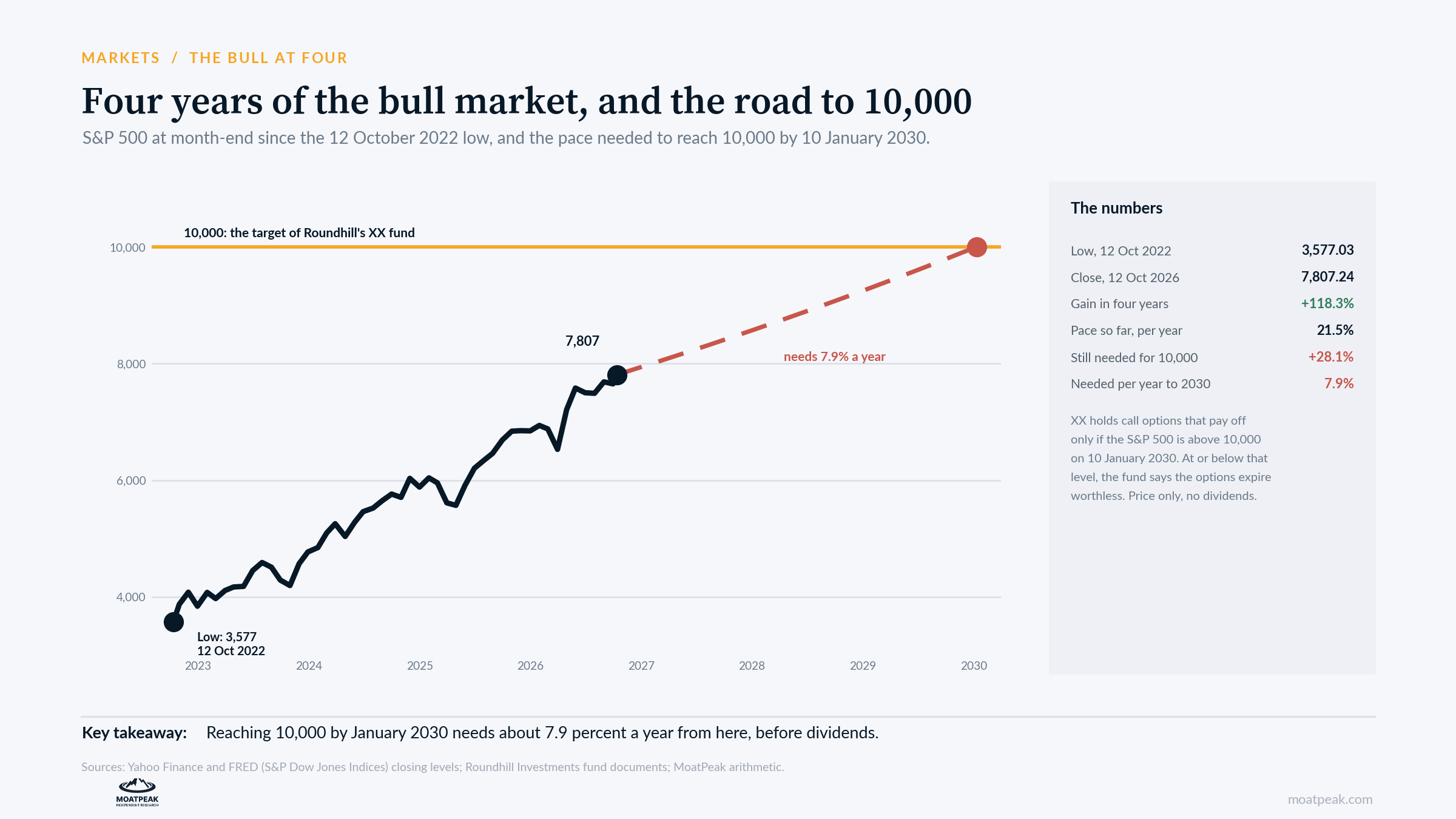
Monday was the fourth birthday of the bull market in US stocks. The S&P 500 closed at 3,577.03 on 12 October 2022, its low after the 2022 bear market. Four years to the day later, it closed at 7,807.24. That is a gain of 118.3 percent, or about 21.5 percent a year before dividends.
Bull markets that reach their fourth birthday have tended to keep going. Carson Group’s Ryan Detrick counts seven others since 1950 that made it this far. He says year five has gained an average of nearly 19 percent, and that only once, in the early 1960s, did a bear market hit during that year.
This bull market faces a hurdle the last long one did not. The 10-year Treasury yields 5.24 percent, which gives savers a real alternative to stocks. The Fed raised rates in September. And the index trades at 19.1 times the earnings analysts expect over the next 12 months, according to FactSet, a price that assumes the profit boom continues. FactSet expects third-quarter earnings to grow 29.6 percent from a year earlier.
A fund that needs 10,000
On 1 October, Roundhill Investments launched the Roundhill S&P 500 Target 10,000 2030 ETF, ticker XX. It holds long-dated call options on S&P 500 index funds, with a strike price that matches 10,000 on the index. Its target date is 10 January 2030.
A call option gives you the right to buy at a fixed price. If the S&P 500 is above 10,000 on the target date, the options are worth the difference. Because they cost far less than the index, the gains are multiplied. If the index is at or below 10,000, the fund says the options “expire worthless,” and investors should expect to lose all or nearly all of their money. Its prospectus expects about 1 to 10 percent of the fund’s assets to remain in that case. The annual fee is 0.99 percent.
So far, few investors have joined. The fund started with $250,000, and less than $300,000 worth of shares traded in its first two days, according to 247 Wall St.
What 10,000 needs
From Monday’s close, the S&P 500 needs to gain 28.1 percent to reach 10,000. Over the three years and three months to January 2030, that works out to about 7.9 percent a year, before dividends. The index has done far better than that over the past four years.
The forecast itself is modest. The risk sits in the structure. The fund’s payoff depends on where the index is on a single day. If the S&P 500 is at 9,990 on 10 January 2030, an index investor has made about 28 percent plus dividends, a good result. The fund has lost almost everything. A sharp fall in late 2029 could undo years of gains just before the date that counts.
Most fund managers trail the index anyway
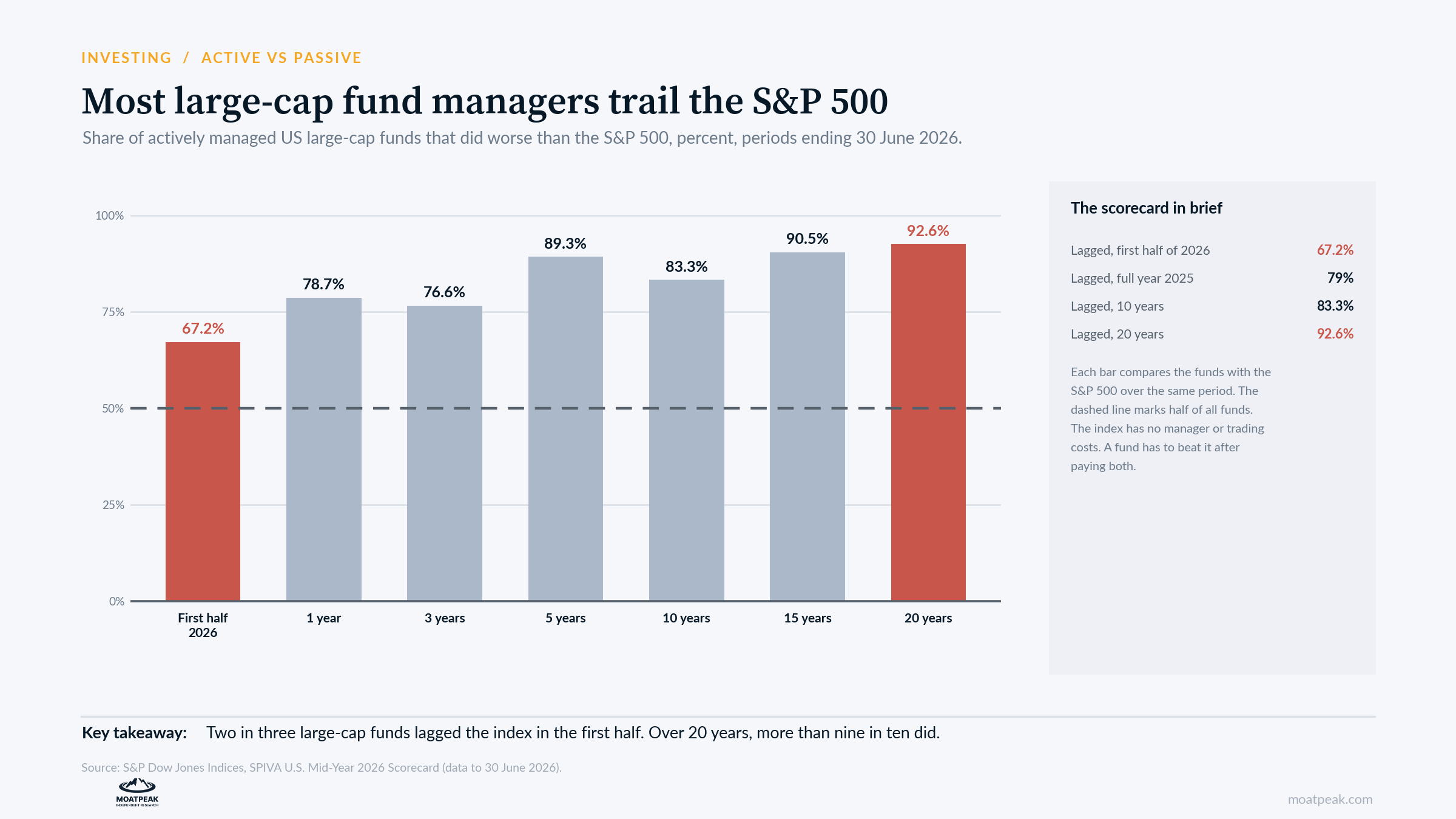
The latest SPIVA scorecard from S&P Dow Jones Indices shows how hard it is to beat the S&P 500. In the first half of 2026, 67.2 percent of actively managed US large-cap funds did worse than the index. Over 20 years, 92.6 percent did.
That cuts both ways for XX. It is a direct bet on the index, so it doesn’t rely on any stock picker. But a plain index fund already captures the same rise, with dividends and without a deadline.
The case against us
Products like this can make sense for some investors. If you want to put a small amount toward a big potential payoff and can accept losing it, you may prefer XX to borrowing money to buy stocks, because your loss is capped at what you put in. And bull markets that reach four have usually kept going, so 10,000 by 2030 is a reasonable outcome.
What it means for your money
Year five has a good record, but where you start matters. Bond yields above 5 percent make this bull market different from the long one that ended in 2020.
Keep the forecast and the product separate. If you think the S&P 500 will reach 10,000 by 2030, an index fund can take you there without the risk of losing it all.
Only put money into all-or-nothing bets that you can afford to lose. The fund’s own documents say you could lose almost all of it.
What we are watching
This week: bank results on Tuesday and Wednesday, and September consumer prices on Wednesday, the next test for bond yields.
Money flowing into XX: a rough gauge of how bullish individual investors have become.
The 10-year Treasury yield: the hurdle stocks have to clear.
Educational research only. Not personalized investment advice. MB “MoatPeak Group”.