


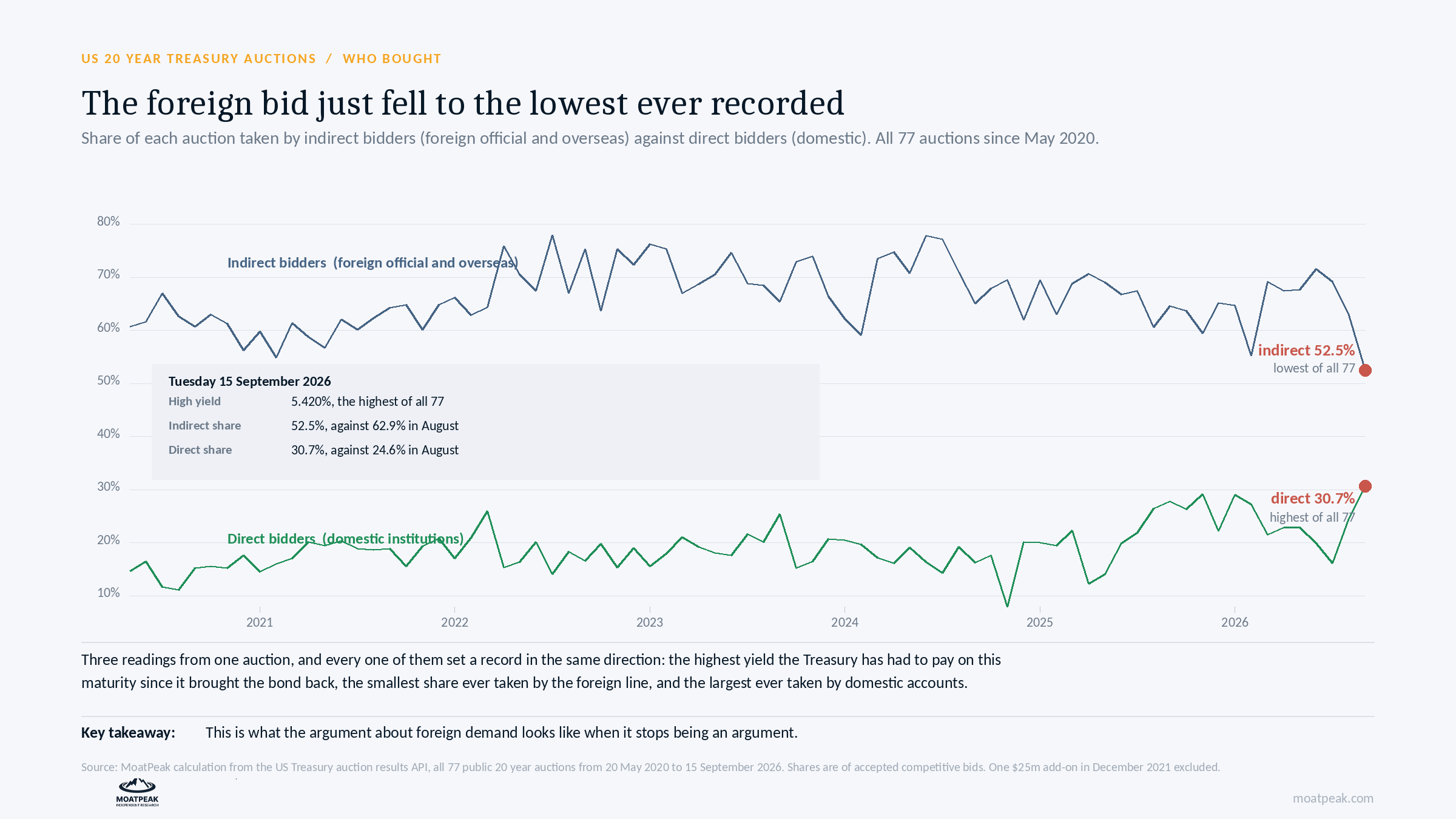
The answer is now clear from this Tuesday’s auction: the foreign portion was the lowest it has ever been, the domestic portion the highest it has been, and the yield the highest it has been since this bond came on the market.
On Tuesday the U.S. Treasury issued thirteen billion dollars’ worth of twenty-year bonds. This is a regular occurrence which takes place every month, is made public in advance and generally doesn’t become a news item.
This auction established three records at the same time.
We obtained the results for all of the 20-year auctions that the Treasury has conducted since it resumed offering this maturity in May 2020; there were seventy-seven such public sales. Rather than depend on other people, we worked out the bidder shares ourselves.
What the results actually say
The auction concluded with a yield of 5.420 percent, which was the highest of all the seventy-seven auctions; the next highest yield was 5.245 percent in October 2023.
Bids can be divided into three categories: among the indirect bidders are foreign central banks and overseas institutions; the direct bidders are mainly domestic institutions that are purchasing for their own account; the rest are primary dealers since they are obliged to.
In the auction in question, indirect bidders obtained 52.5 percent, which was the lowest figure among the seventy-seven auctions; in August they got 62.9 percent, and the average of the prior six sales had been 68.0 percent.
The percentage obtained by direct bidders was 30.7 percent, the highest of all the seventy-seven auctions; in August it was 24.6 percent.
The dealers received 16.9 percent, the bid-to-cover ratio being 2.57 as compared with the average of 2.65 from the earlier six auctions.
The three measures in this auction all set records in the same direction.
Why this bond auction matters
All through the year people have been discussing whether foreigners are pulling back from American debt, mainly relying on holding data which comes two or three months late and is frequently revised.
We too have made use of that data. Two days ago we stated that Japanese holdings of Treasuries had decreased from 1,239.3 billion dollars in February to 1,116.7 billion in June, and that China’s holdings had fallen from 731.4 billion in June 2025 to 633.4 billion one year later. Although these are actual figures, they illustrate the past and refer to stocks rather than flows.
With an auction it is different; the government has to secure buyers at a fixed price on a particular day and there is no possibility of making revisions or delays. Anyone who takes part is included.
On Tuesday, the foreign share reached its lowest level ever, the domestic share was at its highest, and the price had to be adjusted in order to complete the sale.
A fair objection, and why we disagree
That morning, when the Treasury Secretary was questioned in Congress about the rising yields, he mentioned that the ten-year and thirty-year bond sales the previous week had been a success and gave them a positive description. That is correct and does require an appropriate response.
The answer is this: the sales took place on mornings when yields had already gone up sharply before the auction; the buyers at one o’clock got a discount which was announced earlier that day; that is to say, it was a concession, and concessions draw in buyers.
The auction on Tuesday made no concessions. Yields remained close to five per cent for the majority of the session, and it had to be raised by two basis points over the price at which the market had previously priced it for there to be enough bids. Since a sale that clears without any concessions indicates real demand, this outcome was weak.
We would also like to make it clear what we are not saying. A single auction doesn’t constitute a trend; if the October sale causes the foreign share to return to sixty per cent, that should be regarded as nothing more than a bad day, not as a change in the market, and we will state this plainly.
What a regime change would mean
All bonds issued are purchased; the only thing that varies is whether someone buys them and at what price.
For twenty years foreign official institutions purchased a major portion of long-term American debt. They are not sensitive to price in the ordinary way. A central bank which is in charge of reserves is not attempting to beat a benchmark; it acquires securities because it holds dollars and has to invest them.
Private institutions are different; when a pension fund or an insurer purchases a twenty-year bond it is making a value judgment and will only do so if the yield is appropriate. Substituting price-insensitive buyers with price-sensitive ones doesn’t eliminate demand but does make borrowing more costly.
That is why recent headlines have appeared, and we think this situation will continue longer than any individual story. The fact that a government has a deficit of nearly two trillion dollars, as stated in its own eleven-month report, means that it has to sell a large amount of debt to a market that is changing.
What could change our view
If the indirect share at the sale held in October over a twenty-year period exceeds 62 percent, Tuesday’s result was nothing but noise and the idea that the buyers have changed is wrong.
When the figure remains under 58 percent for two consecutive sales, this means that the buyer mix has changed and the yield required to clear these auctions will be higher than most people expect.
For each date there is one figure and anybody can check these figures for free on the Treasury’s website.
The sources
All the figures in this piece have been calculated here on the basis of the Treasury’s own auction results, which are free and publicly available. The period covered is seventy-seven public twenty-year auctions from 20 May 2020 to 15 September 2026. The shares refer to accepted competitive bids, this being the Treasury’s own practice. The one auction involving an additional twenty-five million dollars in December 2021 has been omitted since it was not a public sale and would otherwise appear falsely at the bottom of the table.
Educational research only. Not personalized investment advice. MB “MoatPeak Group”.