


Another measure, one that is frequently mentioned, was, in fact, typical compared with the entire record. The differences between the two are as follows.
We looked at the twenty-year auction on 16 September. We compared it with seventy-seven auctions held since that maturity was introduced, and found that its foreign portion was the lowest ever recorded.
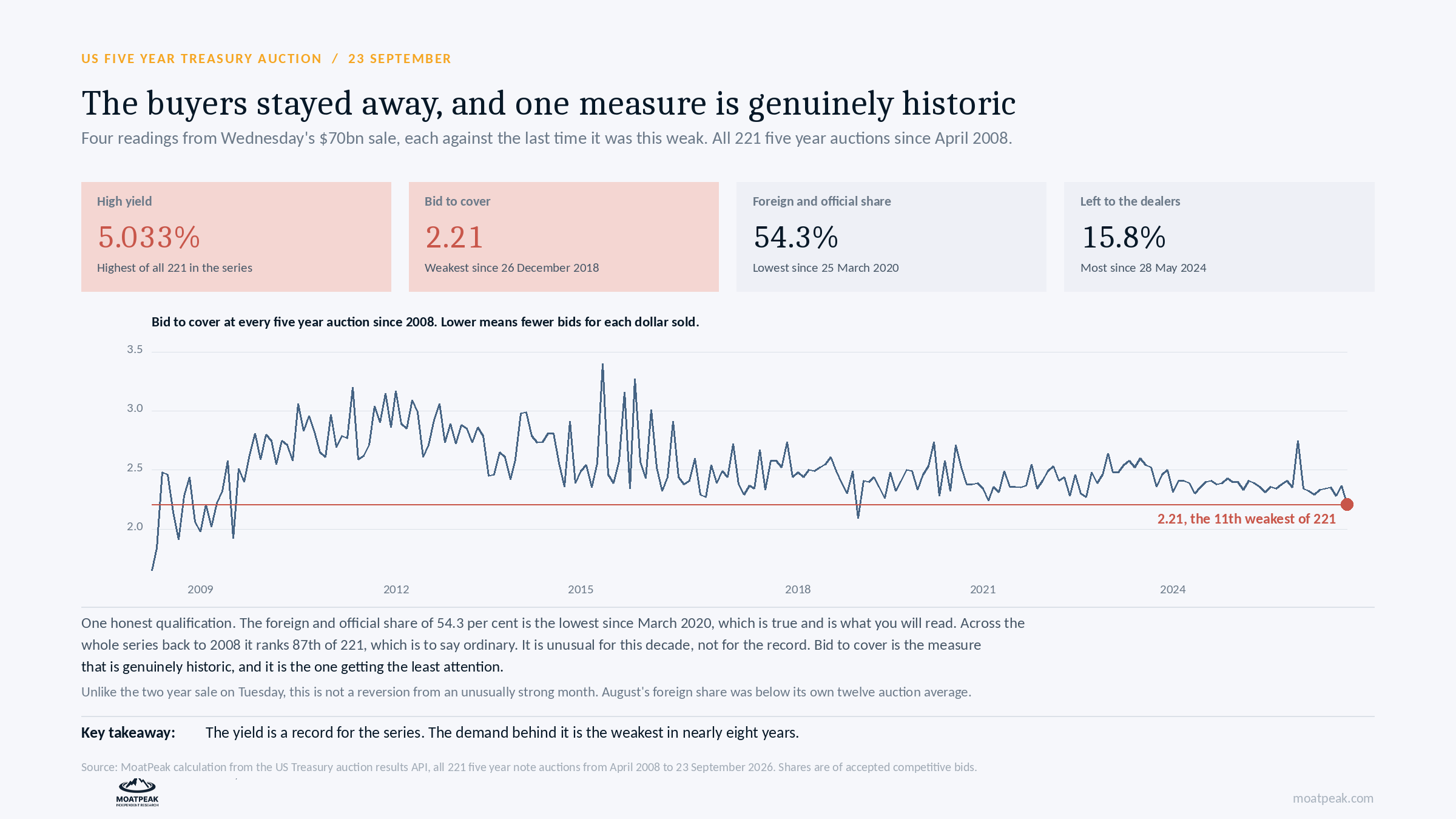
On Wednesday, the Treasury issued $ 70 billion in five-year notes. We have compared this sale with each of the five-year auctions since April 2008, for a total of 221 auctions. We worked out all the figures using the results published by the Treasury.
The four readings
The auction achieved a high yield of 5.033 percent, the highest of the 221 auctions in this series, and, over the period covered by Treasury data, the five-year note has never reached a yield of 5 percent at auction.
The bid-to-cover ratio—the ratio of bids received to notes sold—was 2.21; it last reached that low on December 26, 2018.
The contribution from foreign and official sources—comprising central banks and overseas institutions—was 54.3 percent; it had last been at this level on March 25, 2020.
The dealers, having to take up any remaining notes, ended up at 15.8 percent, the highest figure since May 28, 2024.
Now, the part the headlines will not do
The majority of the reports will highlight foreign demand having reached its lowest level since the pandemic; although this is the case, it doesn’t give the full picture.
The 221 auctions involving a foreign share were ranked, and the auction in question came 87th. A foreign share of 54 percent has been typical since 2008. What is notable is that this is the lowest figure of the decade, since demand from foreign buyers was particularly strong in the early 2020s.
The bid-to-cover ratio paints a different picture: when ranked in the same manner, the auction on Wednesday was the 11th-weakest of the 221. The majority of the poor results occurred in 2008 and 2009 during the financial crisis, with another one in December 2018.
The measure that is genuinely historic is receiving the least amount of attention, whereas the other one is only noteworthy if you begin counting from 2020.
Why we checked the month before
On Tuesday, many people said the two-year auction had revealed a decline in foreign demand, with the figure having fallen from 66 percent to 58 percent. However, on checking, we discovered that the 66 percent figure for August was in fact the outlier, with September’s figure being nothing more than a return to the recent average.
For the five-year auction, we carried out the same check. In August, the foreign share was 61.5 percent, below the average of the previous twelve auctions, and there was no particularly strong month for Wednesday’s result to respond to.
This time, however, there is a genuine decline. The auction over a two-year period had not revealed that. It is precisely because we notice the difference that we examine the data.
What it adds to what we already had
The Treasury has now reached the second auction this month at which the highest yield in the series was obtained, and demand has been weak according to a measurable criterion.
On the 16th of September, the twenty-year bond cleared at 5.420 percent, the highest figure since that maturity was returned, while the foreign portion was the lowest of all 77 sales. On Wednesday, the five-year bond was cleared at 5.033, the highest of all the 221, with the bid to cover at its weakest level since 2018.
There are two stages and two distinct methods, but both tend in the same direction. Neither on its own would be very significant. Only when taken together are they less likely to be dismissed as merely a one-off event.
What would change our mind?
Wednesday was merely a weak session in a busy week if the bid-to-cover ratio of the next five-year sale in late October exceeds 2.35.
If the ratio drops below 2.25 again, it would indicate that the weakness lies in demand for this maturity, not merely in the timing of a single sale.
Available for checking, and the date is given.
Educational research only. Not personalized investment advice. MB “MoatPeak Group”.