


The S&P 500 rose about 1.2 percent last week, and if the index number is all you saw, you would think it was a calm, healthy advance. It was not. Underneath that green number, more than half the stocks in the market actually fell. Small caps dropped. The average stock, the equal-weighted version of the same index, went essentially nowhere. The gain was carried by a small cluster of AI-related giants, and almost nothing else came along. This is the difference between a market going up and an index going up. They are not the same thing, and last week they pointed in opposite directions.
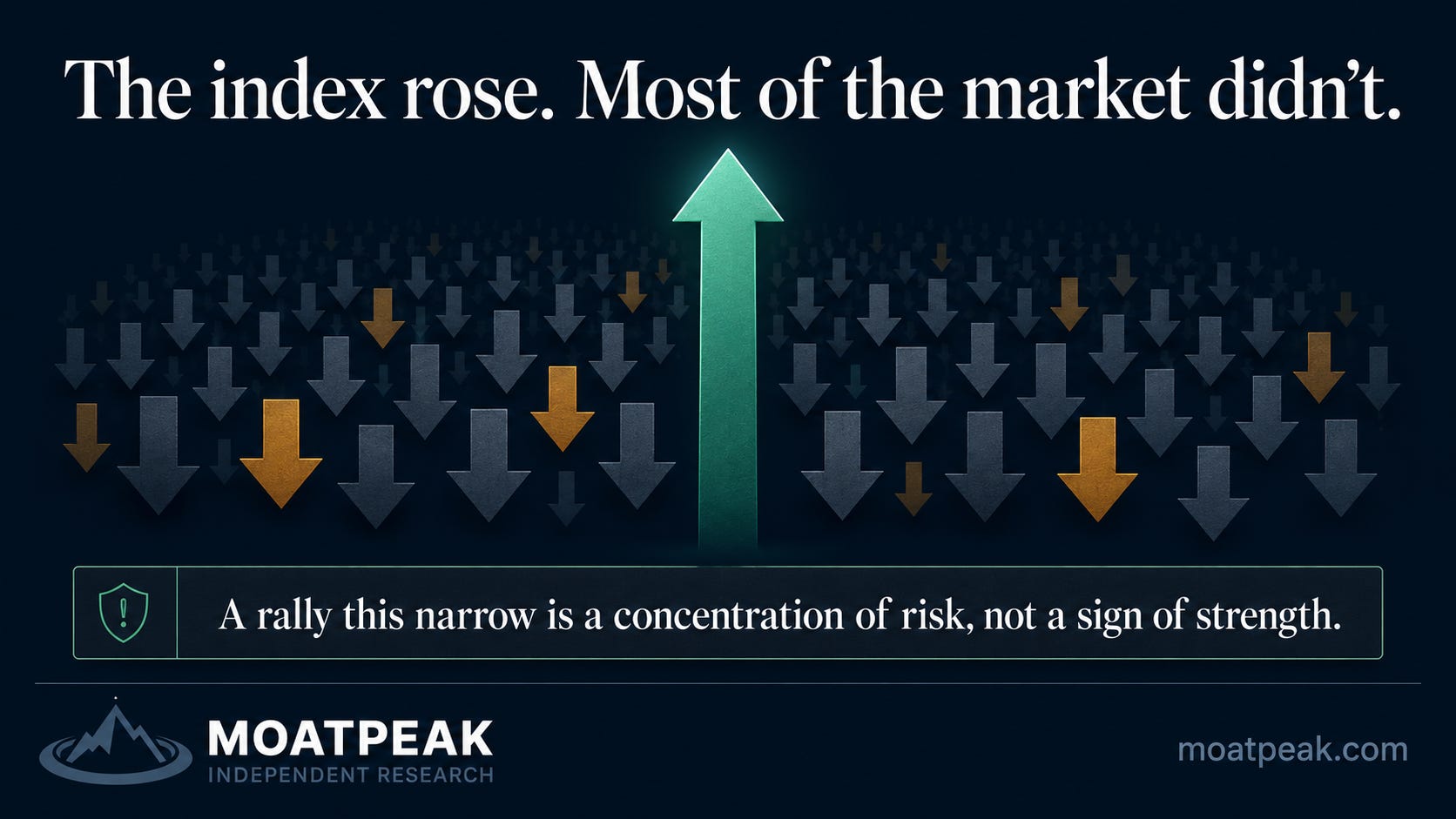
A rally this narrow is not a sign of strength. It is a concentration of risk. When a handful of names are doing all the lifting, the whole index quietly becomes a bet on those few names staying perfect. That is a fragile place to stand, because it removes your margin for error. If even one of those leaders stumbles, there is no broad market underneath to catch the fall. The index looks resilient. The structure holding it up has narrowed to a ledge.
You got a preview of what that fragility looks like last week, and it came from an unlikely place: a blowout earnings report. Samsung posted an operating profit nearly nineteen times larger than a year ago, a genuine record, powered by exactly the AI-memory demand everyone is betting on. The stock fell almost 7 percent. Not because the number was bad, but because the number was already in the price. After the shares had run up around 150 percent, a perfect quarter was simply the cost of admission, not a reason to go higher. That is what “priced to perfection” means in practice, and it is the trap sitting under this entire earnings season. When expectations are this high, even excellence can disappoint.
There is a deeper shift underneath all of this. For a couple of years, bad economic news was good news for stocks, because it meant the Fed would ride to the rescue with rate cuts. That reflex is breaking. The Fed’s latest minutes did not just walk back the promise of cuts, they revealed a committee where some members are now arguing for hikes. And this is happening at the exact moment when even mainstream economists are pointing at the AI buildout itself as a new source of inflation, through the enormous electricity demand it puts on the grid. Sit with that. The boom everyone is celebrating may be part of the reason the rescue everyone is counting on is getting harder to deliver, right when the market leans on it hardest.
Then, over the weekend, the picture got harder. The long-running crisis in the Strait of Hormuz escalated again. After Iran fired on a commercial ship and declared the strait closed, the United States struck back, and a waterway that carries roughly a fifth of the world’s oil is contested once more. Brent crude is back above 76 dollars. We are not going to pretend to forecast a war, and we will not treat a serious conflict as a trading game. But the market mechanism is straightforward and worth understanding: higher energy prices act as a tax on everyone and as fuel for exactly the inflation that is keeping the Fed hawkish. And they press hardest on the parts of the market that were already weakest, the smaller and more indebted companies furthest from the AI story.
Put the pieces together and you get the real picture of this market. A narrow, expensive rally, leaning on a few perfect companies, into a Fed that has stopped promising rescue, with a fresh energy shock pushing inflation the wrong way. None of that is a prediction of a crash. It is a description of fragility. The index can absolutely grind higher from here. But it is doing so on a narrower base, with a thinner safety net and a higher cost of being wrong than the calm headline number suggests. The useful move right now is not to turn bullish or bearish. It is to know which of these forces your own portfolio is quietly betting on.
That is the work we did this week. Our latest weekly note lays out the full framework: how the AI resilience and the macro fragility fit together, the specific scenarios we think the next few weeks run through, and the exact signals that would prove the thesis right or wrong. If you want the whole map instead of the headline, it is at moatpeak.com.
The free letter is where we think out loud. The scenarios, the levels, and the daily research are the desk’s job at moatpeak.com.
Educational research only. Not investment advice. MoatPeak Group, UAB.