


The entire week the discussion was centered on whether the central bank would increase rates even though the job market appeared to be slowing down. A private survey released on Wednesday indicated that there had been only 38,000 new private-sector jobs, whereas July’s report had shown a loss of 23,000 jobs. On Thursday a central bank governor stated that he was inclined to keep the rates unchanged. This line of reasoning was sensible and a great many people formed their views on the basis of it.
However, at 8:30 this morning the story changed.
The number
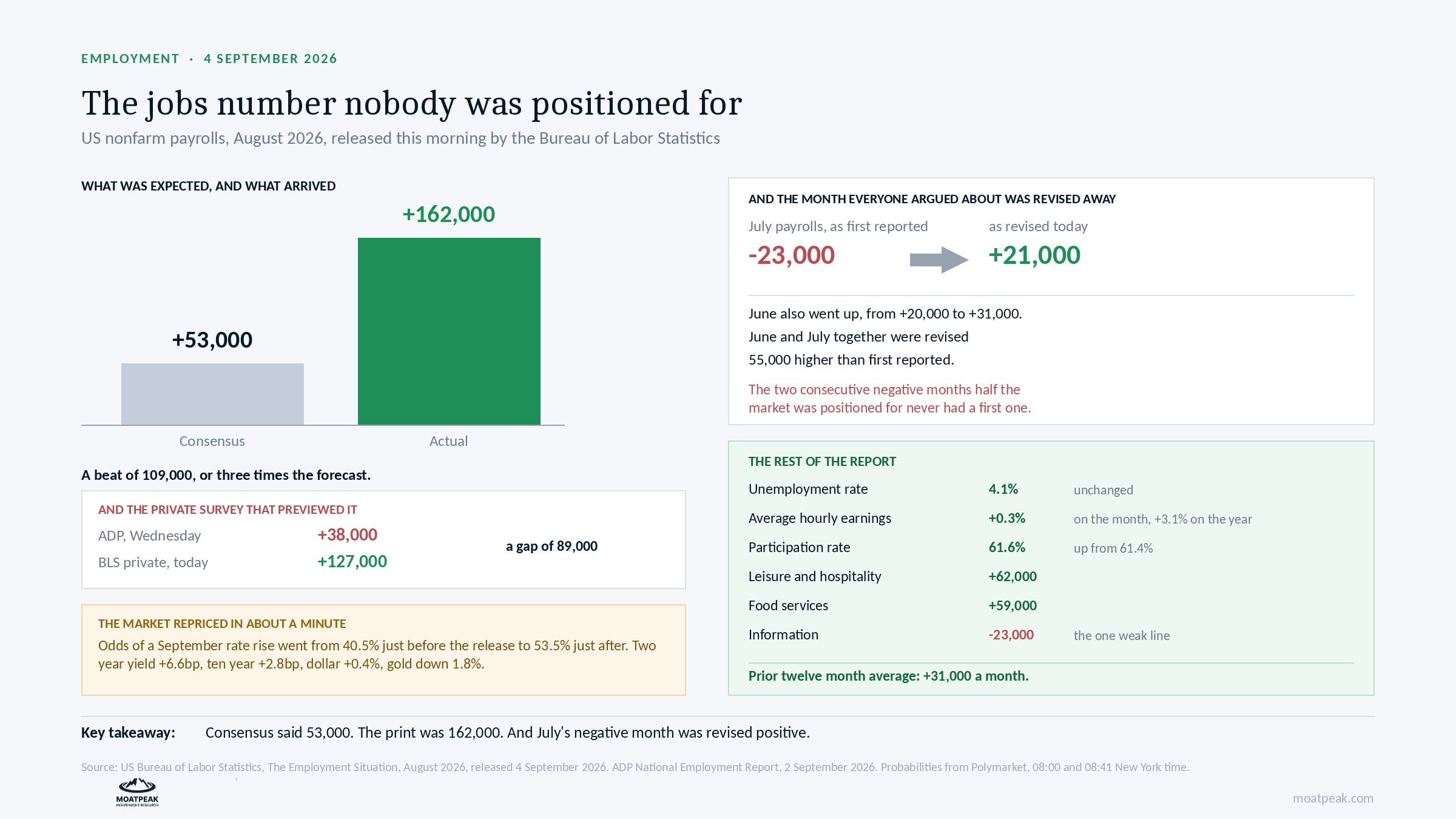
In August the number of US nonfarm payrolls rose by 162,000. The figure that had been expected was 53,000, so the actual result was 109,000 above what had been anticipated—about three times as much. The average monthly increase over the previous year had been about 31,000.
The unemployment rate remained at 4.1 percent, with average hourly earnings going up by 0.3 percent for the month and by 3.1 percent over the year. The participation rate also increased, rising from 61.4 percent to 61.6 percent. This is important since more people began seeking work but the unemployment rate did not rise.
But the real story is in the revisions.
The job number for July changed from a decrease of 23,000 to an increase of 21,000. June’s figure was raised from 20,000 to 31,000. The total for these two months was therefore increased by 55,000 compared to the original figure.
The month in question is not only smaller but has in fact disappeared.
What that does to a week of argument
The comments made this week regarding a slowing job market were based on a figure from July which has since been revised. A large part of what we’ve published was dependent on that figure, and we ourselves would have done the same if we had come out just one day earlier.
The idea that many people were relying on was two months in a row of negative job growth, since that would have changed the discussion from a soft landing to something more serious. However, that situation never in fact took place.
And the private survey: On Wednesday, ADP reported 38,000 new private-sector jobs, and as a result, many people regarded this as an indication that the official report released on Friday would be weak.
But today, the Bureau of Labor Statistics reported 127,000 new private-sector jobs.
The figure for jobs differs by 89,000 between the two reports for that same month, which is nothing out of the ordinary and not an indication of any wrongdoing. The reports rely on different data, have different definitions, and make different seasonal adjustments, and large discrepancies have occurred in the past. It should be borne in mind that the ADP figure is just an estimate in its own right and not a forecast of the official number. Yet it was treated as if it were a forecast all week.
The market repriced in about a minute.
Just before the report, the probability of a rate increase in September was 40.5%; immediately afterwards it rose to 53.5%.
The two-year yield increased by 6.6 basis points and the ten-year yield rose by 2.8. The reason for the yield curve flattening is therefore a more aggressive outlook on interest rates, not due to concerns about growth or supply. The dollar rose by about 0.4% and gold fell by about 1.8%.
All of these moves make sense, and they’re the opposite of what happened Thursday, when a governor’s dovish comments pushed everything in the other direction.
Now the part we owe you.
We produce forecasts and then examine how well they perform; in one of our tests, it was predicted that the August payroll report would be negative, which would have given two months of negative results in a row.
That prediction was wrong on both counts. August showed a gain of 162,000 jobs, and the earlier negative month was revised to positive. So the situation our test described never actually happened.
We’re counting this as a loss today, instead of trying to explain it away or waiting to see if next month’s revision helps. The result is clear, and it didn’t go our way.
It’s not pleasant to admit, but that is the only way to be honest about the situation. If a publisher only gives you their successful predictions, you’ll never get an accurate view of their actual track record—you’ll only see the best aspects of it.
Three things we would hold on to
The initial payroll report is only a draft; on average, revisions alter the figure by tens of thousands, and this month the two-month revision amounted to 55,000 in one direction. If you base decisions on a single-month report, you’re putting them on a figure that isn’t final.
A private estimate is not the same as the official figure; this month, the two differ by 89,000.
You should note the participation rate; it is one thing to have strong job growth together with more people joining the labour force whilst the unemployment rate remains unchanged, and another thing to have strong job growth because people have left the workforce. This month marked the first instance of that.
What this does not settle
Many questions remain. The inflation report released on September 11 will be important for the next meeting, and a strong jobs report alone won’t resolve the issue. Energy prices are still high: US diesel is at a four-year high and Asian gas is close to its level since 2022. The committee which voted 9 to 3 to keep rates steady in July, three members of whom had wanted a rise, is not likely to be influenced by this report alone.
Today’s report altered the narrative but did not affect the outcome.
The research that we carry out every day, together with the tests which we publish in advance and evaluate ourselves against, can be found at moatpeak.com.
Educational research only. Not personalized investment advice. MB “MoatPeak Group”.