


The majority of individuals who purchase a value fund think that they are avoiding technology stocks.
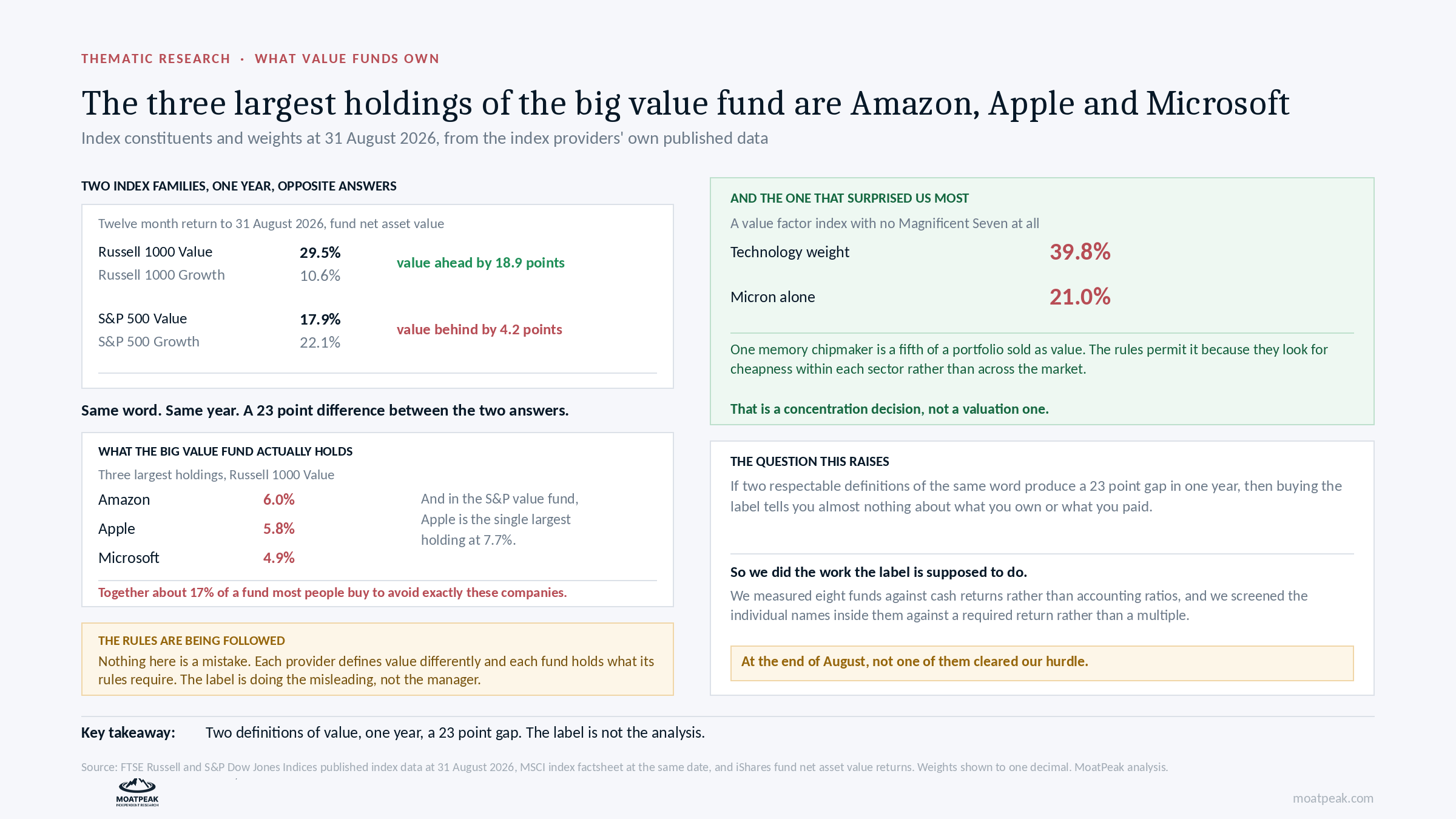
At the end of August, the three largest holdings of the largest Russell value fund were Amazon at about 6.0%, Apple at 5.8% and Microsoft at 4.9%. Together roughly 17% of the fund.
In the S&P version, Apple was the biggest holding at 7.7% of the index.
In this case, there is not a single mistake.
It is important to understand this. No rules have been violated and no manager has made an error. Each index provider has its own way of defining value, and each fund adheres to its own set of rules. According to Russell’s method, a company is included in the value index if it is considered cheap according to its own standards, and companies now satisfy those standards.
The mistake is in the label, not in the manager.
How much the definition matters
Looking at fund net asset value over the twelve months to August 31:
The Russell value fund achieved a return of 29.5%, whereas its growth counterpart returned 10.6%, making value exceed growth by 18.9 points.
The return on the S&P value fund was 17.9%, as compared to 22.1% for its growth counterpart and thus it lagged by 4.2 points.
The same term and the same year, but the scores differ by 23 points.
If the label results in a difference of 23 points in a single year according to which version you buy, then it is not informing you about what you own or what you paid.
The fund that surprised us most
A fund which has no holdings in any of the Magnificent Seven exists and appears to be the purest expression of the concept.
By August the end of that index amounted to 39.8% from technology, and one memory chipmaker alone made up 21.0%.
The reason the rules permit this is that they focus on identifying cheap stocks within each individual sector rather than looking at the entire market. Therefore, a fund might avoid mega-cap technology companies and yet still hold 40% technology exposure, consisting of one cyclical company, which accounts for one-fifth of the total. This is essentially a matter of concentration, not merely a valuation choice.
What we believe is the real question
The idea of cheapness is not a single one; for a bank, a low price-to-book ratio is important, but for a software company, which has few tangible assets, such a ratio carries little significance. With regard to a low price-to-earnings ratio, it may indicate that the market is mistaken, or it might mean that earnings are about to fall; in either case, the multiple appears the same.
Rather than trying to work out which fund is the cheaper one, we began to ask two new questions. The first of these was how much cash each business could earn under ordinary conditions and who would have a claim on that cash; the second was what annual return that implied at today’s price.
What we discovered, and what we’re keeping
To do this, we measured eight funds and checked the companies within them against a required return, not just a multiple.
The conclusion is not as pleasant as a standard recommendation. By the end of August, none of the individual stocks we had examined reached our return target; one was only about half a percent away from the point at which we would begin to show interest, and a number of the others were between six and twenty percent above their targets.
The report includes all of them, provides our assessment of their value, and indicates the price at which each one becomes interesting, and also states which of the funds are closest to true economic value and which are the furthest from it. We explain the circumstances that would cause us to alter our opinion, since an opinion without such circumstances isn’t really an opinion.
If you’re after a list of cheap stocks, then we haven’t prepared one; rather, we’ve explained why the list is currently empty and what changes would be required.
The complete report is available at www.moatpeak.com.
This content is based solely on educational research and does not provide any personal investment advice. MB “MoatPeak Group”.