


On Thursday 1 October, the US Treasury carried out what should have been a routine operation. It proposed to buy back up to $6 billion of older bonds with 10 to 20 years left to run. Holders offered it $46.4 billion.
A similar operation on 10 September drew $10.5 billion of offers, and the one in August drew $7.4 billion. On Treasury records going back to 2000, no buyback of bonds this long has ever drawn more.
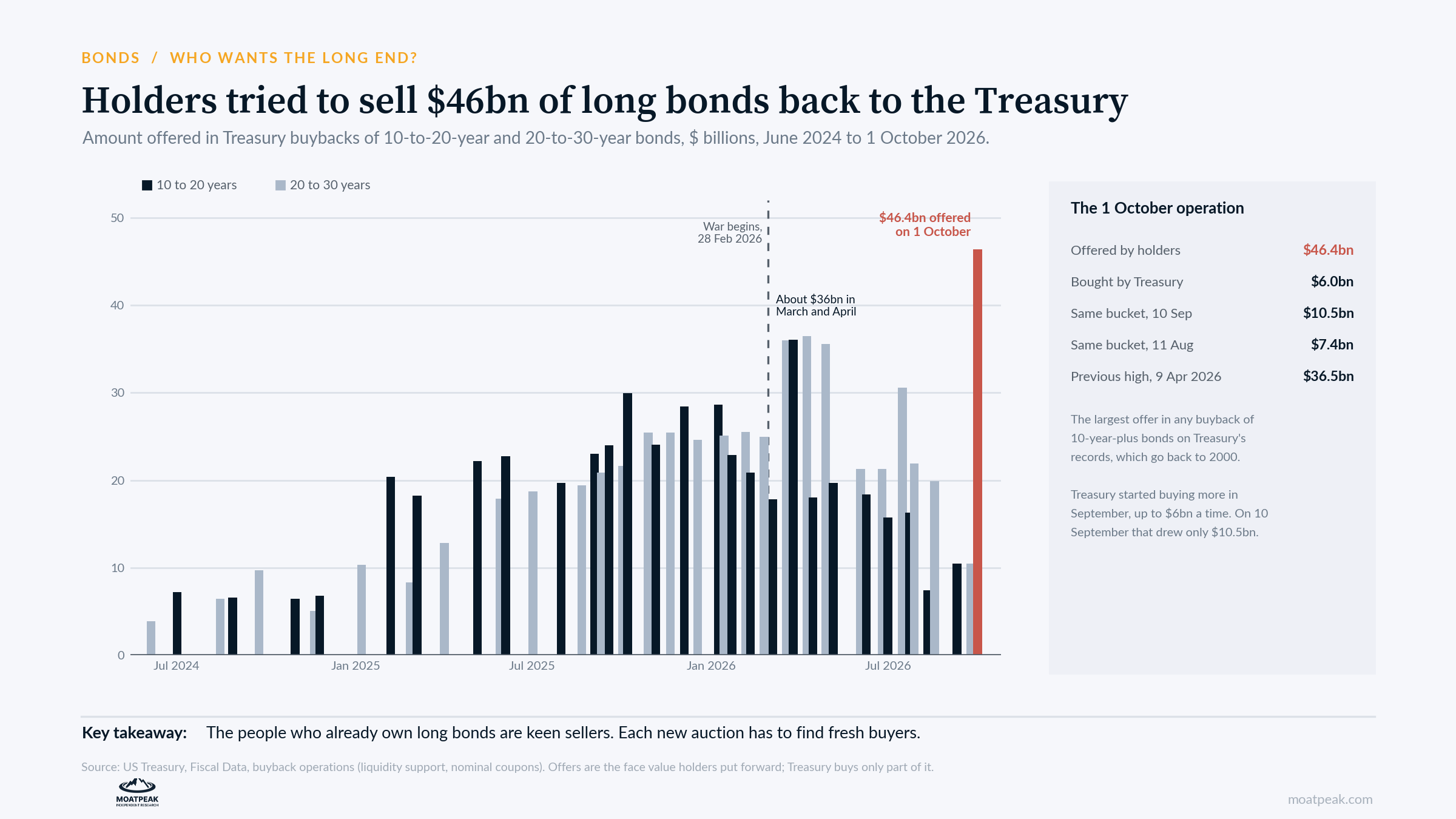
Buybacks are a regular part of market housekeeping. The Treasury buys older, less-traded bonds so that holders have a way to turn them into cash. When the offers are big, many holders would rather have the cash. We read 1 October as a measure of how much long-dated paper is looking for the exit.
Two caveats are worth remembering. The Treasury recently raised the most it buys in each operation, from $2 billion to as much as $6 billion, and a bigger buyer can draw bigger offers. Some holders may also be swapping old bonds for newer ones. Yet the higher limit was already in place on 10 September, and that operation drew only $10.5 billion.
Oil fell. Long rates rose anyway.
On Monday 5 October, WTI crude fell 1.8 percent to $89.43 a barrel after Saudi Aramco cut its prices for buyers in Asia. The 10-year Treasury yield still closed at 5.31 percent, its highest close since 2002.
It was not a one-day oddity. Between 18 September and 5 October, WTI fell from $100.30 to $89.43. Over the same days, the 10-year yield rose from 5.01 to 5.31 percent and the 30-year from 5.34 to 5.66 percent. The 2-year barely moved, from 4.76 to 4.84 percent. Almost all of the movement was at the long end.
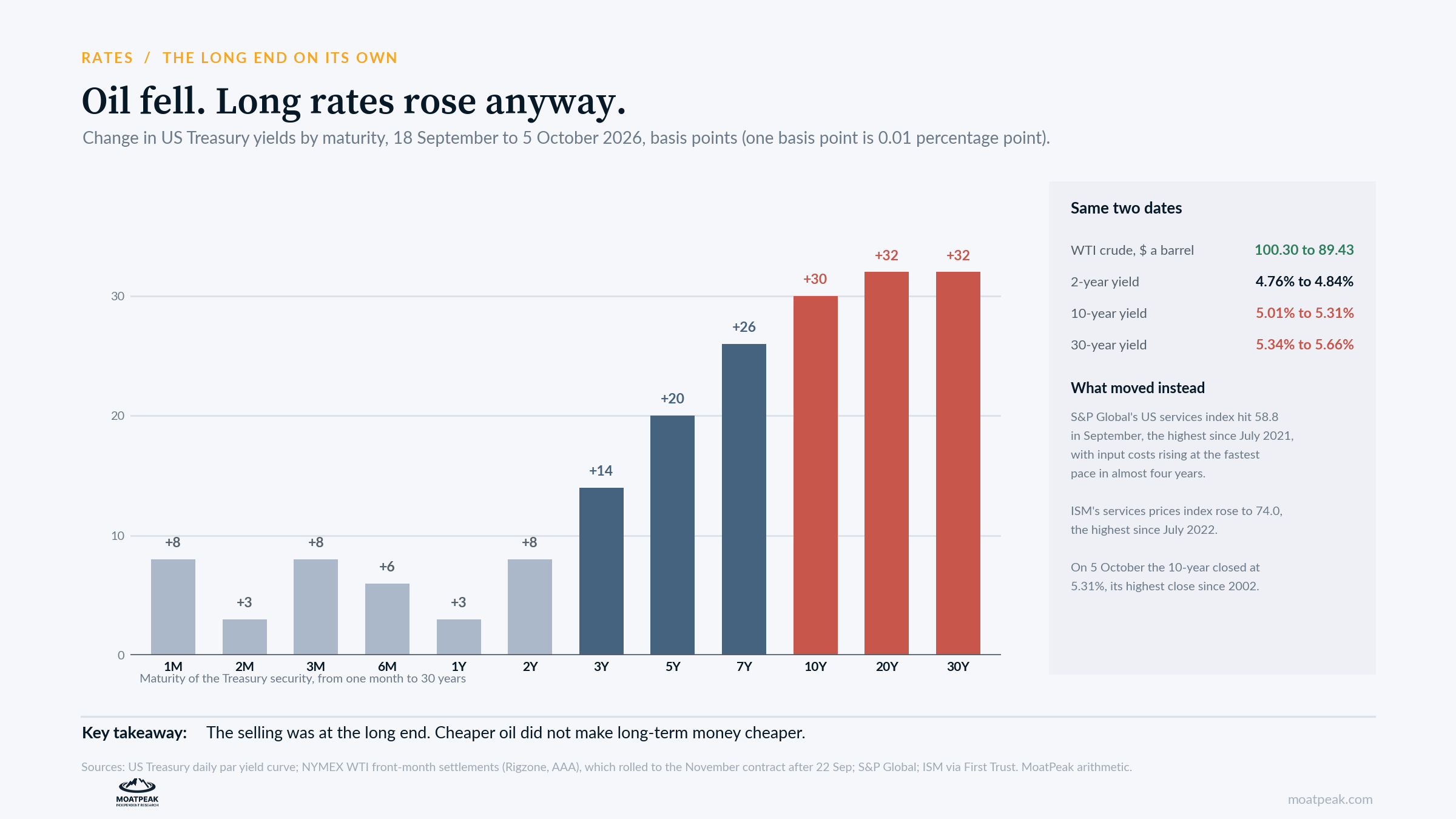
The economy did the work instead. S&P Global’s survey of US service companies reached 58.8 in September, its highest since July 2021, with input costs rising at the fastest pace in almost four years. The prices index in ISM’s services survey rose to 74.0, its highest since July 2022. Strong business activity with rising prices is exactly what long-bond holders worry about most.
The foreign buyer has a better offer at home
For many years, Japanese savers had to go abroad for a decent return. That is no longer the case. On 5 October, Japan’s 10-year government bond yielded 3.085 percent and its 30-year 4.166 percent, on Ministry of Finance figures.
The change is already showing up in Europe. Japanese investors held about 23 trillion yen of French bonds in July, roughly $145 billion, on a Bloomberg estimate. One Tokyo firm, Sumitomo Mitsui DS Asset Management, sold all the French government bonds in its global bond funds and moved into German Bunds and short-dated Japanese bonds, Bloomberg reported. Banque de France Governor Emmanuel Moulin has warned that France risks being “gradually strangled by rising interest rates,” and the euro fell to $1.1161 on Monday, its lowest since May 2025.
We have no figure showing Japanese money leaving US Treasuries. But the arithmetic pulling it out of French bonds applies to every foreign long bond, and Treasuries are the biggest of them.
The borrowers want long money too
Fed Chair Kevin Warsh offered another reason at his 16 September press conference, pointing to the biggest cloud computing companies. “The so-called hyperscalers are out in the market raising funding,” he said. “And so the competition for capital is real, and I think it partly explains the increase in yields.”
So the long end has fewer natural buyers and more borrowers competing for money. Every long bond the Treasury sells has to find a buyer, at a price.
This week’s test
The Treasury sold $58 billion of 3-year notes on Tuesday at 4.932 percent, the highest yield at a 3-year auction since May 2006, on TFTC’s tally. Investors bid $2.62 for every dollar on offer, and indirect bidders, a group that includes foreign buyers and funds, took 57.6 percent.
Next come the long bonds: $39 billion of 10-year notes on Wednesday 7 October and $22 billion of 30-year bonds on Thursday 8 October, both at 1 pm New York time. We will watch three things: whether the yield comes in above where the bond traded just before the sale, which traders call a tail; how much indirect bidders take; and how much is left to the dealers, who buy what nobody else wants.
The case against us
A lot of money is going into bonds. Bond ETFs took in $23 billion over five days, 62 percent of all ETF inflows, Bloomberg’s Eric Balchunas counted on 1 October. At around 5.3 percent, the 10-year pays roughly what many investors expect from stocks, a point we take up separately.
The buyback has a technical side, as we said. If Wednesday’s Fed minutes sound softer, or the consumer price report on 14 October is weak, long yields could fall quickly. And if both auctions this week go smoothly, the buyer problem is smaller than we think.
What it means for your money
Long bond funds carry the risk. When long yields rise, long bond funds fall the most. The iShares 20+ Year Treasury fund (TLT) lost about 10 percent on price in the third quarter.
Mortgages follow the long end, not the Fed. A 30-year mortgage is priced off long yields, so it can get dearer even while the Fed holds still.
Short Treasuries still pay. On Monday, Treasury bills and notes out to two years paid between about 4.0 and 4.8 percent, without the big swings of long bonds.
What we are watching
8 October: the 10-year and 30-year auctions.
The next long-end buybacks: whether offers stay this high.
14 October: the September consumer price index.
Educational research only. Not personalized investment advice. MB “MoatPeak Group”.