


On Thursday, 10 September, the pipeline from the east to the west in Saudi Arabia was the victim of an attack. The following day, the Ministry of Energy announced this and declared the pipeline closed as a precautionary measure. It is still closed.
Oil is transported from eastern Saudi Arabia to Yanbu on the Red Sea by means of the pipeline, and its primary function is to get crude oil to the coast without going through the Strait of Hormuz; for the past six months, the standard reply to worries about the Strait has been that Saudi Arabia can avoid it.
At the moment, that option is no longer available.
The figures elsewhere are inaccurate; here are the correct ones.
While some reports state that the pipeline can handle 7 million barrels per day, that figure is incorrect. The International Energy Agency estimates the pipeline’s design capacity at 5 million barrels per day for the two lines. The figure of seven million barrels comes from a statement made in March 2025, but the agency notes that this level had never been tested under continuous flow.
The pipeline was recently transporting approximately four million barrels each day, the agency stating that this amount is about four per cent of the global supply based on its lower estimate. Some sources claim that the volume carried was less than one million barrels per day before the war, although the agency says normal usage was around two million barrels per day. This confusion arises because people are mixing up the quantity of oil that entered the pipeline with the quantity that left Yanbu by ship. Around two million barrels per day remain in Saudi Arabia for use by the country’s own refineries.
We are deliberately being precise. Stories of this kind are frequently repeated for several days, and the details passed on usually include the highest available figures.
The numbers that really matter
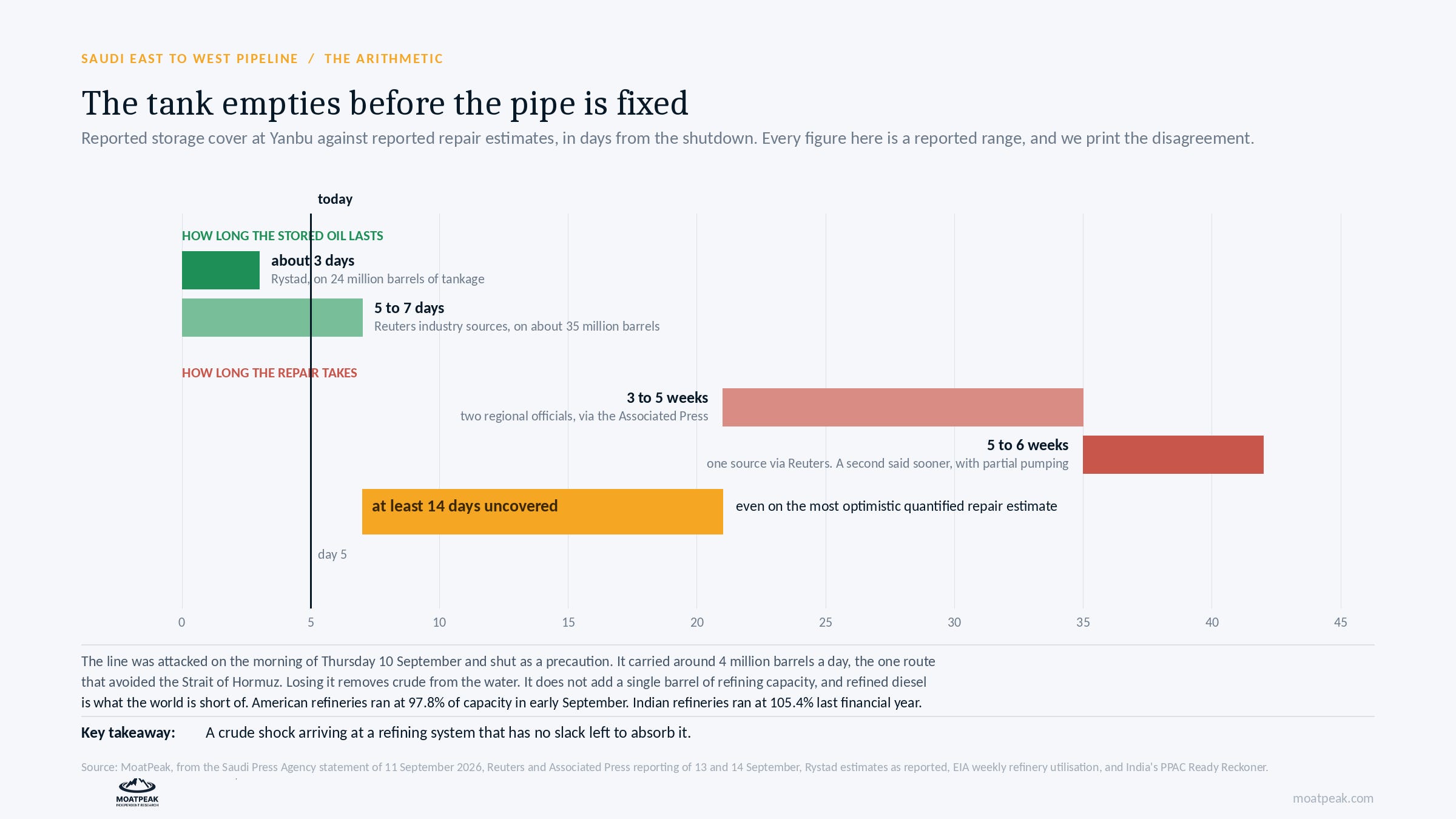
There are two important timelines: how long the oil currently stored at Yanbu will last and how long the repair work will take. Since both of these are the subject of debate, we will present the various estimates rather than selecting one.
According to industry sources speaking to Reuters, there is sufficient oil to last for five to seven days, with a storage capacity of about 35 million barrels; Rystad, by contrast, estimates a storage amount of 24 million barrels and a supply lasting about three days. The figures do not agree and nobody has yet explained the discrepancy.
With regard to the repairs, two regional officials told the Associated Press that the repairs would take between three and five weeks. A Reuters source said the time needed would be between five and six weeks, although another believed it could be sooner, with some pumping possibly occurring during the repairs. On Monday, the U.S. energy secretary, Chris Wright, told Bloomberg TV that he expects the pipeline to be running again soon.
When you look at the two timelines, the problem becomes obvious. Even if you take the highest possible storage figure and the shortest repair time, there would still be at least 14 days without coverage. If the lowest estimates are used, the gap would be about forty days.
The main problem is that gap, which is also why learning that ‘Riyadh regards it as precautionary’ is not reassuring; ‘precautionary’ merely explains why the line was closed, not how long it will remain closed.
Now for the part that most people won’t mention
The loss of this pipeline removes crude oil from the market and drives crude oil prices higher, but it has no effect on refining capacity.
We have already made it clear that the actual shortage is of refined diesel, not of crude oil; the pipeline shutdown has not altered this fact, in fact, it has only made it clearer.
In September, United States refineries were operating at 97.8 percent of capacity, and the Indian petroleum ministry stated that Indian refineries had been operating at 105.4 percent of their official capacity during the most recent financial year. A refinery director mentioned that his plants have been operating at 105-108 percent for six months and intend to exceed capacity next year. Diesel production rose by 2.2 percent, whereas jet fuel production fell by 7.4 percent, indicating that refineries are prioritizing diesel because it is more profitable.
If a system is already operating beyond its design limits, using a more expensive grade of crude oil will not increase output; it will only raise the cost of the final product.
That is the main issue: the pipeline problem concerns crude oil and has affected Brent prices. The actual shortage lies in refining capacity, and the pipeline doesn’t change that. Should the market focus solely on crude oil prices, it might assume the problem is over when those prices stop fluctuating.
The key figure to watch is the difference between diesel and crude oil prices, not merely the price of crude oil. A shortage is, in fact, becoming more severe if both prices rise, but diesel prices rise faster, even though the headlines may imply otherwise.
What would prove us wrong
If the pipeline does do a restart in a few days and the Brent prices fall back again, then this has been nothing but a short scare and we have written two articles about two weeks of nothing.
If American refinery usage falls below 95 percent while the diesel price gap remains large, then capacity must not have been the real problem and our whole analysis of the past two weeks is wrong.
The shortage is worsening because the difference in diesel prices is narrowing while crude oil prices remain high, indicating that the pipeline had no real effect and that we overemphasized its importance.
We will keep a record of three numbers together with today’s date, and then state in which direction they moved.
The sources
The information about the shutdown and the date comes from a statement issued by Saudi Arabia’s Ministry of Energy through the Saudi Press Agency on 11 September. The capacity figures are taken from the International Energy Agency’s published factsheet. The estimates regarding throughput, storage and repair are based on reports by Reuters and the Associated Press of 13 and 14 September, and are attributed to the sources named by those news agencies rather than to the agencies themselves. Data on American refinery utilization is drawn from the Energy Information Administration’s weekly status report. The figure for Indian utilization has been calculated from the Petroleum Ministry’s own Ready Reckoner, showing 271.99 million tonnes of throughput against 258.12 million tonnes of capacity.
We want to mention rather than conceal the fact that the Rystad storage figures were obtained from a secondary report which had been translated and that we were unable to open the original note; they have therefore been labeled as such in the exhibit.
Educational research only. Not personalized investment advice. MB “MoatPeak Group”.