


All of the headlines referred to the same data. In the meantime, the price of the oil that refineries actually purchase increased by 25 percent over six trading sessions.
There are two prices for Brent.
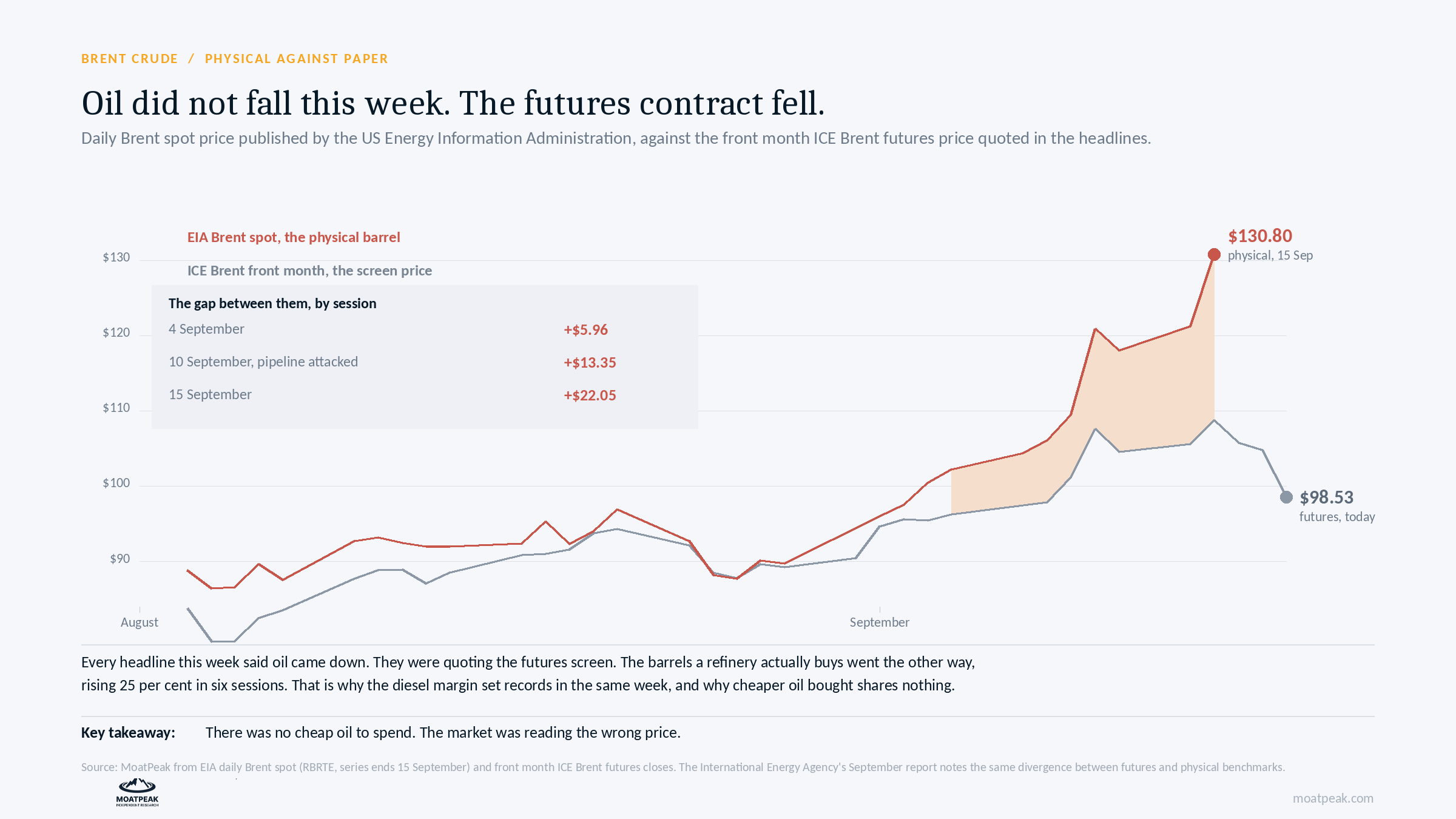
The front-month futures contract, which is traded on ICE, is the one that appears in the headlines, on trading terminals, and in market summaries. This week it fell from around $105 to $98.53.
The other is the physical spot price, the price at which actual shipments of crude oil are bought and sold. The US Energy Information Administration releases this price daily at no cost and has done so for many decades.
On the latest day for which it published figures, 15 September, it reported $130.80.
The gap, session by session
The two prices are generally only a few dollars different. That is essentially what a futures contract is for; when they diverge, it indicates that the paper market and the physical market no longer agree about the value of a barrel of oil.
The situation regarding this month's gap was as follows.
On the 4th of September, the physical price was $6 higher than the futures price; by the 9th, the difference had become $8. After the attack on the Saudi east-to-west pipeline on the 10th, it had risen to $13 and remained at that level on the 11th before reaching $16 on the 14th.
On the fifteenth, the amount was $22.05.
The physical price rose from $104.47 on September 7 to $130.80 on September 15, an increase of 25.2 percent over six sessions.
On the other hand, the futures contract did not change much over the same week and then fell.
What this explains
This week, there were two things that could not be explained on the basis of future prices alone.
On Wednesday morning the diesel margin—the margin between the price of crude oil and that of finished diesel—reached approximately $117 per barrel. Diesel futures reached record levels in both the United States and in Europe, and retail diesel also set a new record at $6.3956 per gallon on Thursday. This occurred in a week when crude oil prices were falling. At first glance, this seems inconsistent when looking only at futures prices, but it becomes sensible when the physical crude price of $130.80 is taken into account.
Second, the prices of shares did not respond to the oil, which was apparently cheaper. Several of the reports referred to Wednesday’s session as the market taking a downward turn on a gift, indicating that policy had become more important than energy as the main influencing factor.
There wasn’t any gift; during the week the cost of oil for the real economy went up and it was only a financial product that decreased.
We must avoid going too far with this point. On Wednesday, the Federal Reserve’s forecasts still had an impact on the market since they clearly did so. However, the explanation relating to energy was rejected on the basis of a price which in fact did not reflect the actual situation.
Why this happens, in plain terms
A futures contract is settled at a future date and can be sold by someone who does not own oil and bought by someone who has no intention of taking delivery; the contract's price is influenced by expectations, trading positions, and events such as pipeline repairs.
A physical cargo has to be produced, shipped and delivered to a refinery which needs it quickly. The price will depend on whether the barrels are actually available.
Usually, when the two prices diverge it means that the market expects the shortage to finish even though the shortage is still going on. That is exactly what took place this week: the time needed to carry out repairs on the Saudi pipeline was reduced, production in Libya picked up again, and the futures market had already priced in a recovery. Yet the market still does not have enough barrels at present.
There is also further evidence concerning a price gap. On September 15 the gap between physical Brent and physical West Texas amounted to $23.78. When we examined this spread over 8,395 trading days, it was the 55th-widest gap on record, with the average being $4.18 from 2015 to 2019. Physical crude prices in the Atlantic basin are behaving very differently from what the screens indicate.
What it means for a portfolio
Whenever oil prices are used for any purpose—and since most people do use them—it is important that you know which oil price you are referring to.
The arguments concerning discount rates or inflation which are based on falling crude prices are currently grounded in the futures curve. Yet the cost of fuel for freight and refining margins is at record levels, and the oil that refineries purchase has never been more expensive than the futures contract meant to represent it.
We are not attempting to predict what direction either price will take. Instead, we are highlighting that the two prices have diverged so much that one can no longer serve as a stand-in for the other. Nevertheless, most of the commentary this week did exactly that.
What would tell us we are wrong
If the spot price for physical goods falls within $10 of the price of the front-month contract within a month, then the problem had been merely a temporary disturbance caused by a single pipeline failure and was not as serious as we have said.
When the diesel margin decreases rapidly even though the actual prices of crude oil stay high, the refining and crude oil situations are in fact independent and our link between them is overly simple.
We have recorded both points with today's date, and both of them can be verified on the EIA’s free website.
One honest limitation
The EIA releases its spot price series with a delay, the most recent figure being from September 15; the futures prices, on the other hand, are updated in real time. As a result, the largest discrepancy occurs when a physical price from Tuesday is compared with a futures price from Friday, and part of this difference will decrease as more data becomes available. Where possible, we have matched the dates, and the $22.05 figure is from the same day. Although the direction of the gap is obvious, its exact amount can vary from day to day.
The International Energy Agency’s September report also points out this discrepancy, stating that the futures were at $105 whereas the physical benchmarks were considerably higher. This indicates that the problem is not limited to a single data source.
Educational research only. Not personalized investment advice. MB “MoatPeak Group”.