


The Fed funds rate has fallen by 1.4 points since May 2023, while credit card rates have remained unchanged, making the difference between the two rates the widest that the Fed has ever reported and at the same time card balances are at a record high.
On Tuesday the Federal Reserve issued its monthly report on consumer credit and the New York Fed released its monthly survey of household expectations. Taken together, these reports show that the typical household is unlike the resilient one which is so frequently mentioned in the press.
What they owe
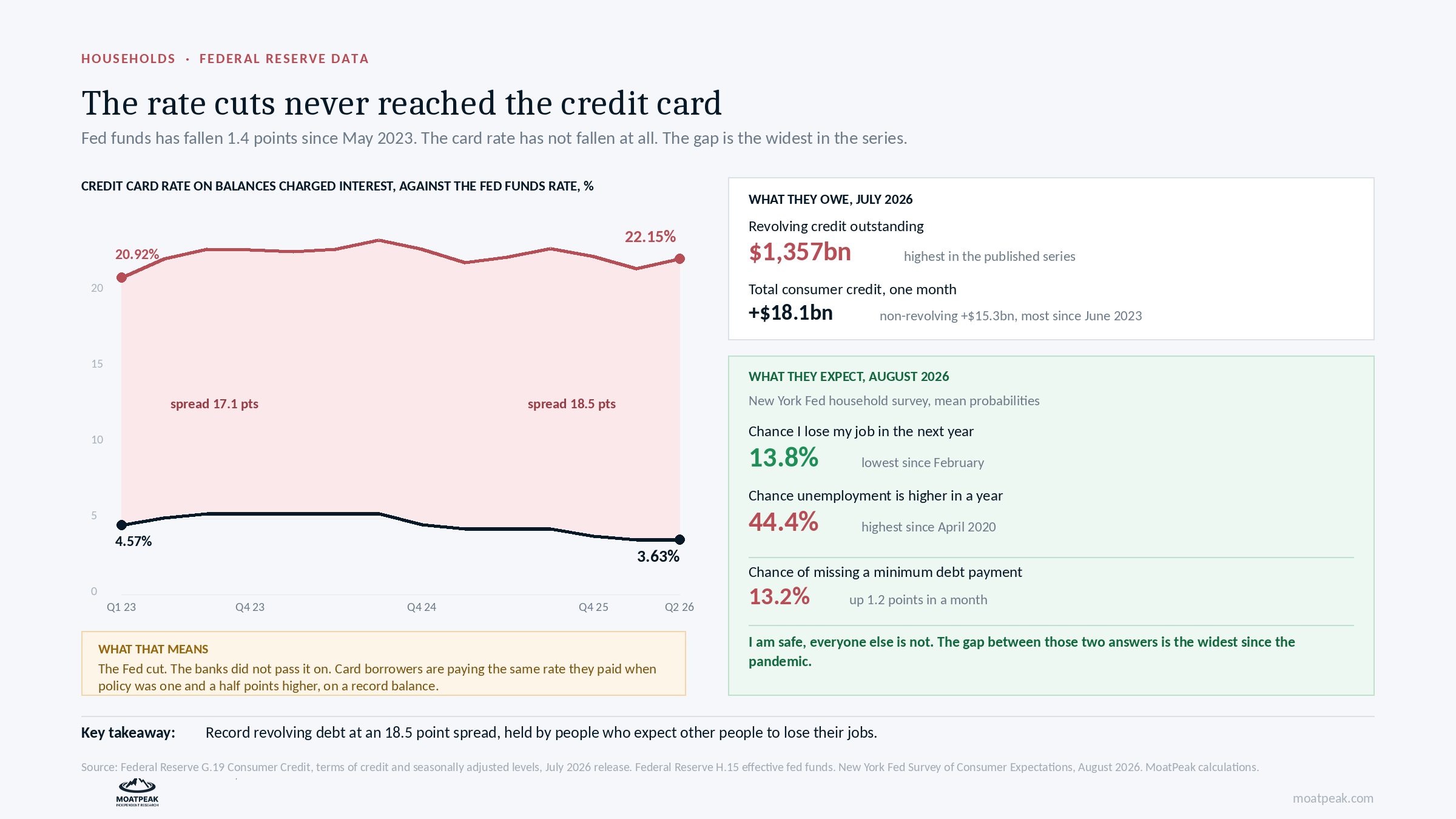
Consumer credit rose by $18.1 billion in July. Revolving credit, which mainly consists of credit cards, reached $1,357 billion, the highest amount ever reported by the Fed. Non-revolving credit, including car loans and student debt, increased by $15.3 billion, which was the largest monthly rise since June 2023.
This proves that consumers are continuing to spend. Let’s now consider the interest rates they are paying.
What they pay
In each quarter the Federal Reserve publishes the average interest rate applicable to credit card balances which charge interest; in the second quarter this rate was 22.15%.
To compare it with the policy rate, consider that in May 2023, when the card rate was last at this level, the Fed funds rate was 5.06%; nowadays it is 3.63%. Therefore, the central bank has reduced its rates by approximately 1.4 points, even though the credit card rates have remained unchanged.
It is even clearer when you compare the two rates. In May 2023 the difference between the card rate and the Fed funds rate was 17.1 points; nowadays it is 18.5 points, which is the largest gap yet since the Fed started publishing this information in 2023.
Since that time, each reduction in interest rates has been taken in by cardholders before reaching them. People who have balances on their credit cards are still paying the same rates as they were when the rules were stricter, and they now owe more than at any previous time.
It should be noted that the Fed also gives an average rate based on all card accounts, covering those which are paid off each month, this rate having fallen to 20.94%. The rate of 22.15% refers to the money that has actually been borrowed. Therefore, if anybody says that ‘the average card rate has gone up’, they are looking at the wrong figure. The actual situation is even more alarming.
What they expect
Every month the Federal Reserve in New York asks a few thousand households the same questions and two of the answers given in August are particularly important to compare.
When asked what the probability was that they would lose their jobs in the coming year, the average response was 13.8 percent, which is the lowest figure recorded since February.
When people were asked what the probability would be that unemployment would be higher next year, the average answer given was 44.4 percent; this is the highest figure seen since April 2020, when the pandemic caused the economy to shut down.
People are confident regarding their own jobs but are concerned about those of others; the gap between these two attitudes is as wide as it has been since the lockdown.
In the same survey another result was found, showing that the average probability of missing a minimum debt payment over the next three months rose by 1.2 points in a month and reached 13.2%.
What we think this describes
There is a situation in which households are taking out loans at record levels, despite the fact that interest rates have not fallen as a result of the policies introduced, and their opinions regarding the job market are divided. Although people are confident about their own personal circumstances they are pessimistic about the nation as a whole, and some of them are now saying that they might fail to make a payment.
Although none of these facts might appear to be very significant on their own, collectively they indicate a consumer who has personal rather than general confidence. Such confidence is capable of changing rapidly.
The counter, which is real
The survey also indicates that expectations of inflation for the next year remain at 3.6% and that five-year expectations are 3.0%. These figures are not something to worry about. The most recent payroll report was strong in that a greater number of people had joined the labour force. Moreover, the fact that the gap between policy rates and card rates is increasing is merely evidence that the banks have not yet passed on the rate cuts, which is typical at the beginning of an easing cycle and generally happens to reverse later on.
The actual problem isn’t that consumers are breaking down; it is that the safety net which people had hoped for as a result of the rate cuts has not reached the main area where households borrow money.
What would change our reading
When the card rate for the third quarter, which was released in the autumn, falls below 21.5 percent, this will indicate that rate reductions are beginning to affect cardholders, and the difference between the rates will therefore be less important. If the probability of missing a payment drops back towards 12 percent in the September survey, then the rise in August was only a temporary spike.
The habit
If the subject of rate cuts comes up, consider which one affects you. Although the policy rate is the one that receives media attention, it is the card rate that appears on your statement. This year those two rates have been going in opposite directions.
The complete research, together with the tests which we publish in advance and assess ourselves against, can be found at moatpeak.com.
Educational research only. Not personalized investment advice. MB “MoatPeak Group”.