

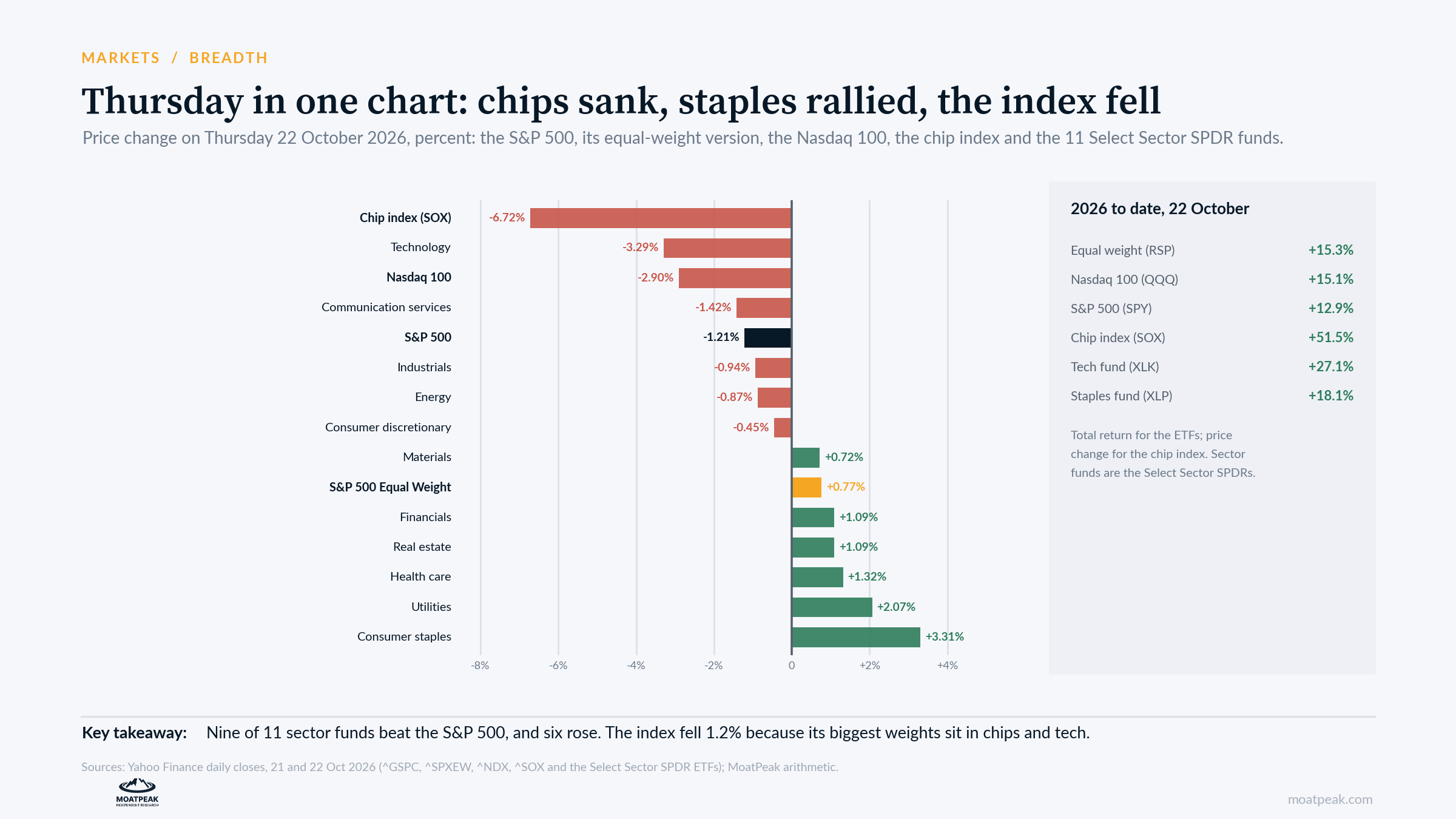
Thursday looked like a rough day for stocks. The S&P 500 fell 1.21 percent, the Nasdaq 100 fell 2.90 percent and the chip index dropped 6.72 percent. Meta fell 7 percent after its results, and Lam Research fell 12 percent after its guidance.
Still, most stocks did well. The S&P 500 Equal Weight index, which treats all 500 companies equally, rose 0.77 percent. Nine of the 11 sector funds beat the S&P 500, and six of them rose. Consumer staples gained 3.31 percent, utilities 2.07 percent and health care 1.32 percent.
How unusual Thursday was
The gap between the two indexes was 1.97 percentage points. That’s the seventh widest since December 2006, when our daily data began, and the widest since July 2024.
The direction was rarer still. Thursday was the first day in that period when the S&P 500 fell more than 1 percent and the equal-weight index rose more than half a percent. The closest call was 27 January 2025, the day of the DeepSeek sell-off, when the S&P 500 fell 1.46 percent and the equal-weight index rose just 0.02 percent.
One day in four
Thursday was the most extreme example of a trend that has been building for years. In 2026, the S&P 500 and its equal-weight version have moved in opposite directions on 50 of 203 trading days, or 24.6 percent. That is the highest share in any year since at least 2007. In 2024 and 2025, it was about 19 percent. From 2007 to 2015, it ranged from 3.6 to 8.8 percent.
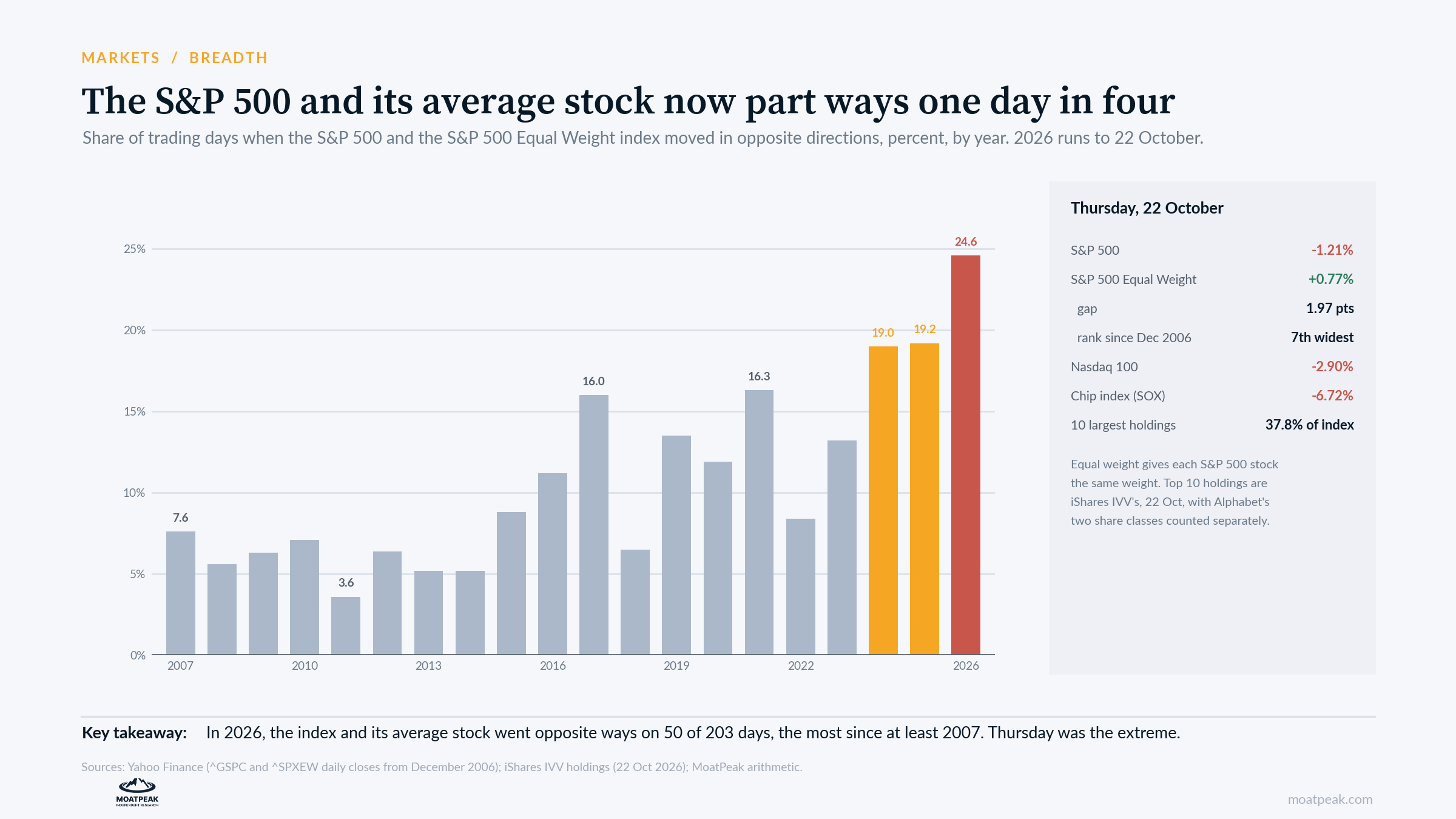
The main reason is concentration. On Thursday, the 10 largest holdings of the iShares Core S&P 500 ETF made up 37.8 percent of the fund: Nvidia, Apple, Microsoft, Amazon, Alphabet’s two share classes, Broadcom, Meta, Tesla and Eli Lilly. Six of those nine companies sit at the center of the AI build-out, as its biggest suppliers or its biggest spenders: Nvidia, Microsoft, Amazon, Alphabet, Broadcom and Meta. When they move together, they can pull the index away from everything else in it.
Our read: the tilt hasn’t paid this year
The scary headline and the comforting one are both partly true. The AI trade had a bad day, and most stocks did fine. The more useful point for investors is about exposure. Buying “the market” through a cap-weighted index now means making a large bet on one theme.
So far this year, that bet hasn’t worked out. Through Thursday, the Invesco S&P 500 Equal Weight ETF (RSP) has returned 15.3 percent in 2026. The SPDR S&P 500 ETF (SPY) has returned 12.9 percent. Even the Nasdaq 100 fund (QQQ), the most tech-heavy of the three, has returned 15.1 percent, slightly behind the average stock.
That is a quiet reversal. Concentration was a winning strategy for years, and many investors stopped questioning it. This year, it has cost them.
The case against us
Concentration has a long track record of paying off. The equal-weight ETF trailed the S&P 500 ETF by about 12 points in both 2023 and 2024 and by more than 6 points in 2025. The largest companies earned their weight with profits, and they may do so again.
Ten months isn’t a long time. Equal-weight funds hold more cyclical and smaller companies, which usually struggle more in a recession. If Thursday’s bond rally is right about slower growth, the average stock may not stay ahead.
What it means for your money
Check what’s in your index fund. If you own an S&P 500 fund and also hold Nvidia or Microsoft directly, your exposure to one theme may be larger than you think.
Don’t take “the market fell” at face value. On Thursday, the index fell, and most of its stocks rose. Both can be true on the same day.
Treat equal weight as a choice with trade-offs. It reduces concentration but adds smaller and more cyclical companies, and it has fallen behind in years when the biggest companies do well.
What we are watching
Wednesday 28 October, after the close: results from Microsoft, one of the index’s three largest weights.
Tuesday and Wednesday, 27 and 28 October: the Fed’s rate decision.
The rest of the year: whether the index and its average stock keep moving in opposite directions as often as they have in 2026.
Educational research only. Not personalized investment advice. MB “MoatPeak Group”.