


This year a large number of people have stated that a small number of the major technology companies are influencing the market and that the index places too much faith in them.
We investigated it. The truth is just the opposite.
Here are three numbers, all measured over the same period and using the same method
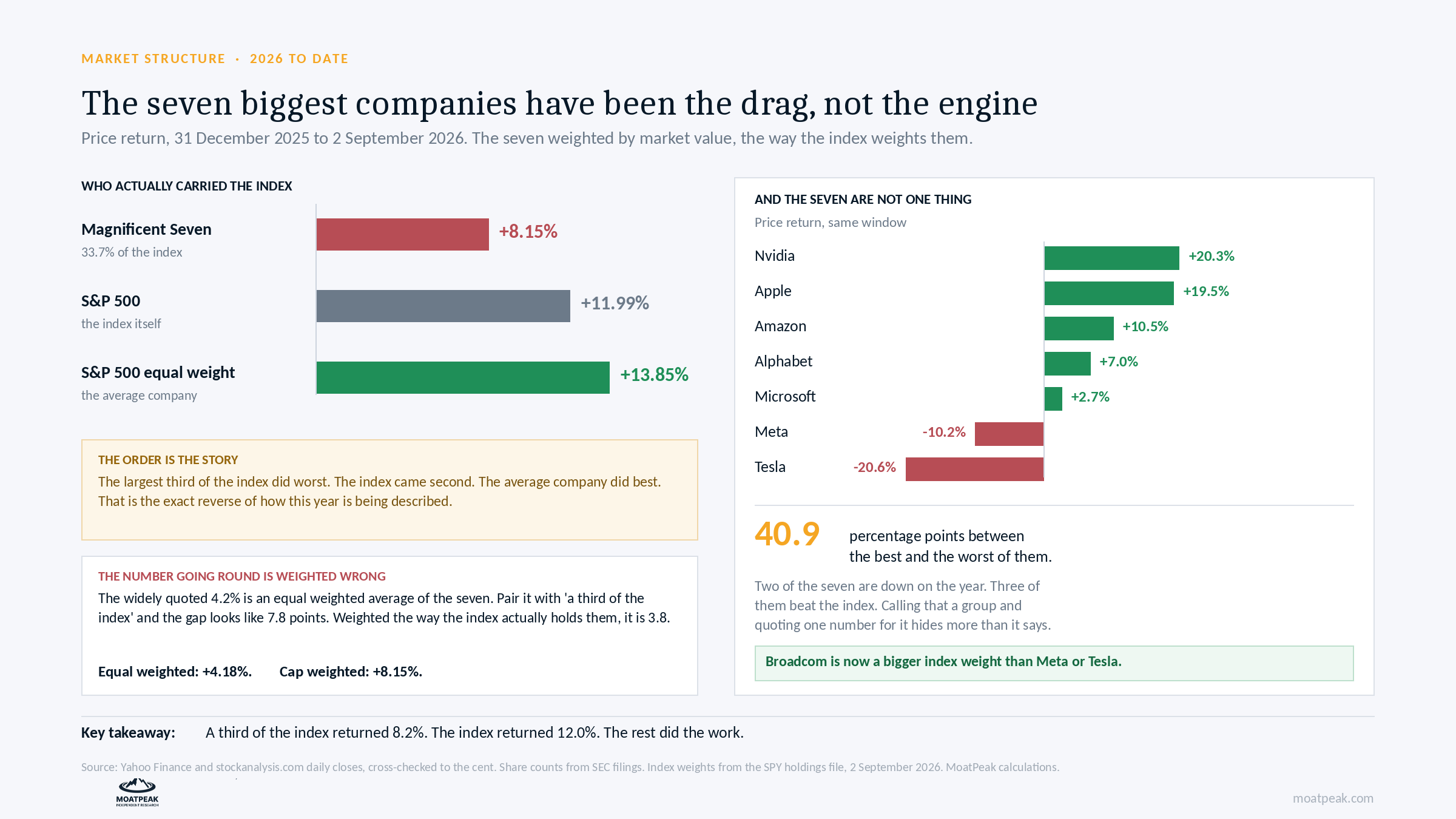
Looking at price returns from December 31, 2025 to September 2, 2026:
The Magnificent Seven, their returns being weighted in accordance with the weights of the index, amounted to +8.15%.
The S&P 500 had a return of +11.99%.
The equal weight index of the S&P 500 – where the smallest company is given the same weight as the largest – registered a return of +13.85%.
Look again at the results. The one-third of the index that was largest did the worst. The index stood in the middle. The average company achieved the best result.
This is the complete opposite of the usual story, and the difference is clear. The seven companies make up 33.7% of the index by weight. While this third returned 8.2% and the whole index returned 12.0%, the other two-thirds had to perform much better to lift the average. They did, as shown by the equally weighted index.
Now, let’s talk about how this number is usually reported
You could come across statements claiming that the Magnificent Seven have increased in value by 4.2% this year; that figure is correct since it is based on an equal-weighted average of the seven, just as the popular equal-weighted fund calculates.
The issue is the sentence in which it usually appears, namely a version of “the Magnificent Seven are up 4.2% and they are a third of the index.”
The two figures involve different weightings; while the return considers Tesla and Nvidia to be of equal importance, the index does not, since Nvidia’s market value is about four times that of Tesla’s. In this case, combining the two figures might lead readers to think that one-third of the index returned 4.2%, which would imply a 7.8 point underperformance.
When the same weighting is applied to both, the difference amounts to 3.8 points; combining them has the effect of doubling it, which is the central idea of the argument.
We are not claiming that anyone is being careless. What we wish to point out is a common practice – when a return and a weight appear in the same sentence, verify that they have been calculated in the same way. This kind of error is frequently made in market commentary and is something that most people fail to notice.
Also, these companies are not really a group
The way in which each of the seven did so this year.
Nvidia has increased by 20.3 percent, Apple by 19.5 percent, Amazon by 10.5 percent, Alphabet by 7.0 percent, Microsoft by 2.7 percent, and Meta has dropped by 10.2 percent. Tesla has fallen by 20.6 percent.
There is a 40.9 percentage point gap between the best and worst performers. Two of the seven lost value this year. Three beat the index. Microsoft, for example, returned less than a third of what the index did.
To refer to these companies as a group and to give them a single figure masks the important differences between them. There is no common factor affecting them. Nvidia and Tesla had quite different years, and the average fails to show that.
The list of companies is no longer up to date; Broadcom now has a greater weight in the index than either Meta or Tesla. The original list was prepared for a market which has since changed.
Here is what we think this really means
The three points are all there are, and none of them constitutes a trading idea.
Worries regarding concentration and performance are by no means the same. It is correct that seven companies account for one-third of the index, and that is a genuine risk. However, it is wrong to say that these companies have been responsible for the returns this year. People tend to confuse these two statements, but only one of them is accurate at the present time.
This year, holding the index has been equivalent to betting against the largest companies, not in favour of them. If you had held the equally weighted version, you would have achieved almost two points more. People who purchased the market-capitalization weighted index in January in order to gain exposure to the AI leaders ended up with a result worse than that of the average company.
Using one label for these companies is asking too much. With a 41-point difference between them, they are not a single theme. They are just seven separate companies.
What could make us change our view
If the return of the cap-weighted Magnificent Seven ends up beating that of the equal-weighted S&P 500 by the end of the year, then this year’s movement can be regarded as merely a pause rather than a rotation, and we will state that.
We’d like to make one point clear at this stage: the figures referred to are merely price returns. The gap does become a bit narrower if dividends are taken into account, since on average companies pay out more in dividends than the seven. The general trend remains unaltered, but the precise amount of the difference does change.
A habit worth keeping
If anybody gives you information about how a group of stocks has performed, you should ask them two questions: what the group’s weighting was and what the range of the returns in it is.
If the weighting doesn’t match the way the sentence is phrased, then the figure is misleading. And in the case of a spread of 41 points, the average only reflects the calculation and not what actually occurred.
The research that we carry out every day, as well as the tests which we publish in advance and evaluate ourselves against, can be found at moatpeak.com.
Educational research only. Not personalized investment advice. MB “MoatPeak Group”.