


On Wednesday, the Treasury announced that it would double the amount it was buying of ten- to thirty-year bonds, raising the figure from about $2 billion each time to at least $4 billion, from 9 September to 4 November. As a result of the announcement, shares, bonds, gold and bitcoin all rose, and many people referred to this as setting a floor under long-term bonds.
The announcement is important, but most people haven’t carried out the calculation, even though it only takes around fifteen minutes with two free files.
What it adds up to
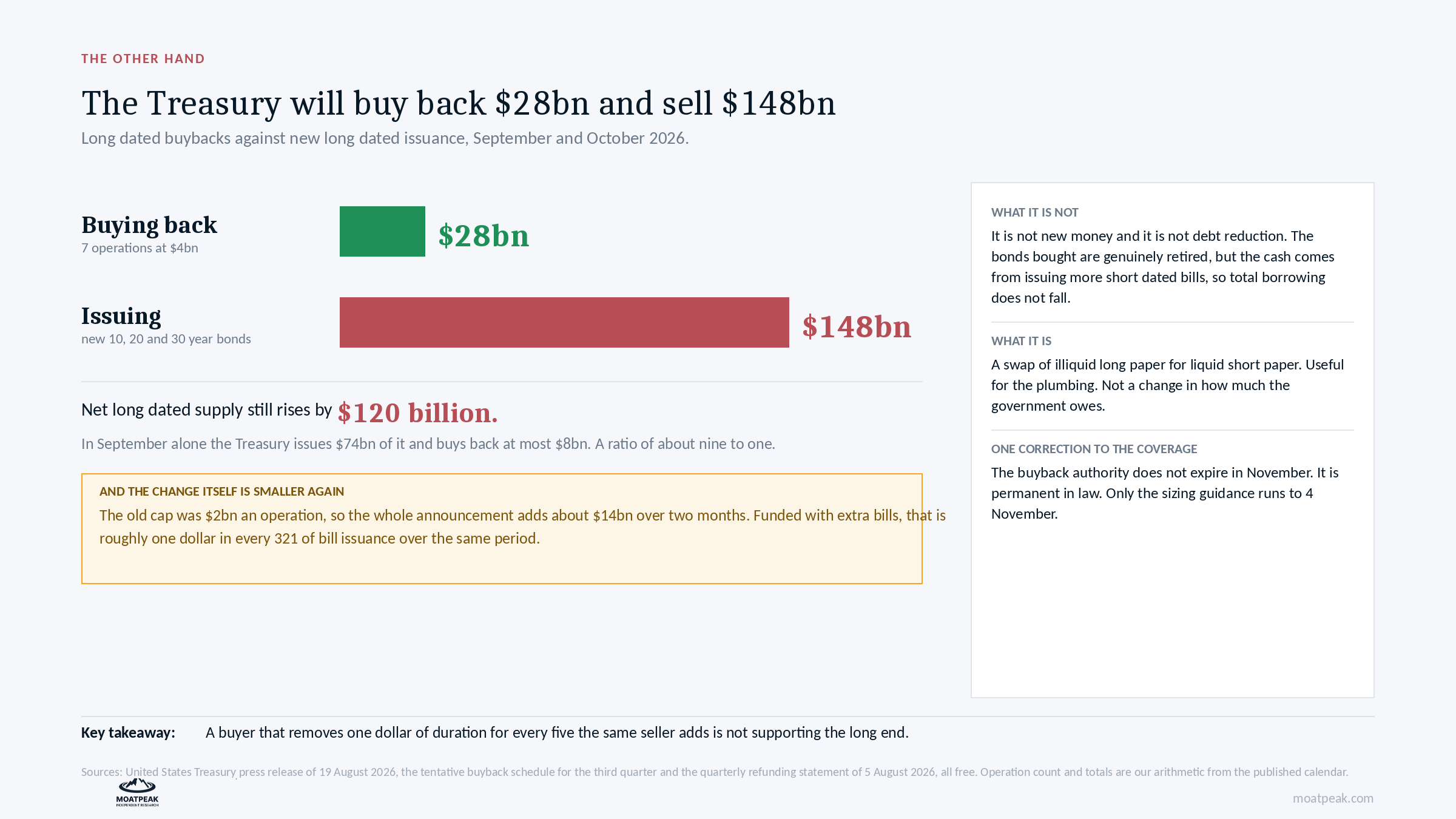
The Treasury publishes a preliminary buyback calendar which includes all the dates and maturity categories. Between 9 September and 4 November, there are seven operations: four with a maturity between ten and twenty years and three with a maturity between twenty and thirty years. Since each of these is at “at least $4 billion”, the total amounts to $28 billion.
Under the previous limit, the total would have amounted to $14 billion. Therefore, the new announcement includes an additional $14 billion.
If you now look at the actions of the Treasury over the same period, it was auctioning approximately $148 billion worth of new ten, twenty, and thirty year bonds in September and October.
In September alone approximately $74 billion will be issued whereas at most $8 billion will be repurchased. That gives a ratio of just over nine to one.
For the two months the total supply of long-term bonds still rises by around $120 billion.
That doesn’t make the buyback pointless since it actually helps the market to function, provides dealers with a means of getting rid of old bonds which are rarely traded, and having a buyer who is not concerned about price can calm a jittery market. The fact is, though, that a scheme which removes one dollar of duration for every five that is added does not set up a real floor.
What it is, mechanically
There are three sentences which deal with most of the usual misunderstandings.
This is not an instance of quantitative easing since no bank reserves are created; the Treasury cannot carry out such a thing, only the central bank can.
It isn’t actually debt reduction, even though it’s more complicated than just stating that ‘no debt is paid off’. The particular bonds that are purchased are genuinely retired when the settlement takes place. Nevertheless, the total amount of debt remains unchanged. The Treasury has indicated to the market that the sizes of the coupon auctions will remain the same for a number of quarters, and any changes in its borrowing requirements will be satisfied by issuing additional short-term bills. That is, it borrows on a short-term basis to retire long-term debt. The impact on maturity is negligible since there will be approximately $14 billion more in bills than the roughly $4.5 trillion from bill auctions in the same quarter; that works out to about one dollar in every 321. 321.
One correction to the coverage
The authority for buybacks doesn’t expire on 4 November; it is permanent and has been given by law. It is only the guidance concerning the scale of the buybacks that is valid until that date. Some reports have confused the schedule with a deadline.
And the part that changes the reading entirely
This will be dealt with in the following article, but the main point is that in 2026 twenty-one of the twenty-two long-term operations reached exactly two billion dollars and hit the cap in almost every case.
All the other maturity groups had a cap of $4 billion, but they did not reach that limit and, on average, filled only about half of it.
The Treasury hasn’t introduced a new tool; rather, it has taken off the limit in the two instances where it was in fact imposing one and left all the other aspects unchanged. Although this might not seem very significant, we think that this is the correct account of what has happened.
What we are watching, with the dates
Whether operations fill at the new cap
From 10 September
If they fill at $4bn immediately, demand was real and constrained. If they do not, the cap was never the binding thing — corporate issuance in the same month.
Through September
Last September saw $226bn of investment-grade supply. That is roughly 28 times the long-end buybacks scheduled for this one.
What would change our mind?
Operations printing well below $ 4 bn. It would mean we have read the fill data wrong, and we will say so
Details about our analysis of the longer end and its implications for positioning are available at moatpeak.com.
Educational research only. Not personalized investment advice. MB “MoatPeak Group”.