


On Monday, Nvidia filed a report saying it will support up to $105 billion in land, power, and residual value at a data center in Pike County, Ohio. Nvidia does not own this center; it was built by a SoftBank subsidiary and is leased to OpenAI.
Most coverage has focused on the headline. The document is free, takes about ten minutes to read, and there are three details in it that change how you should see the arrangement.
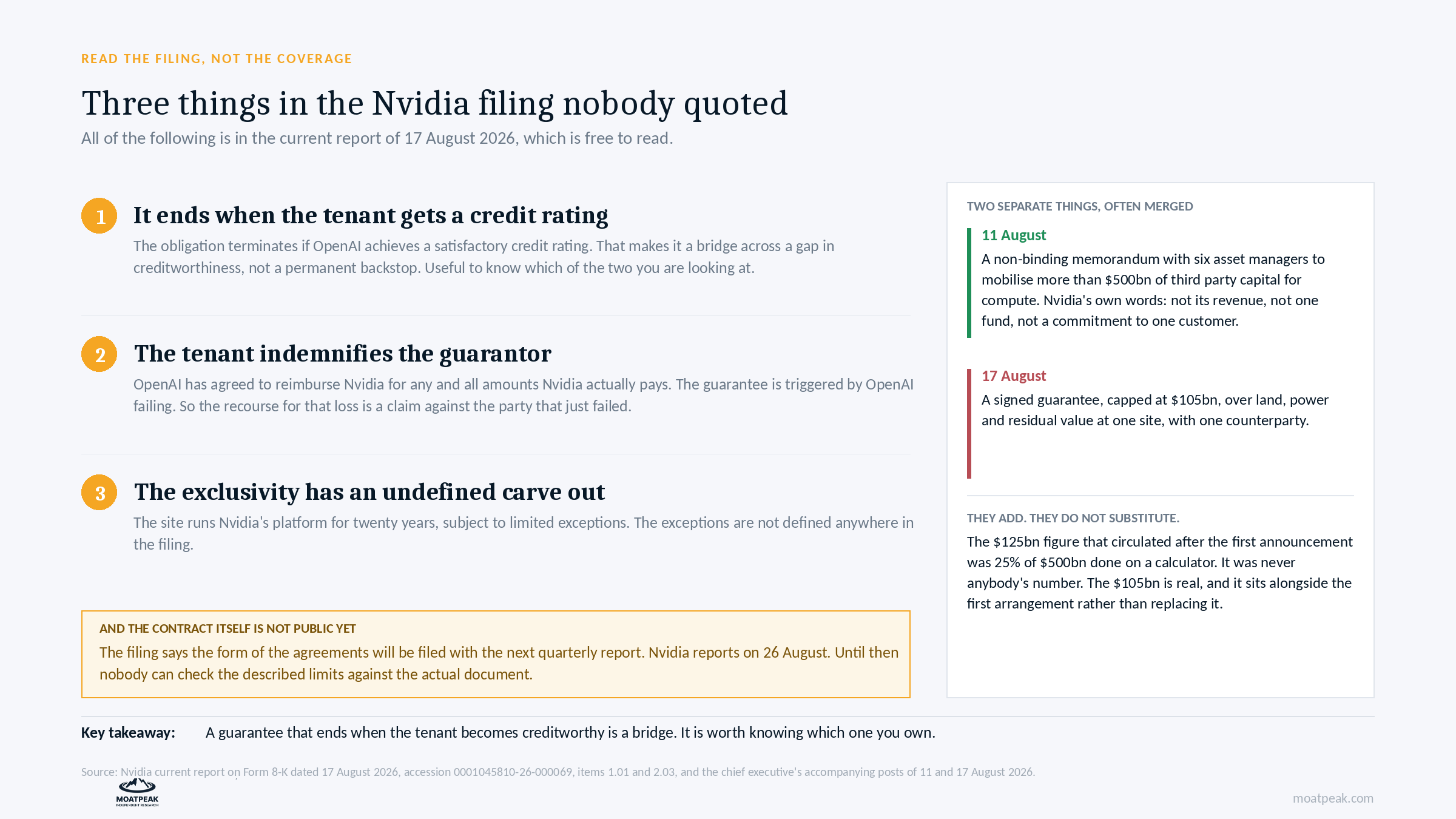
One. It ends when the tenant becomes creditworthy
The obligation terminates if OpenAI achieves a satisfactory credit rating.
That one clause explains what this really is. It’s not a permanent guarantee for a twenty-year asset. Instead, it’s a temporary fix for a gap in creditworthiness, meant to go away once that gap is closed.
This is a more understanding and accurate way to look at it than most coverage suggests. A bridge only fails if the other side never gets built.
Two. The tenant indemnifies the guarantor
The filing says OpenAI has agreed to reimburse Nvidia for any and all amounts actually paid by Nvidia under the agreements.
Consider that alongside what triggers a payment: Nvidia pays if the lease obligations aren’t met. The indemnity is simply a claim against OpenAI.
So, if the guarantee is ever needed, the only way to recover the loss is to make a claim against the party that just failed to pay. This isn’t a criticism of the contract – it’s standard practice. But it shows that the indemnity doesn’t offer as much protection as some might think, and this is clearly stated in the public document.
Three. The exclusivity has an undefined carve-out
The site will use Nvidia’s platform for twenty years, with a few exceptions.
The filing doesn’t define what those exceptions are. Since the deal relies on securing demand for twenty years, it’s important to pay attention to this detail instead of making assumptions.
And the contract is not public yet
The filing says the actual agreements will be shared with the next quarterly report. Nvidia’s report is due on August 26.
Until then, the only description of what the support covers – “defined portions of lease and power payments, along with a specified residual-value commitment” – is in a company blog post. No one outside the companies can compare it to the actual document yet.
We’ll review the document on August 26 and publicly compare it to this analysis.
While we are here, a number we called in August
On August 14, we explained that the “$125 billion Nvidia backstop” mentioned in the press was just 25% of $500 billion calculated on a calculator, and it wasn’t an official figure.
Nvidia’s own blog post of 11 August says it plainly. The $500bn figure “represents aggregate third-party capital that these platforms are designed to mobilize over time” and is “not NVIDIA revenue, a single fund or a commitment to a single customer”.
The company told people not to multiply those numbers, but it happened anyway.
But the truth is less comfortable. These are two separate deals. The August announcement was a set of non-binding agreements with six asset managers about computing. Monday’s filing is a signed guarantee with one party, focused on land, power, and buildings.
They are different types of deals covering different assets, so they add up rather than replace each other. The $125 billion figure was made up, but the $105 billion is real and will be counted along with whatever the compute platforms eventually use.
There is one specific concern we have.
A guaranteed residual value means promising what equipment will be worth in a few years, and that promise is made by the same company that sets the price for the new equipment.
Nvidia decides when its own equipment becomes outdated. Each time it releases a faster generation, it makes its own guarantee more costly to keep.
This isn’t fraud, and no one is saying it is. But it’s a conflict that didn’t exist when Nvidia only sold hardware, and it’s the main thing we’re watching – not the headline numbers.
We’re watching for the contract text on August 26 to see if the described limits match what’s in the actual document.
Our full work on what this structure means for the companies inside it is at moatpeak.com.
Educational research only. Not personalized investment advice. MB “MoatPeak Group”.
Congrats on the sub growth btw!