


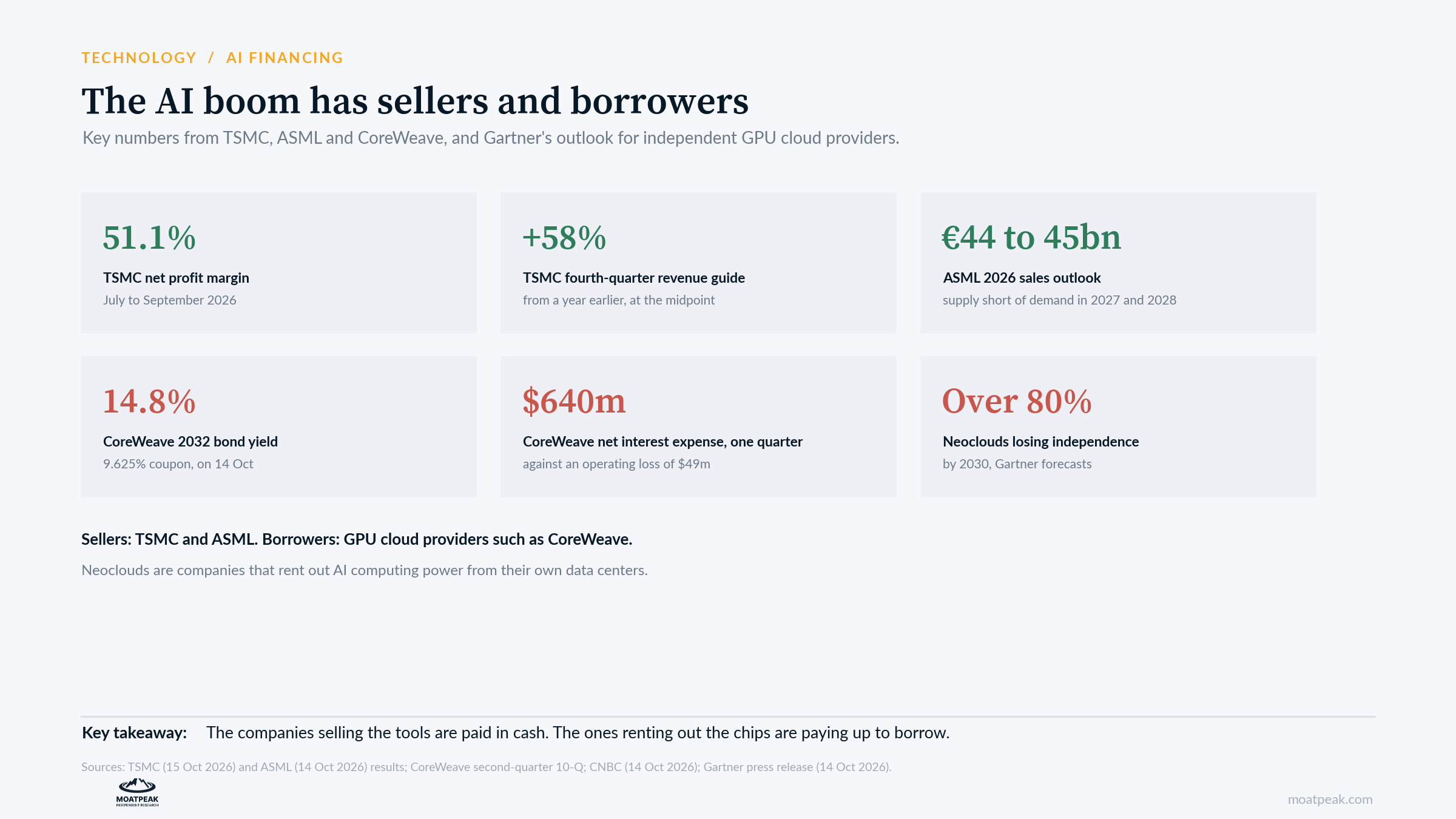
Taiwan Semiconductor Manufacturing, the world’s largest contract chipmaker, said on Thursday that its third-quarter net profit rose 69 percent from a year earlier. Revenue of $46.7 billion beat the top of its own forecast. For the fourth quarter, it expects $52.3 billion to $54.3 billion, about 58 percent more than a year earlier at the midpoint.
A day earlier, ASML, the Dutch company that makes the machines used to print those chips, raised its 2026 sales outlook to €44 billion to €45 billion. It said the supply it has planned for 2027 and 2028 will not fully meet its customers’ demand, and that some customers want to place orders for 2029 and even 2030.
On the same Wednesday, CoreWeave’s shares fell 15.5 percent. CoreWeave rents out AI computing power from its own data centers and borrows heavily to buy the chips. Its 9.625 percent bonds due 2032 traded at a yield of about 14.8 percent, according to CNBC.
Two balance sheets
The difference starts with who pays whom. TSMC and ASML sell to some of the richest companies in the world and are paid as they deliver. TSMC’s net profit margin last quarter was 51.1 percent.
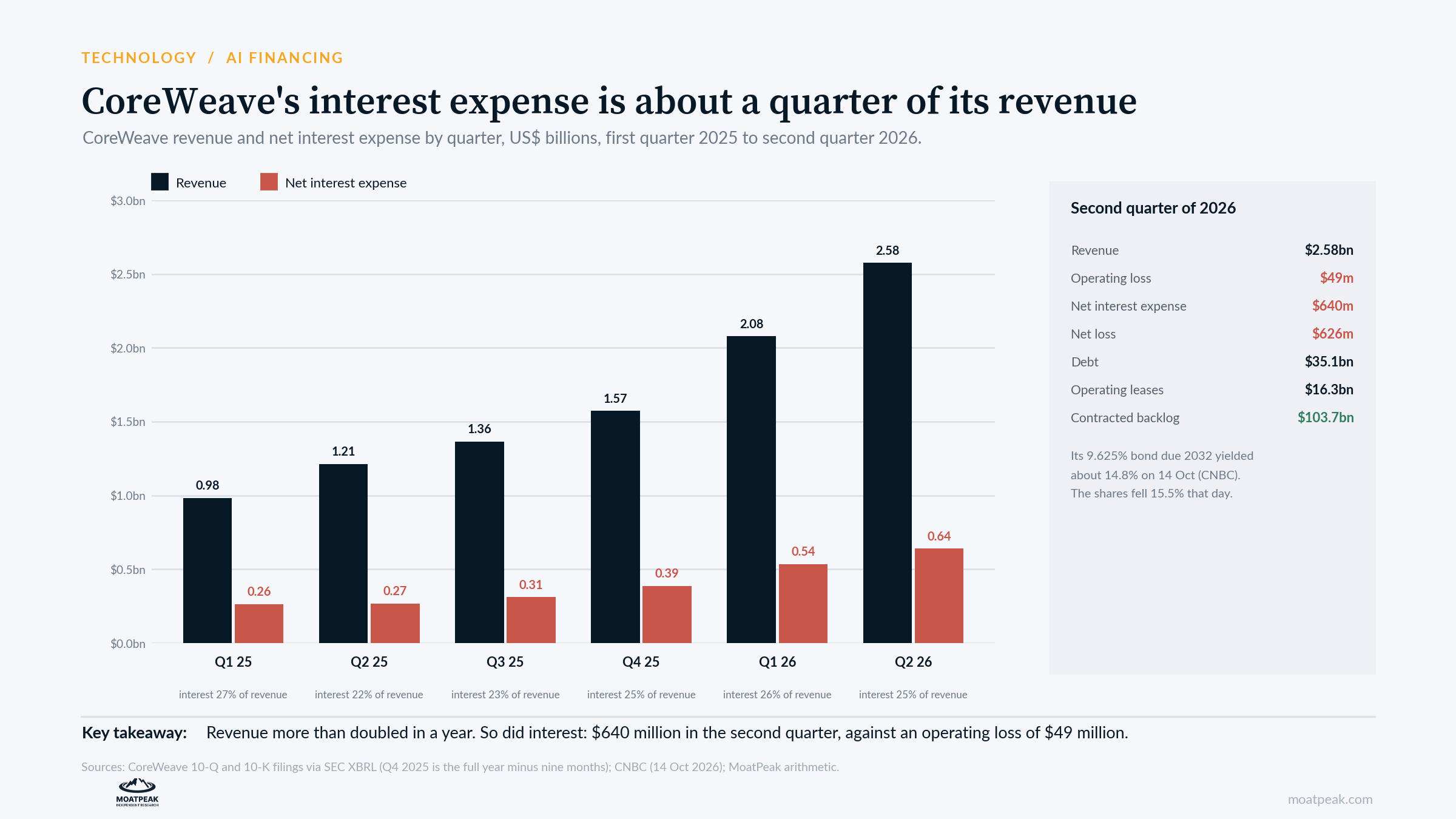
CoreWeave’s numbers look very different. In the second quarter, its revenue more than doubled from a year earlier, to $2.58 billion. But it lost $49 million before interest and had $640 million of net interest expense, and its net loss came to $626 million. Net interest expense has equaled between 22 and 27 percent of revenue in each of the past six quarters. At the end of June, CoreWeave had $35.1 billion of debt and $16.3 billion of operating lease obligations.
Why lenders are nervous
Gartner, the research firm, said on 14 October that AI data center owners would need about $8.5 trillion of revenue through 2030 to cover their planned spending, financing costs and a 12 percent return. It expects AI to bring in no more than $3.6 trillion of revenue that can be attributed to those data centers. It also predicts that by 2030 more than 80 percent of neoclouds, the companies that rent out GPUs, will no longer operate independently.
Higher interest rates make the gap harder to close. The 10-year Treasury yield is near its highest since 2007, and every company that must refinance pays more for it.
The case against us
CoreWeave’s contracted backlog was $103.7 billion at the end of June, about twice its debt and leases combined. Chief executive Michael Intrator told staff in a memo, reported by Bloomberg, that the backlog “more than supports all of our debt obligations.” If its customers keep paying, today’s bond prices may prove too gloomy. TSMC’s guidance also suggests that demand for AI chips is still growing fast. And Gartner’s gap is a forecast that rests on assumptions about prices, usage and costs.
What it means for your money
Look at who carries the debt. In a building boom, the suppliers who are paid as they deliver often fare better than the buyers who borrow to expand.
Treat bond prices as an early warning. A yield near 15 percent says lenders see a real risk of not being paid back in full.
Check what your AI fund owns. Some hold mostly chip makers. Others hold the companies that borrow to buy the chips.
What we are watching
28 October: Microsoft’s results and spending plans, after the US close.
Late October: results from Alphabet, Amazon and Meta, the other big buyers of AI chips and computing power.
The 10-year Treasury yield: the higher it goes, the more it costs to refinance the debt behind the build-out.
Educational research only. Not personalized investment advice. MB “MoatPeak Group”.
The backlog deserves the same scrutiny as the bond price — management was publicly quoting a $104.2B backlog this week while lenders demanded ~16% on the bonds. Those loans are collateralized by the GPUs and the customer contracts themselves — that's how the pile scaled from $8.0B to $35.6B. We pulled the footnotes here: https://thetape2.substack.com/p/the-ai-buildout-in-footnotes