


Third-quarter reporting season is about to get under way, and on paper the prospects look excellent. FactSet expects S&P 500 earnings to grow 29.5 percent from a year earlier, which would make it the third quarter in a row above 25 percent. Analysts raised their estimates during the quarter, which is unusual, and a record 72 companies gave guidance above expectations, including 44 in technology.
So the question for anyone who owns the index is where that growth is coming from.
Where the growth comes from
FactSet estimates the index’s third-quarter earnings at $800.8 billion. An increase of 29.5 percent means about $182 billion more than a year earlier. To find out which companies supply it, we went through FactSet’s sector data and the companies’ own reports.
Micron alone accounts for about 19 percent. Its non-GAAP net income for the quarter it reported on 30 September was $38.4 billion, up from $3.5 billion a year earlier. Nvidia, which reports in November, is expected to add about 16 percent, based on FactSet’s estimate of $2.47 a share against $1.30 a year earlier. Together, two companies supply about a third of the growth of the whole S&P 500.
Look more broadly and growth is still concentrated. FactSet expects semiconductor earnings to rise 130 percent, which on our arithmetic is about 43 percent of the index’s growth. The energy sector, boosted by oil averaging $85.68 a barrel in the quarter against $64.97 a year earlier, is expected to grow 114 percent, another 16 percent of the total. Chips and oil together account for about 60 percent.
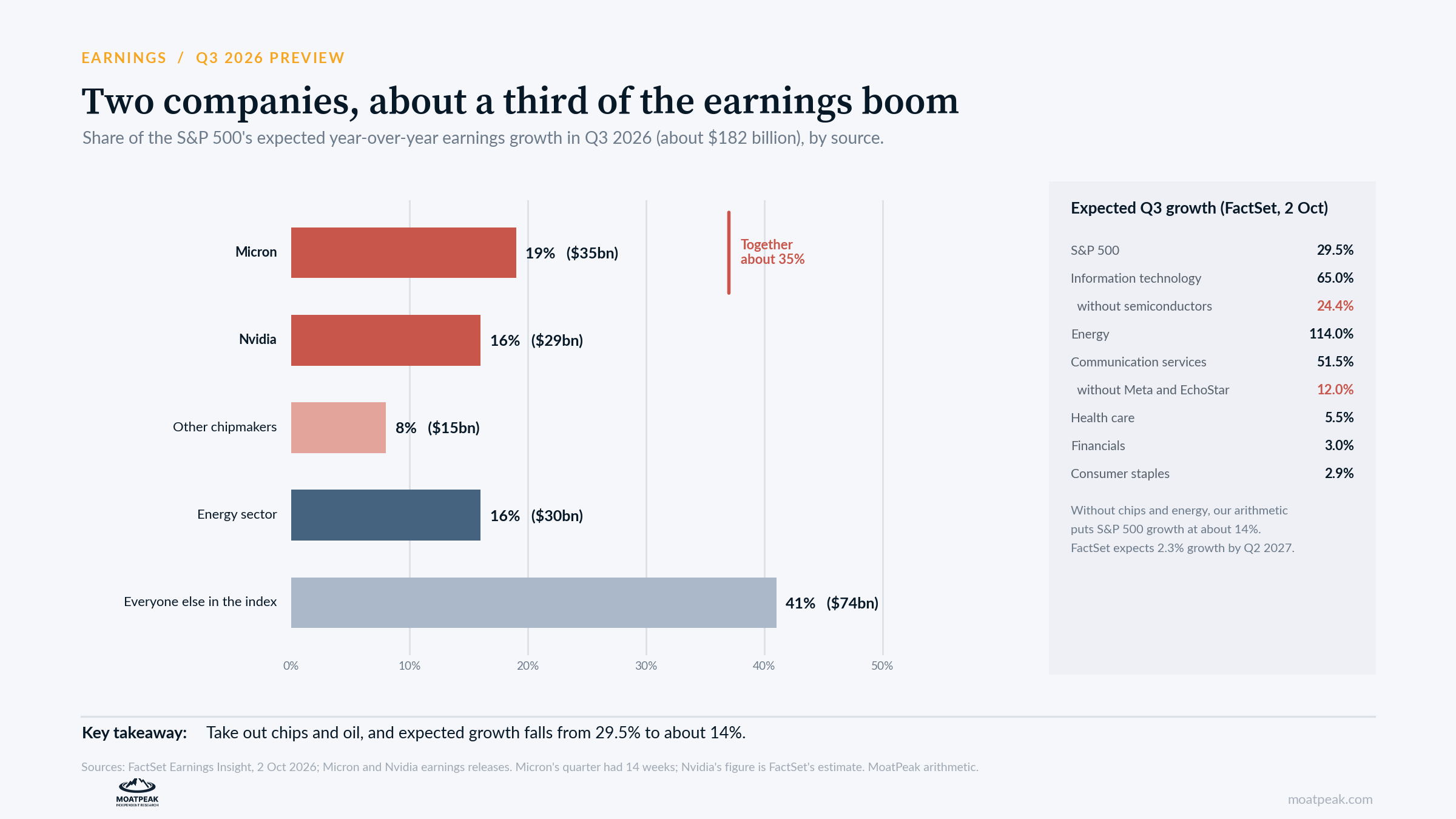
Take chips and oil out, and the rest of the index is still expected to grow about 14 percent. That is respectable, but FactSet’s own breakdown shows how much of the headline depends on a small number of companies. Technology earnings are expected to rise 65.0 percent, but only 24.4 percent without semiconductors. Communication services are expected to grow 51.5 percent, but 12.0 percent without Meta and EchoStar. Financials are expected to grow 3.0 percent, health care 5.5 percent and consumer staples 2.9 percent.
These figures are estimates. Micron’s latest quarter ran 14 weeks rather than 13, which flatters the comparison, and Nvidia’s number stays an estimate until it reports.
The most cyclical product in technology
Micron’s figures are remarkable. Revenue in the quarter was $54.2 billion, compared with $11.3 billion a year earlier. Its non-GAAP gross margin reached 87.0 percent, against 45.7 percent a year ago. For the current quarter, Micron expects revenue of $61.5 billion, plus or minus $1.5 billion, and a margin of about 86 percent.
Memory chips have never been this profitable. Before this cycle, Micron’s highest margin was 61.4 percent, in the quarter to August 2018.
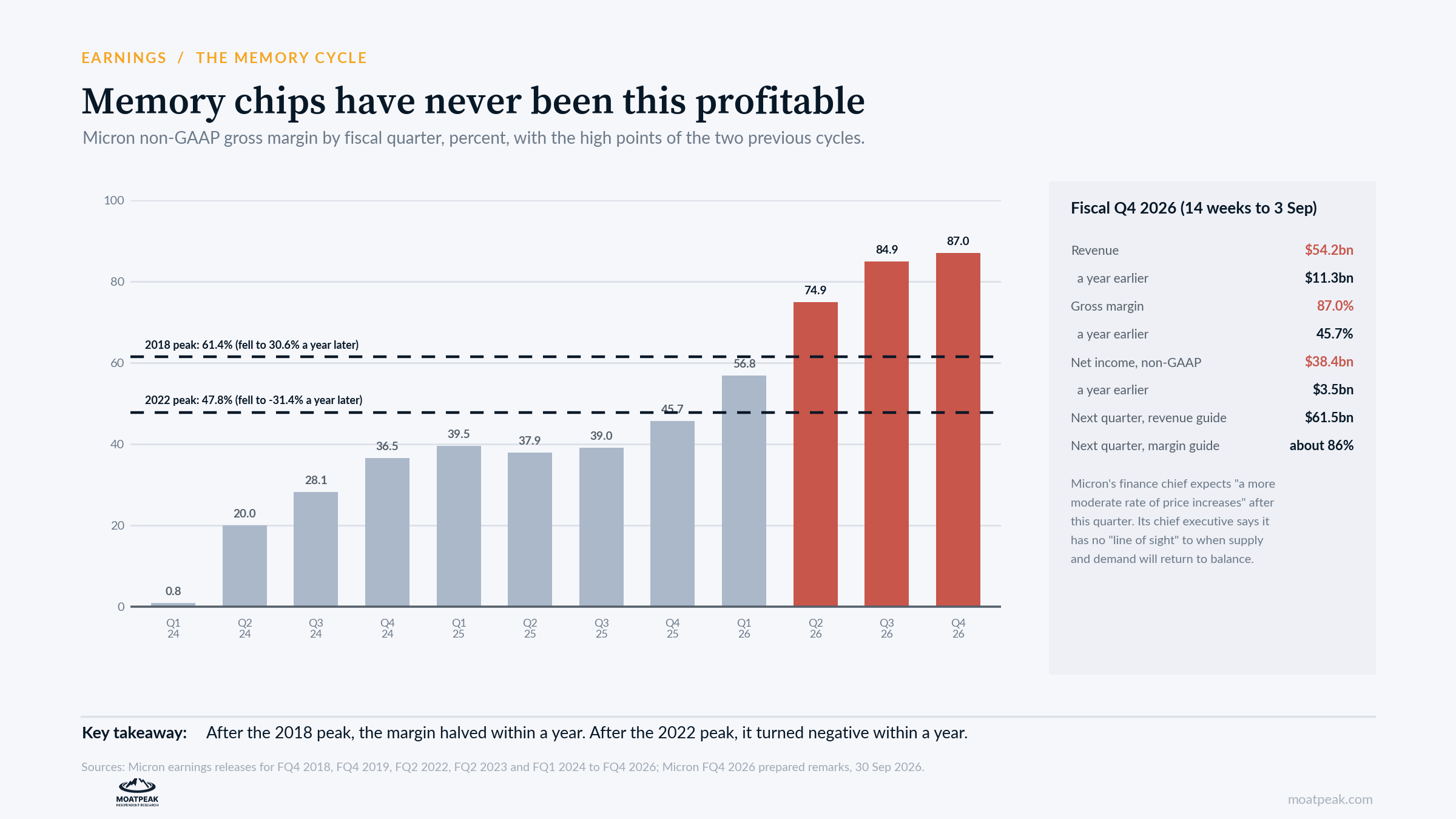
Memory is also the most cyclical corner of technology, because prices follow supply, and supply arrives in waves. After the 2018 peak, Micron’s margin halved to 30.6 percent within a year. After its 2022 peak of 47.8 percent, it fell to negative 31.4 percent a year later.
Micron’s management says this cycle is different in one important way. Chief executive Sanjay Mehrotra said the company does “not have line of sight to when supply and demand will return to balance,” and that he expects conditions to be “much tighter in calendar 2027 and 2028 than they were in 2026.” On the other hand, the finance chief expects “a more moderate rate of price increases” after this quarter, and TrendForce also expects DRAM contract price increases to slow.
Why it matters for the index
The S&P 500 trades at 19.0 times expected earnings for the next 12 months, close to its 10-year average of 19.1, on FactSet’s figures. That looks reasonable. But those earnings include memory margins never seen before, and energy profits that depend on an oil price about a third higher than a year ago.
A simple example: at its 2018 record margin of 61.4 percent, the revenue Micron is guiding to this quarter would produce roughly $15 billion less gross profit, in this quarter alone.
FactSet’s own forward estimates already show the boom fading. Analysts expect earnings growth of 27.6 percent in the fourth quarter, 19.1 percent in the first quarter of 2027, and just 2.3 percent in the second.
The case against us
There are good grounds for optimism. Micron says it has already signed agreements for most of its 2027 supply of high-bandwidth memory, the kind used in AI chips, at significantly higher prices. TrendForce expects that market to stay tight through 2027. Nvidia guides to revenue of about $108 billion for its current quarter. And growth of about 14 percent outside chips and energy is strong by most standards.
If supply stays as tight as Micron expects through 2027, the peak is still ahead, and today’s earnings estimates may turn out to be too low.
What it means for your money
Know what your index fund is betting on. A third of this quarter’s expected profit growth comes from two chip companies, and about 60 percent from chips and oil.
Peak margins are not a run rate. A company earning record margins on a cyclical product deserves a lower valuation than one earning the same amount from a steady business.
Watch prices, not volumes. For memory chips, the signal to look for is slowing contract prices, not falling demand.
What we are watching
From mid-October: third-quarter results from the rest of the index, especially outside technology.
14 October: the September consumer price index.
TrendForce contract price updates: whether DRAM price increases keep slowing.
November: Nvidia’s results and outlook.
Educational research only. Not personalized investment advice. MB “MoatPeak Group”.