


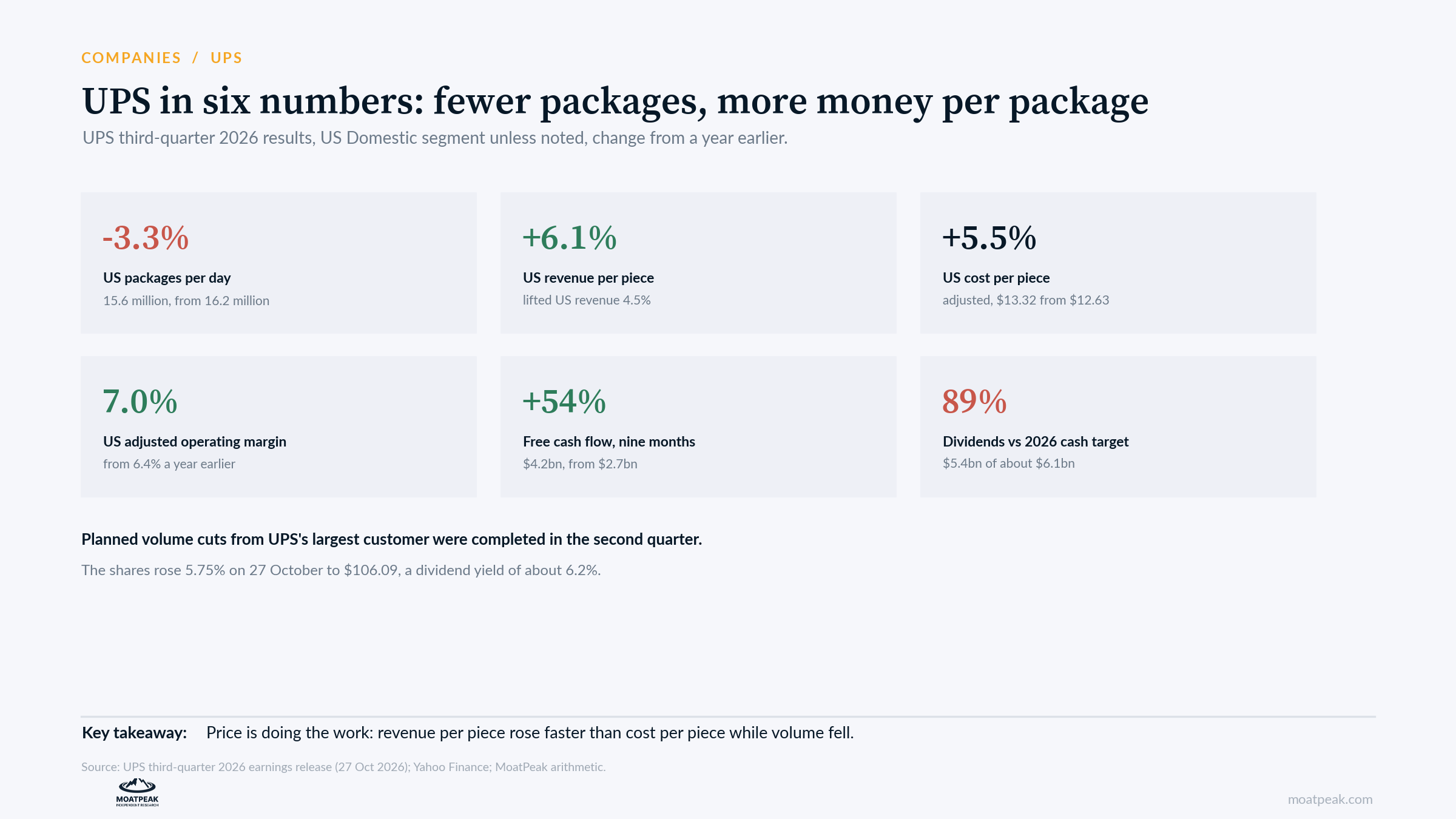
UPS shares rose 5.75 percent on Tuesday after third-quarter results showed something the market had stopped expecting: a smaller business making more money. In the US, the company handled 15.6 million packages a day, 3.3 percent fewer than a year earlier. Revenue per package rose 6.1 percent, so US revenue still grew 4.5 percent.
That is the plan working. UPS has spent two years shedding low-margin volume, much of it from its largest customer, and says it completed those planned reductions in the second quarter. What remains is a network carrying fewer, better-paying packages.
Price did the work
The arithmetic is simple. Adjusted cost per piece in the US rose 5.5 percent, to $13.32, but revenue per piece rose faster, by 6.1 percent. That gap lifted the US adjusted operating margin to 7.0 percent from 6.4 percent.
The rest of the company helped. International revenue rose 7.1 percent with a 14.9 percent margin, and Supply Chain Solutions revenue grew 18.2 percent. For the full year, UPS raised its outlook to about $92.6 billion of revenue and about $8.75 billion of adjusted operating profit.
The cash is catching up
Free cash flow is improving too. In the first nine months, UPS generated $4.2 billion of free cash flow by its own definition, up 54 percent from $2.7 billion. Part of that came from spending less: capital spending fell to $2.2 billion from $3.0 billion, and the full-year budget of about $3.0 billion is the lowest since 2016.
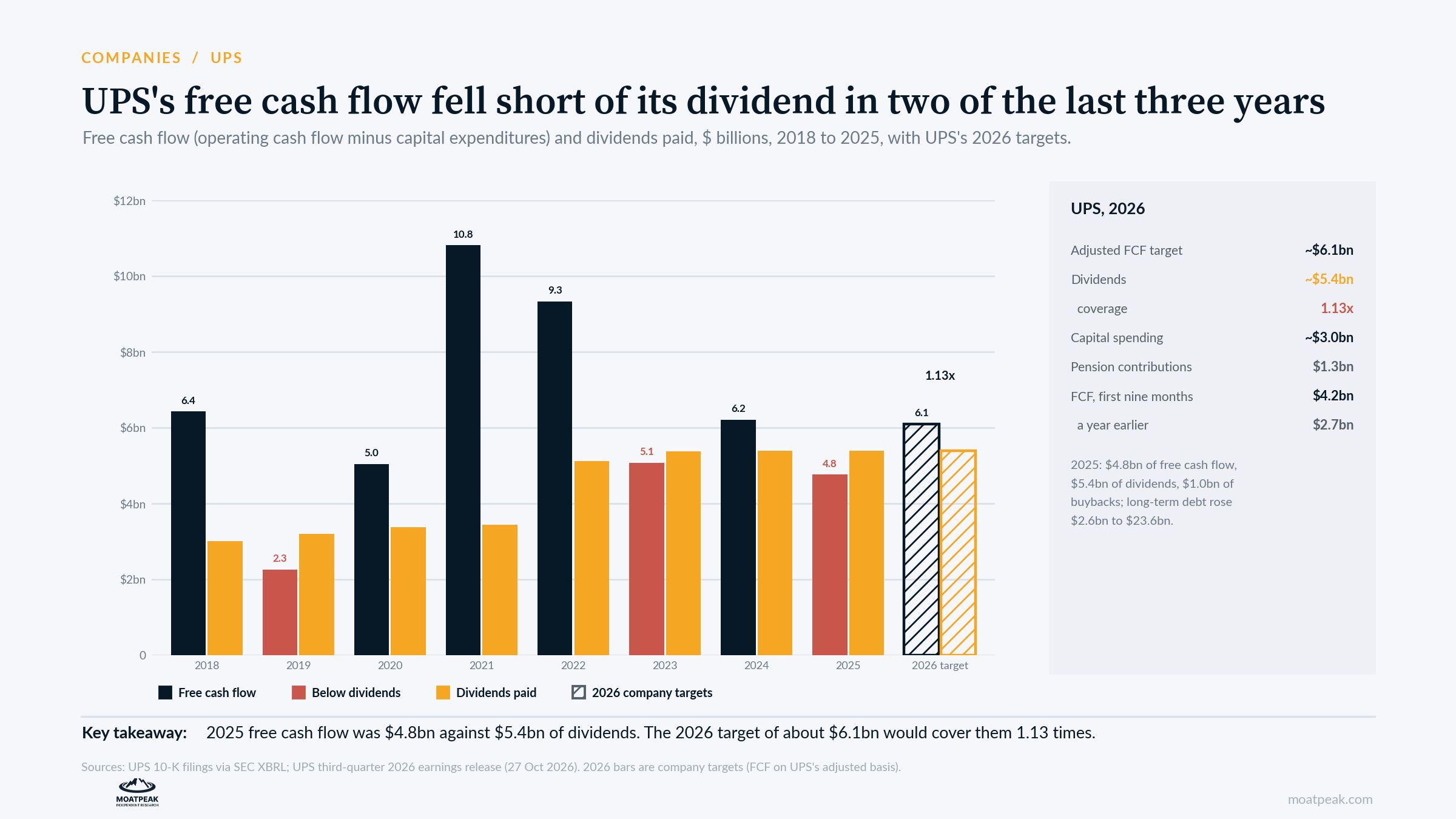
For 2026, UPS now targets about $6.1 billion of adjusted free cash flow. It expects to pay about $5.4 billion in dividends.
The dividend is the weak link
That means the dividend is covered about 1.13 times. In two of the last three years, free cash flow, measured as operating cash flow minus capital spending, fell short of the dividend: $5.1 billion against $5.4 billion in 2023, and $4.8 billion against $5.4 billion in 2025. Last year, UPS also bought back $1.0 billion of stock, and its long-term debt rose $2.6 billion to $23.6 billion.
At Tuesday’s close of $106.09, last year’s dividend of $6.56 a share yields about 6.2 percent. A yield that high is the market’s way of saying it is not sure the payout is safe.
Our read
The bear case on UPS has been that losing volume means losing relevance. This quarter argues otherwise. Pricing power is the real test of a delivery network’s moat, and UPS passed it: it raised revenue per piece faster than costs while shedding volume.
The dividend is where the thesis is still thin. With almost 90 percent of this year’s cash target committed to shareholders, any slip in margins, a costlier pension year or a pickup in capital spending would push the payout back above free cash flow. The next proof point is whether the margin gains hold through the holiday peak, the year’s busiest and most expensive stretch.
The case against us
The cash picture may improve further. UPS has spent $1.4 billion on transformation costs so far this year, and those costs should fade as its restructuring winds down by the end of 2027.
Volume declines may not be over. If customers keep shifting to cheaper carriers or their own networks, price increases alone may not protect revenue.
The 2026 cash target is UPS’s adjusted measure, which can differ from reported free cash flow.
What it means for your money
Read the yield as a risk signal. At about 6.2 percent, the market is pricing in doubt about the payout.
Watch cost per piece. The strategy works only while revenue per piece grows faster than cost per piece.
Follow the cash, not just the margin. Coverage of 1.13 times leaves little room for a weak quarter.
What we are watching
Thursday 29 October: Amazon’s third-quarter results. Amazon has long been UPS’s largest customer.
UPS’s fourth quarter: guidance calls for about $25.7 billion of revenue and $3.3 billion of adjusted operating profit.
Educational research only. Not personalized investment advice. MB “MoatPeak Group”.