


Last week, Treasury Secretary Scott Bessent told Newsmax that he and the president are working on a “fiscal consolidation plan,” and that they will unveil it “right after the midterm.” Fiscal consolidation is the technical term for spending less, taxing more, or both, so the government borrows less.
For bond investors, the timing matters. The midterm elections are on Tuesday, 3 November. The next day, the Treasury will announce how it plans to borrow over the coming months, including the size of its auctions of long-term bonds. Some investors hope the two events will line up: a deficit plan first, then fewer 30-year bonds for sale, which would push long-term yields down and bond prices up.
We think that hope mixes up two different things. Here is why, and what history says.
A deficit plan is not a bond plan
The deficit is the gap between what the government spends and what it collects in a year. The debt is the sum of all past deficits.
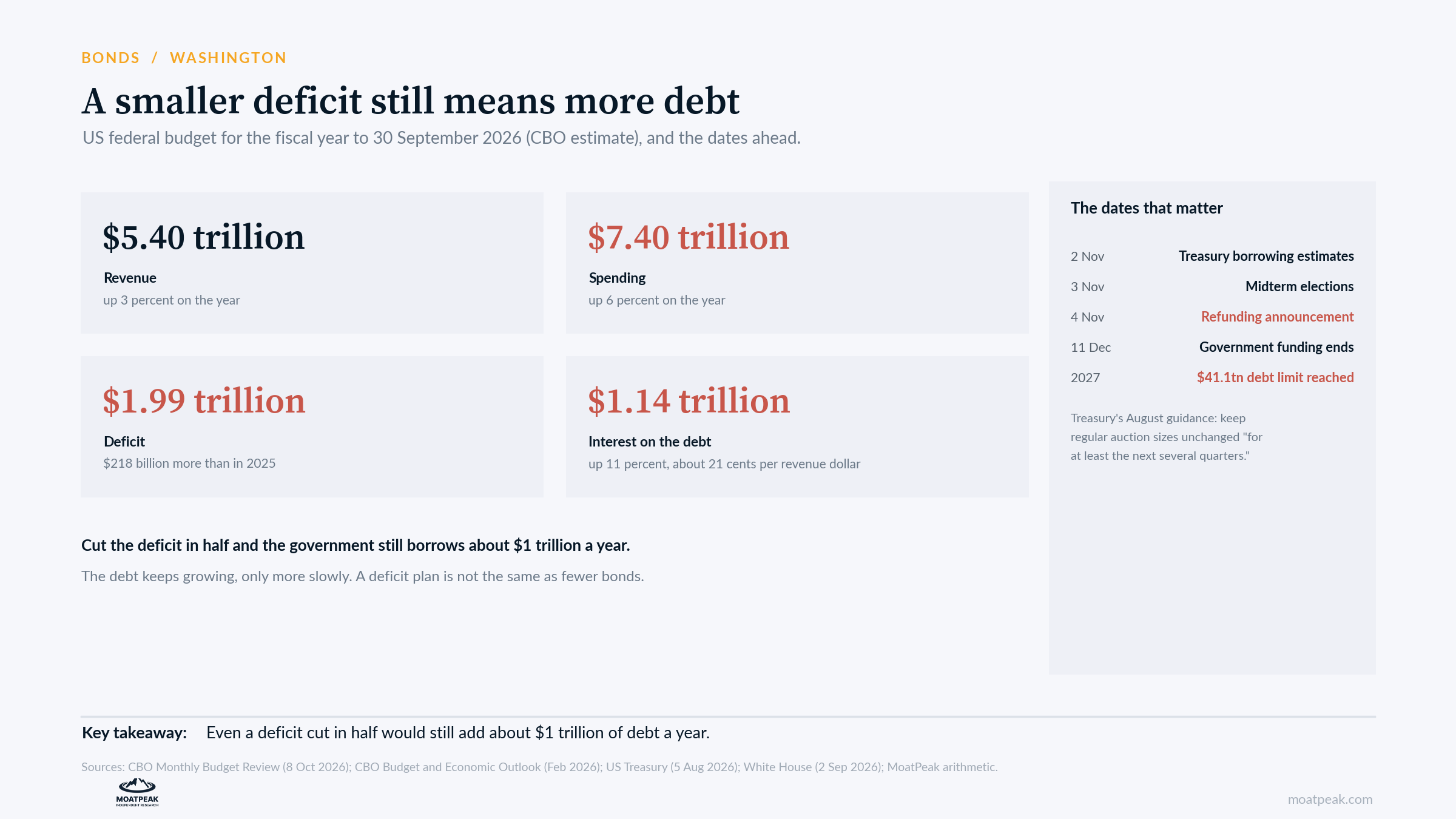
On 8 October, the Congressional Budget Office (CBO) estimated the deficit for the fiscal year that ended on 30 September at $2.0 trillion. That is $218 billion more than the year before. Revenue rose 3 percent, but spending rose 6 percent. Interest on the debt alone cost $1.14 trillion, up 11 percent. That is about 21 cents of every dollar the government collected.
Now imagine a very ambitious plan that cuts the deficit in half. The government would still borrow about $1 trillion a year, and the debt would keep growing, only more slowly. So even a good deficit plan does not mean the Treasury stops selling bonds. It means it sells fewer than it otherwise would.
The one time Washington stopped selling 30-year bonds
It has happened before. On 31 October 2001, the Treasury announced it was suspending the 30-year bond. The government had just run budget surpluses, and officials said they did not need 30-year money to meet current financing needs.
Bond traders reacted fast. The 30-year yield fell from 5.22 percent on 30 October to 4.89 percent on 31 October, and to 4.79 percent the next day. That is a drop of 0.43 percentage points in two days, a huge move for a government bond.
It did not last. By 15 November, the yield was back at 5.22 percent. By 14 December, it was 5.59 percent, well above where it started. A Treasury advisory committee later summed it up: the yield fell almost 0.40 points almost immediately, “but the move was subsequently reversed.”
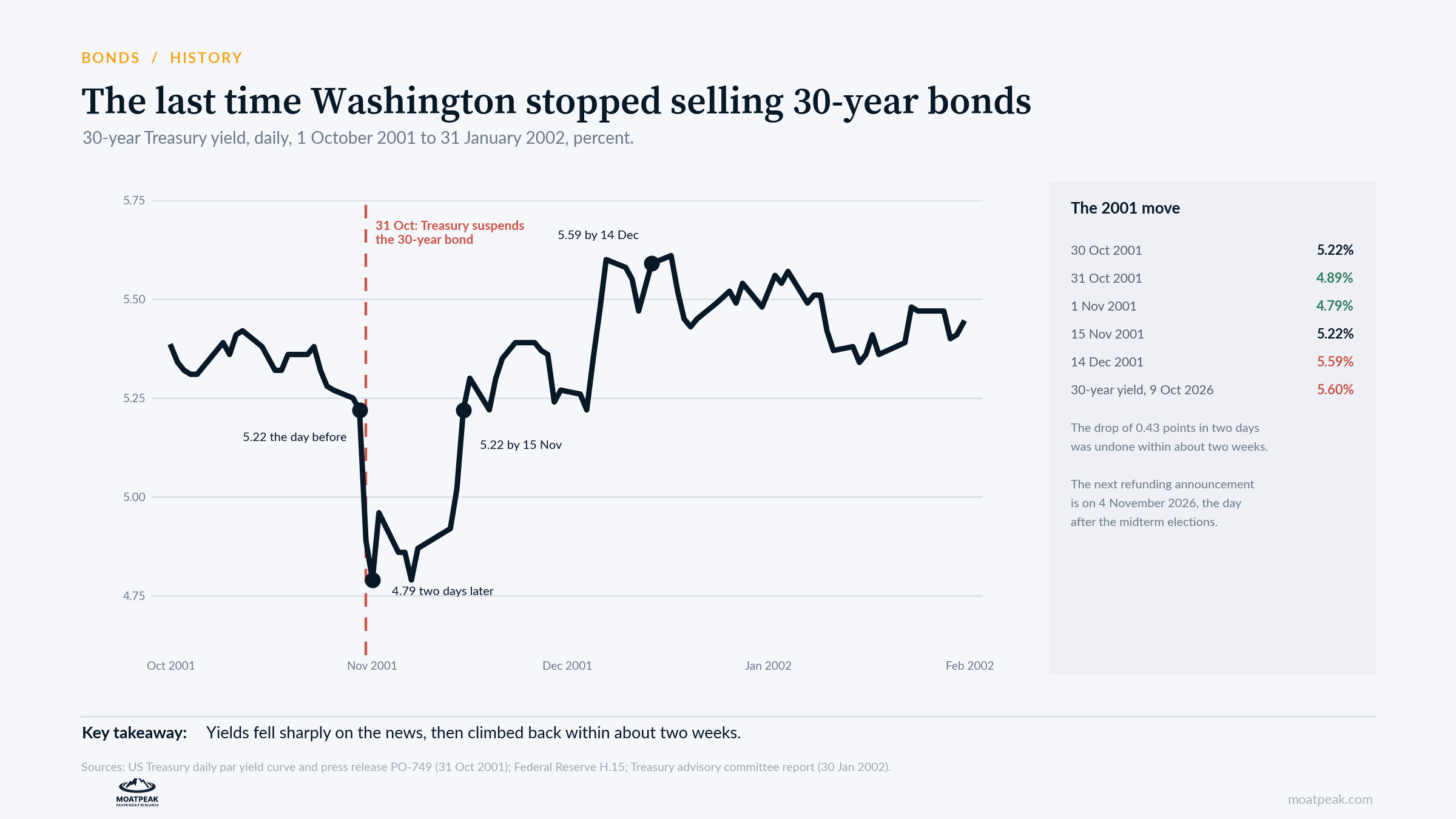
The lesson is simple. A surprise cut in supply can move long bonds for days or weeks. After that, the bigger forces take over again: inflation, growth and how much the government needs to borrow in total.
Today the Treasury’s advisers point the other way
In August, the Treasury said it expects to keep the size of its regular note and bond auctions unchanged “for at least the next several quarters.” It also at least doubled the size of its buybacks of older long-term bonds, to at least $4 billion per operation. Those buybacks help, but they are small next to the $25 billion of new 30-year bonds sold at the August auction.
The bigger issue is the math ahead. At the Treasury’s advisory meeting in August, officials said the median forecast of the primary dealers, the large dealers expected to bid at every Treasury auction, implied a $1.45 trillion funding shortfall over fiscal 2027 and 2028 at current auction sizes. The dealers expect auction sizes to rise sometime in 2027. In other words, the base case is more long-term bonds, not fewer.
Swapping bonds for bills does not shrink the debt
Suppose the Treasury cut long-term bonds anyway. It would still need the same amount of money, so it would sell more short-term bills instead. The debt does not shrink. It comes due sooner and has to be refinanced more often.
The Government Accountability Office (GAO) flagged this trade-off in a report this spring. Bills are usually cheaper to issue, it said, but the Treasury must refinance them at whatever rates apply at the time, “leading to more variable interest costs.” By its count, about a third of the debt was due within a year as of September 2025, up from about a quarter in 2014.
The case against us
A credible deficit plan could still help long bonds. If investors came to believe the government will borrow much less over the next decade, they might accept lower yields even with no change in auction sizes. And a surprise on 4 November could move prices for a while, just as it did in 2001.
What it means for your money
Do not buy long bonds only on the hope of a supply cut. In 2001 the rally lasted about two weeks.
Look for numbers, not promises. A plan with dollar amounts of savings matters more than the word “consolidation.”
Know the trade. The 30-year Treasury yields 5.60 percent. That income is real, but long bonds swing a lot. As a rough rule, a fund with an average duration of about 16 years loses about 16 percent of its value if long yields rise by one percentage point.
Bills still pay. Short-term Treasury bills yield more than 4 percent, with little price risk, while Washington decides.
What we are watching
2 November: the Treasury’s borrowing estimates.
4 November: the refunding announcement, with auction sizes and any change in guidance.
11 December: the date government funding runs out unless Congress acts.
2027: the year the $41.1 trillion debt limit is likely to be reached, according to the CBO.
Educational research only. Not personalized investment advice. MB “MoatPeak Group”.