


Although US economic activity reached its peak level in 52 months, the stock market did not go up. The market is not moving away from growth but is rather adjusting to the higher inflation and the greater financing costs required to maintain it.
The fact that last week demonstrated that favorable economic figures can still be bad news, even when the long-term real interest rates remain unchanged.
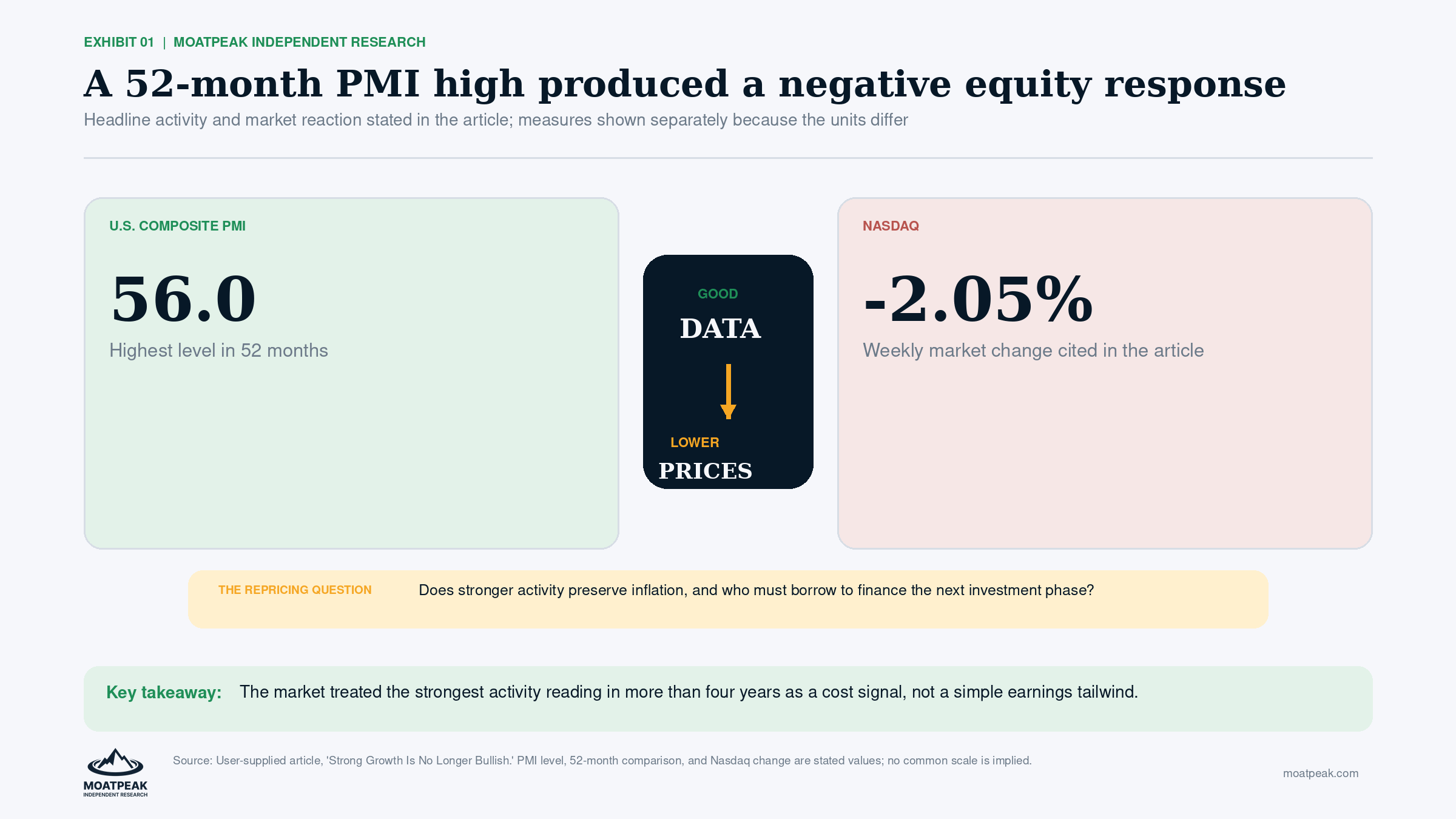
The U.S. Composite PMI reached 56.0, the highest figure it had been since over four years earlier. Yet all of the major U.S. stock indexes fell, the Nasdaq declining by 2.05 percent. The drop was not due to slowing growth but rather to the costs associated with growth.
Now investors are taking each positive data point and turning it into two questions: does it serve to keep inflation high? and who will have to borrow in order to finance the next phase of investment? The first of these questions applies to the energy sector; the second applies to AI.
We do not consider the latest increase in Treasury yields to have represented a permanent change in real interest rates. During that week, inflation expectations for the five-year term rose by 10 basis points, although the 30-year real yield remained unchanged. The main cause of this was higher energy prices, together with investors pulling out of overpopulated trades. Underlying all of this, however, there is a more significant change taking place: AI companies are now financing their infrastructure through borrowed funds rather than drawing on their own cash.
It by no means signifies that the demand for AI is disappearing; it only means that the problems facing the sector will be different.
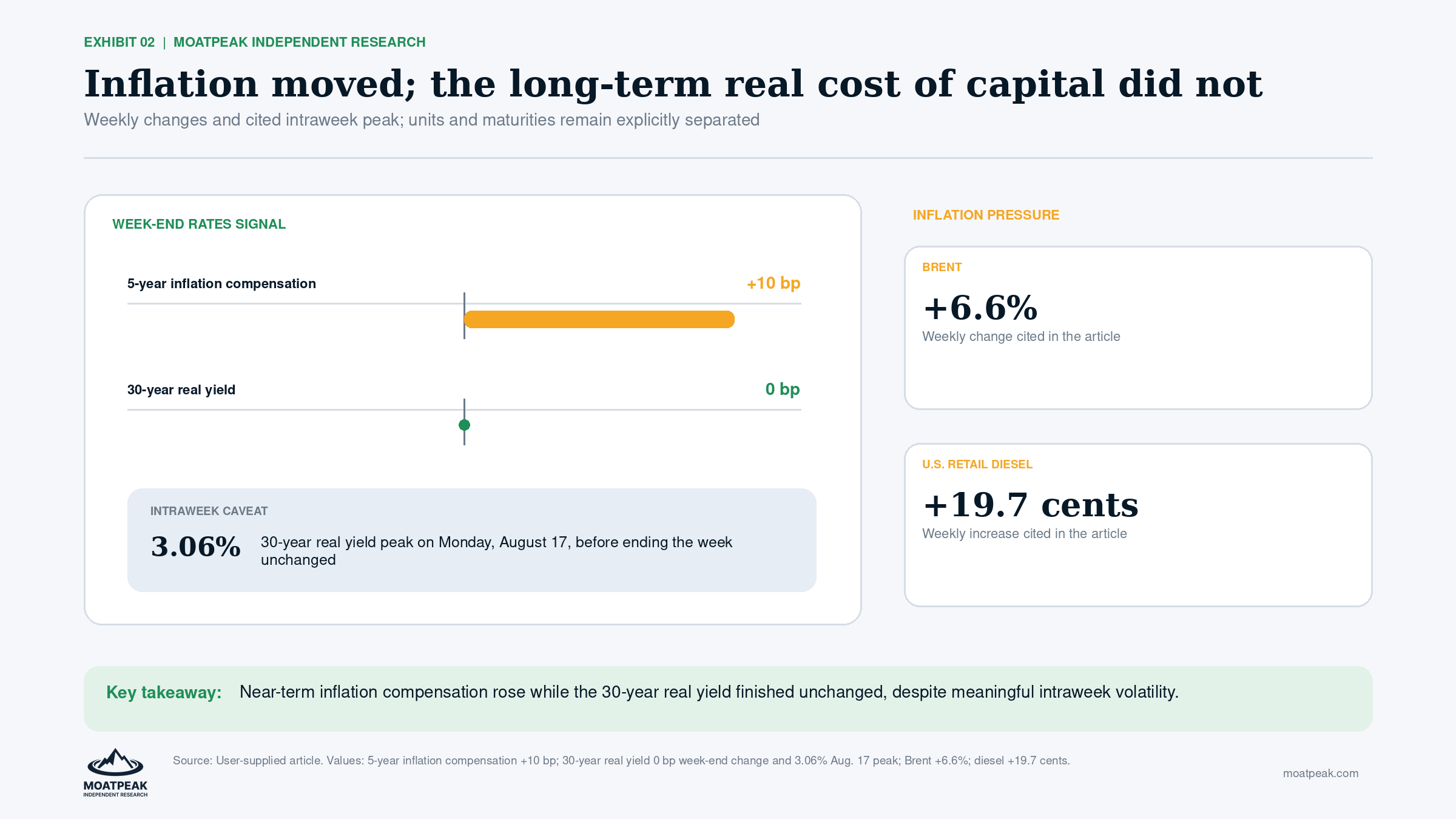
The latest change in the rates was due to inflation, not because of the length of time that money is invested.
Nominal yields consist of two components: the real yield, which represents the cost of waiting, and a payment for inflation, which covers the expected decrease in buying power. Although this distinction may appear to be technical, it is important when the two parts change for different reasons.
Last week, the five-year inflation compensation increased by 10 basis points, the 30-year real yield ended the week unchanged, Brent went up by 6.6 percent, and U.S. retail diesel rose by 19.7 cents. By the end of the week the market was demanding a higher price for near-term inflation risk but had not assigned a permanently higher real price to capital.
The situation was far from smooth. On Monday, August 17, the 30-year real yield reached 3.06%, whereupon it exerted pressure on stock prices before dropping again. Although Treasury buybacks helped to improve liquidity for longer-term bonds and provided a certain amount of short-term relief, they are unable to address budget deficits, inflation uncertainty, or the continuing requirement for capital.
It is important to realize that a sharp fall in valuations resulting from short-term inflation is quite different from a gradual increase in real interest rates. The two should not be confused. Yet inflation should not be ignored because it can cause central banks to remain cautious, reduce the amount that households are able to afford, and make it more difficult for investments to be profitable, even if long-term real rates remain low.
Why momentum cracked while speculative innovation rallied
The stocks performed contrary to expectations. Although steady long-term real yields usually help companies that depend on future earnings, this time, technology stocks fell by 3.53%, and Utilities declined by 3.48%.
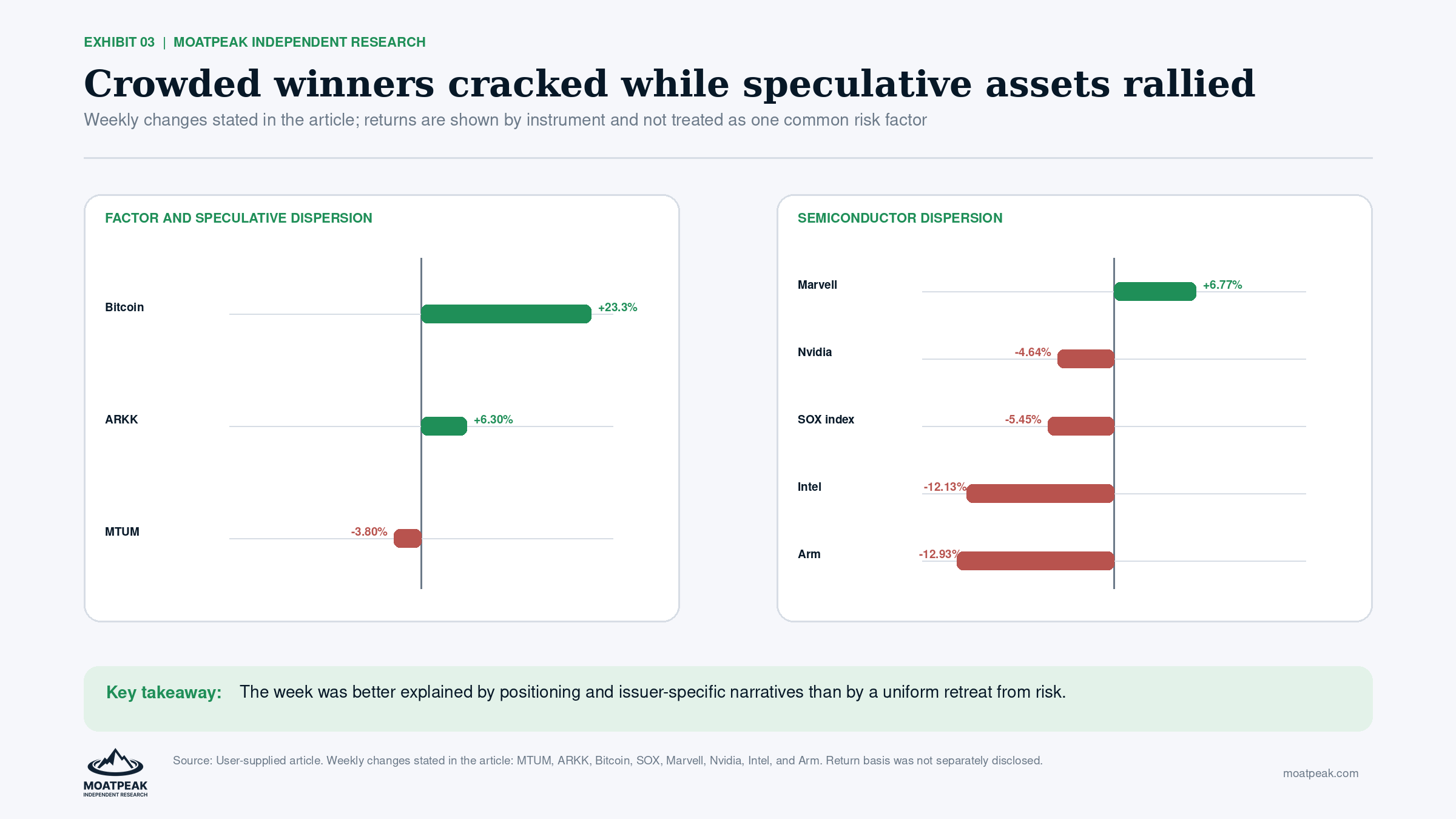
A more appropriate example can be found within the market. The MTUM Momentum ETF dropped by 3.80%, the ARKK Innovation Fund increased by 6.30%, and Bitcoin surged by 23.3%. We believe that investors were disposing of the popular winning stocks rather than spreading their avoidance of risk across all areas. The rise in the most speculative assets was most likely due to short covering.
The semiconductor stocks also displayed the same kind of division. The SOX index fell by 5.45%, yet the gap between the best and worst performers was almost 20 percentage points. Marvell increased by 6.77% because of its own strengths, whereas Arm and Intel declined by 12.93% and 12.13%, respectively. Nvidia had dropped 4.64% prior to the release of its earnings report.
The market wasn’t just choosing to take on more or less risk; rather, the company’s narrative, its financial condition, the way it was valued and its position before the earnings announcement carried more weight than the general index. Therefore, the large fall in the headline index did not give the full picture when compared with the differences between the individual stocks.
Credit could turn out to be the new barrier to the growth of AI.
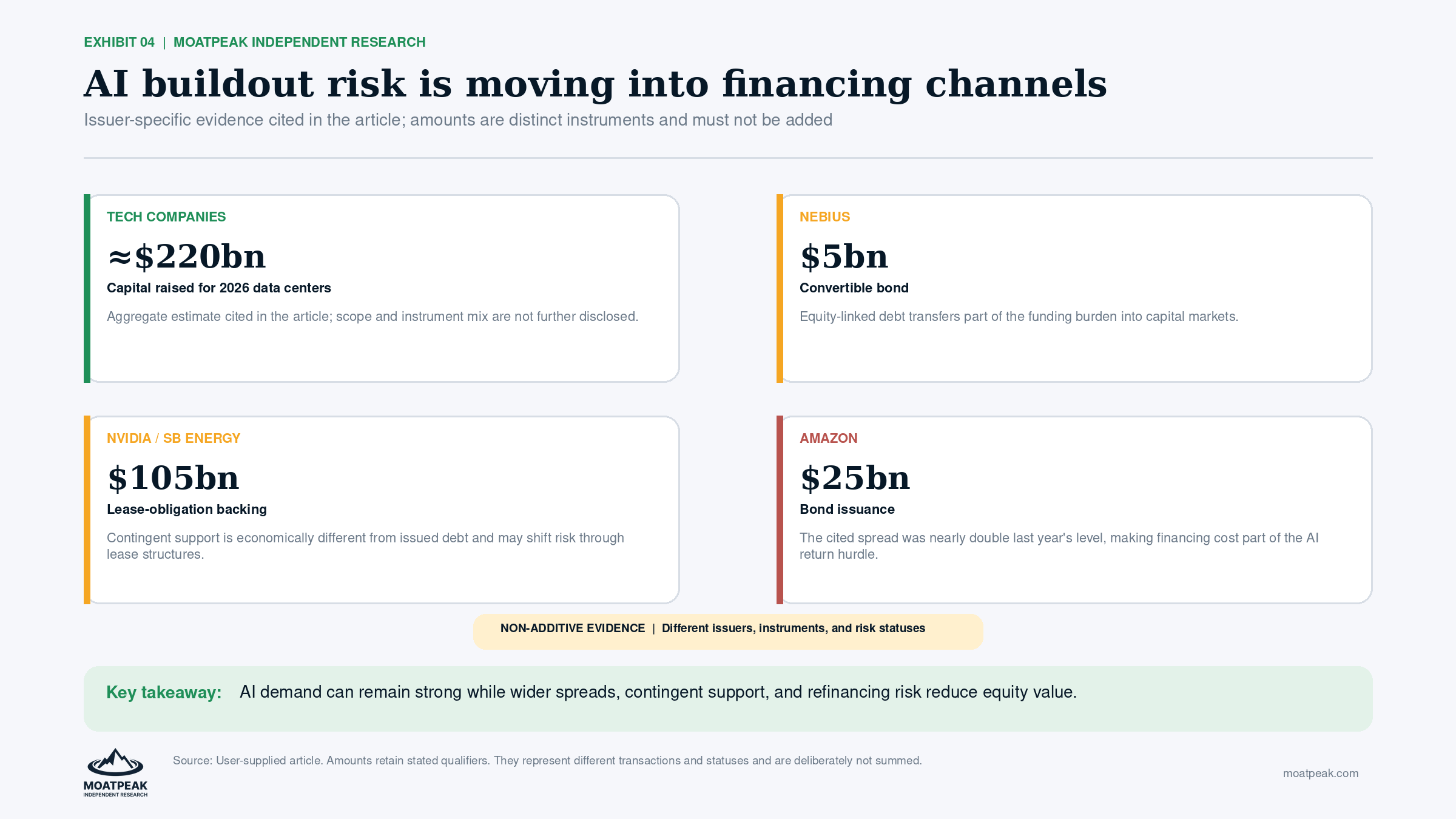
The most significant change could be taking place outside the stock market. Tech companies have raised around $220 billion for data centers that are planned for 2026. Nebius has issued a $5 billion convertible bond. Nvidia has provided backing for $105 billion in lease obligations for SB Energy. The spread on Amazon’s $25 billion bond was nearly double what it was last year.
Instead of using their own cash, companies are now obtaining money by borrowing from the credit markets. For many years, investors were unsure whether spending on AI would generate sufficient revenue. At this stage, the issue is who will assume the risks involved in borrowing, using leverage, and refinancing in order to set up this infrastructure.
We don’t see this as proof that the AI buildout is coming to an end since demand can still be strong even if financing conditions worsen. The difference lies in the fact that cheap credit has now become another assumption incorporated into the AI thesis.
AI infrastructure is now having to compete with the government for long-term financing, which can result in wider spreads and lower valuations even if demand remains strong. The important issue is not merely the amount of growth in computing and data centers, but whether each new project is able to cover its cost of capital.
For investors, it is important to tell the difference between companies that can pay for investments themselves and those that need to keep borrowing; between those who own key assets and those who borrow to use them; and between steady cash flows and riskier bets. The next downturn in AI may show up in credit markets before it affects revenue.
Retail exhibited a less substantial instance of the same trend.
The figures from the retail sector presented a similar analytical issue in a more limited form: the overall figures appeared stronger than the underlying economic data. Each of the seven major retailers examined reported results that included one-time IEEPA tariff refunds.
Walmart received $2.9 billion and used the money to reduce its prices; its adjusted operating income increased by 28.8%, although the growth would have been 17.4% if the refund had not been included. Target performed even better, with store traffic rising by 3.6% and earnings per share increasing by 20% without the refund. The situation with TJX was more complicated since Marmaxx sales only increased by 1%, rather than the 2.7% that had been expected.
People are still spending, but the strength is focused on certain areas. The mass-market and discount types of retail are faring better than those in the big-ticket and confidence-dependent sectors. Moreover, within the world of discount retail, the category is not a single entity.
The lesson involves more than just retail. In fact, temporary benefits, simpler financing, or short-term assistance can make the results appear better without, in fact, improving the business. Investors should ignore the headlines and concentrate on the quality of cash flow.
A better dashboard for the next phase
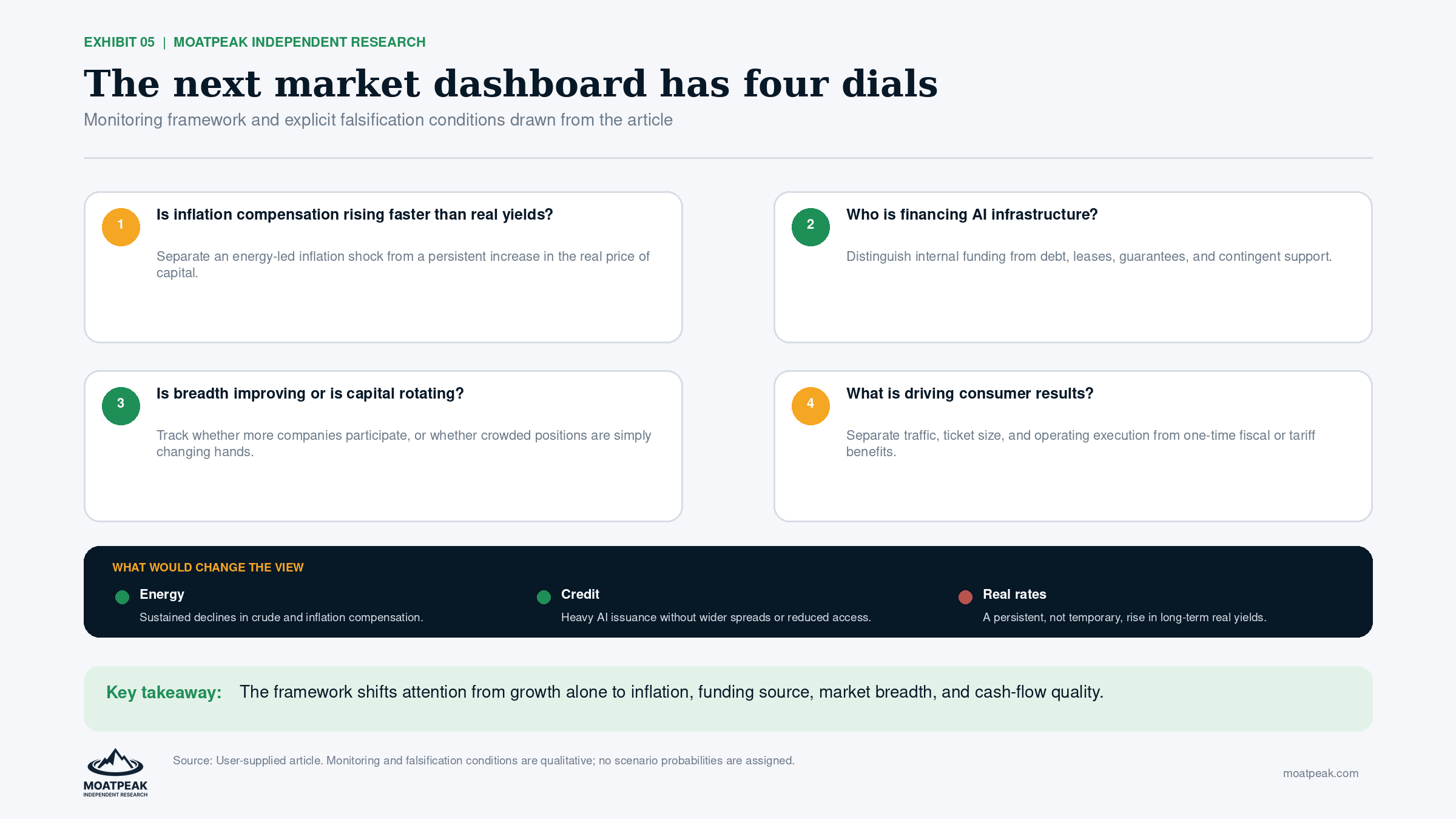
In the old days, people mostly wanted to know whether growth was accelerating and whether the Federal Reserve was easing its policy. That is no longer sufficient. We think the following four questions are now more important:
Is the rate at which inflation compensation is increasing exceeding that of real yields?
What AI investments are based on debt or on contingent support and which of them are financed internally?
Whether or not the market breadth is actually improving, or whether capital is merely rotating among a small number of sectors?
Are the results obtained by consumers due to traffic, the size of the tickets, or to temporary fiscal advantages?
What would change our mind
A long-term decline in crude oil prices and in the amount of inflation compensation would undermine the energy aspect of this argument. If substantial issuance of AI debt continues without there being wider spreads or a reduction in market access, the financing risk would still seem to be under control.
The other risk is just as significant. If long-term real yields rise continuously rather than just temporarily, the market would be experiencing a structural real-rate shock, not merely a temporary inflation spike. In that case, the valuation pressure would be wider and more long-lasting than our present understanding.
The market is not at this moment rejecting growth; rather, it is now wondering who is going to finance it. This is a more difficult question, but also one that is of greater significance. Since it is becoming more difficult to obtain capital, a company’s financial strength and cash flow may be just as important as its growth story.
MoatPeak conclusion: The market is not turning away from growth, but is questioning who will pay for it. The next big issue for AI may show up in credit markets before it affects revenue.
MoatPeak Team