


July’s inflation numbers came in lower than expected, and the market reacted positively. But three other factors moved in the opposite direction, all suggesting the good news was about the past, while the challenges lie ahead.
First, the drop was in petrol prices, but those have already gone back up.
A 2.9% drop in gasoline prices helped bring down July’s inflation number. This was the most encouraging detail in the report.
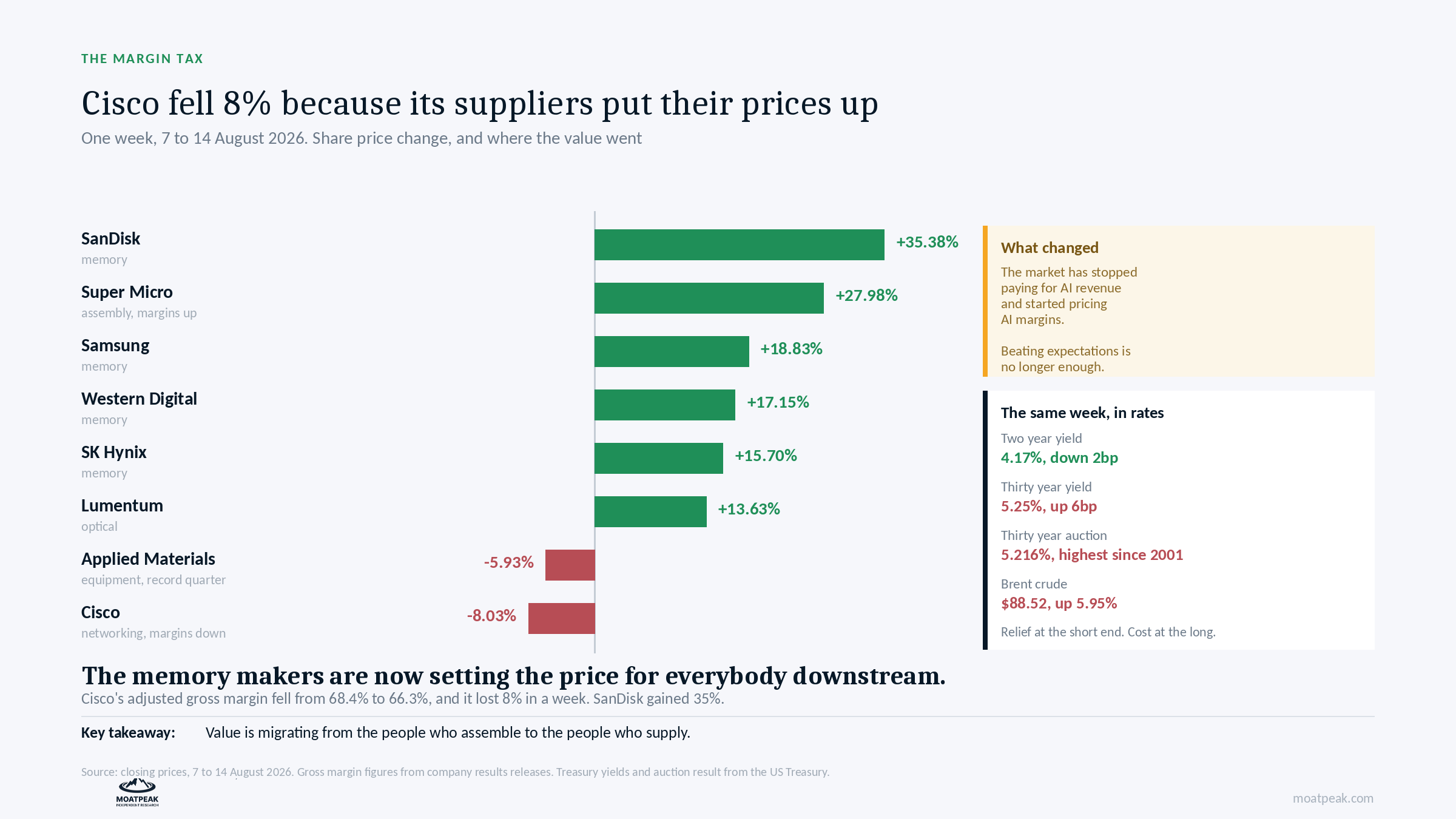
But in the week after the data period ended, Brent crude oil jumped 5.95% to $88.52 because of new tensions near the Strait of Hormuz.
So the lower inflation everyone cheered was for a month that’s already behind us, and the key input cost has already risen again. If Brent stays at this level, it will push up inflation in September and October instead of helping.
This isn’t a prediction – it’s just pointing out which months these numbers actually reflect.
Second, short-term rates eased, but long-term rates rose.
Over the same week:
The two-year Treasury yield dropped by 2 basis points to 4.17%. Meanwhile, the thirty-year yield rose 6 basis points to 5.25%. The latest thirty-year auction cleared at 5.216%, the highest since 2001.
The yield curve steepened after the soft inflation report, which is the opposite of what you’d expect if prices were the main story.
This isn’t just happening in the US. German ten-year yields went up from 3.13% to 3.20%, and UK ten-year yields rose from 4.93% to 5.05% in the same period. When long-term yields rise in three countries despite lower inflation at home, the cause must be global.
What does it mean for you as an investor? The discount rate applied to anything with a value ten years out has gone up, not down. That is a headwind for long-duration growth assets, for property, and for utilities, regardless of what the Federal Reserve does in September.
Third, in the AI sector, the market shifted what it values.
This is the part that will matter most, and it happened in a single week of price changes.
Suppliers saw big gains: SanDisk rose 35.4%, Super Micro 28.0%, Samsung 18.8%, Western Digital 17.2%, SK Hynix 15.7%, and Lumentum 13.6%.
Assemblers, meanwhile, fell: Applied Materials fell 5.9% and Cisco 8.0%.
Cisco’s revenue held up, but its adjusted gross margin dropped from 68.4% to 66.3%. The company blamed higher memory costs and the lower margins of large AI cluster projects.
Applied Materials had a record quarter but still fell nearly 6%, partly due to a $253 million export compliance charge and ongoing exposure to China, which now accounts for 28% of its revenue.
Taken together, these changes show a shift. For two years, investors in AI focused on revenue growth. Last week, they started rewarding profit margins instead, moving value from assemblers to suppliers.
We call this the margin tax. Memory suppliers are now setting the terms for everyone further down the supply chain, and you can see the impact clearly in company results.
There is a valid exception: Lumentum rose 13.6% despite reporting a $7.2 billion GAAP loss. That loss was a non-cash charge from retiring convertible debt, and the company’s core business was strong. So the market isn’t just reacting to headlines. It’s looking past accounting noise and focusing on real profit trends, which is more nuanced than it seems.
Now to the consumer, a part of the story many prefer to ignore.
Retail sales fell 0.6%, contrary to expectations. The control group also fell by about half a percent. Consumer sentiment fell to 51.0 from 55.2, with declines across all groups. Existing home sales slipped 1.7% as the ten-year yield hit 4.68%.
On the other hand, initial jobless claims were 209,000, showing the labor market is still holding up.
This creates an uneasy mix of weak demand but few layoffs. In this situation, the idea that ‘bad news is good news’ no longer works, because if demand drops too much, lower earnings will hurt more than any help from a Federal Reserve pause.
We’re keeping an eye on the following three points:
First, if the thirty-year yield goes above 5.35%, that would signal a real shift in the cost of long-term borrowing, not just a temporary move.
Second, whether Nvidia confirms the ‘memory tax’ on August 26. Cisco blamed memory costs for its margin drop, and Nvidia is the biggest buyer of those components. If Nvidia faces the same issue, it points to a wider supply chain problem, not just a Cisco issue.
Third, whether Walmart’s results confirm the retail control group data. A 0.4% drop could be just noise or the beginning of a trend, and Walmart, the largest retailer, reports on the 20th.
What would prove us wrong? Brent fell below $83.55 and the thirty-year yield dropped under 5.19%. Both are clear and easy to check.
You can find our full scenario framework, probability weights, and detailed supply chain analysis at moatpeak.com.
Educational research only. Not personalized investment advice. MB “MoatPeak Group”.