


This year the story about financial data has been simple: AI will do the analyst’s job, so the companies that sell analysts their screens and their data are in trouble. By the close on 25 September, FactSet was down 5.9 percent for the year, Moody’s 8.3 percent and MSCI 3.9 percent. Ten-year Treasury yields went above 5 percent in September, which weighs on these stocks too, so AI isn’t the only reason.
On 10 September OpenAI launched ChatGPT for Financial Services, a product built for bankers and research analysts. Look past the headline, though, and there’s a detail that doesn’t fit the story. OpenAI says it is building shared sign-in with S&P Capital IQ, LSEG, MSCI, Dow Jones Factiva and Moody’s, so its users can reach data they already pay those firms for.
In other words, the AI will log in through the data owners. The product also hosts licensed data from Daloopa, PitchBook, LSEG News and Crunchbase, which makes it a bundler of data as well as a door to it.
That doesn’t make every data vendor safe. It changes the question. AI will be used in finance; that part is settled. What isn’t settled is which layer of the data business AI can go around, and which layer it has to pay for.
The draft is getting cheap. The proof is not.
Stanford’s AI Index tracks how fast the price of AI is falling. For a model performing at the level of GPT-3.5, the price per million tokens dropped from $20 in November 2022 to 7 cents in October 2024. That’s more than 280 times cheaper in under two years.
That is the drafting layer: summarizing filings, pulling out numbers, writing the first version of a note. It is turning into a commodity.
Checking is a different job. Before a fund can act on an answer, it needs data somebody is allowed to use, cleaned and verified. The owners of that data are spelling out that AI use falls under their licenses. This year Cboe told its data customers that putting its data into AI products may need additional licenses, and that any AI output which can substitute for its data needs a license of its own. Nasdaq’s AI policy says much the same in its own words: AI use sits inside the license, and the customer has to buy it.
There’s also an early warning on quality. A working paper posted last December, not yet peer-reviewed, used the 2023 launch of FactSet’s AI platform as a natural experiment. Analysts who adopted it wrote richer reports, drew on 40 percent more sources and worked faster. Yet their forecast errors rose by 59 percent. The authors put the extra errors down to the cost of digesting more information, not to speed. It’s one unrefereed study, but it’s a warning that more data and a faster draft don’t by themselves make a better answer.
Four layers, and the question that matters
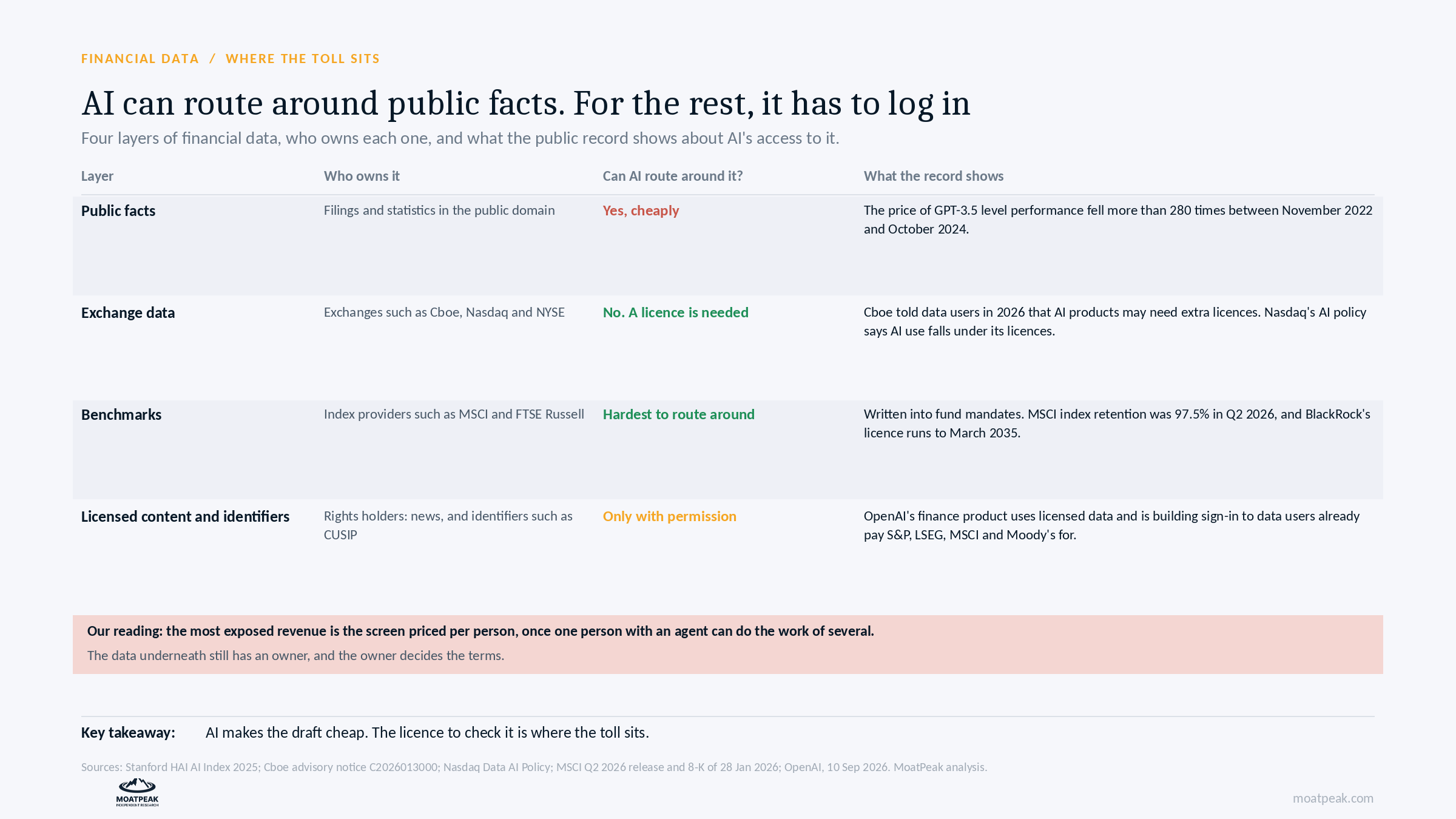
We split financial data into four layers and asked one question of each: can AI go around it?
Public facts. Filings, statistics, anything already in the public domain. Yes, and cheaply. A business that mainly repackages public filings is now competing with a model that costs pennies.
Exchange data. Prices and trades, owned by the exchanges. No. The license is the product, and the exchanges have said in writing that the license covers AI.
Benchmarks. The indexes written into fund mandates and prospectuses. This is the hardest layer to go around. A fund can’t swap its benchmark just because a cheaper AI tool exists. Changing one takes lawyers, trustees and a letter to every client.
Licensed content and identifiers. News, and the codes that identify securities. Only with permission, and permission is exactly what OpenAI is negotiating.
Once you have the layers, the rest follows. Value moves toward whoever controls the license. The revenue most exposed is the kind priced per person, once one person with an agent can do the work of several.
Three companies in three different positions
FactSet sells the screen and the data behind it. So far its numbers are better than the story about it. Organic subscription value grew 7.1 percent in the year to May, driven mainly by data solutions and workstations. Its user count rose about 12 percent, mostly wealth managers. Client retention slipped to 90 percent from 91, while retention measured by subscription value stayed above 95 percent. FactSet also runs CUSIP Global Services, the securities identifier business, which sits in the layer our map puts behind a license.
More people are using FactSet, not fewer. What matters next is the price of each seat when one analyst with an agent does more, and how much of FactSet’s revenue still moves with the number of seats. The company says that share is smaller than it used to be. Its results on 30 September and its investor day on 10 November are where it has to show it.
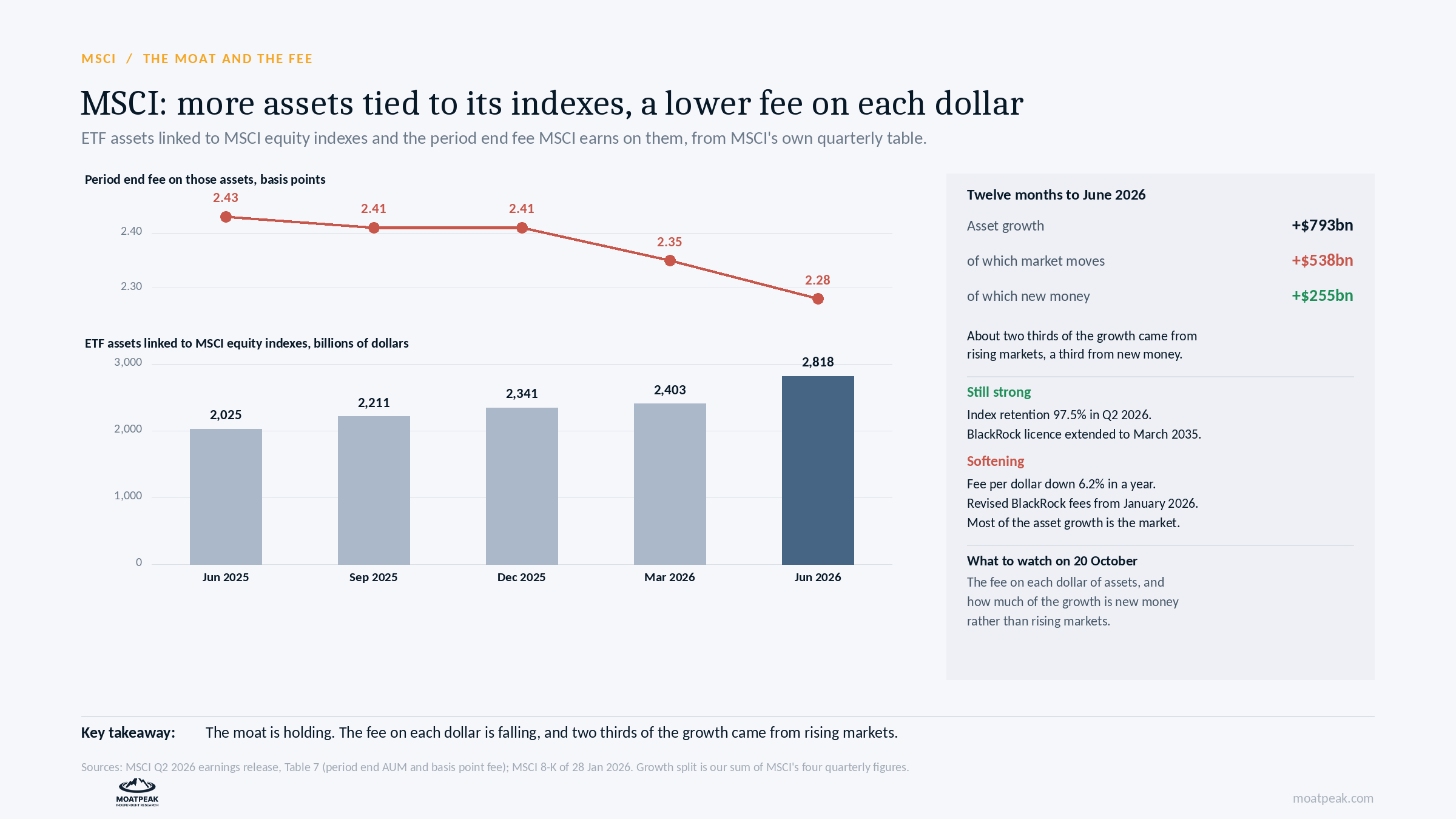
MSCI owns the layer AI finds hardest to touch, and its numbers show it. Index retention was 97.5 percent in the second quarter. BlackRock extended its ETF license to March 2035.
Look one line lower and the picture changes. The fee MSCI earns on each dollar of ETF assets tied to its indexes fell from 2.43 basis points (hundredths of a percentage point) to 2.28 in the year to June, a drop of 6.2 percent. MSCI says the BlackRock amendment revises fees for some funds from January 2026, with more changes in January 2027, trading price for volume; the fee schedule itself is redacted in the filing. Asset-based fees still rose 26.6 percent in the second quarter. And of the $793bn those ETF assets grew by over the twelve months, $538bn came from markets rising and $255bn from new money, on our sum of MSCI’s own quarterly table.
What a moat like this is worth is the valuation question the report answers. The inputs are public: the fee trend, and how much of the growth came from markets.
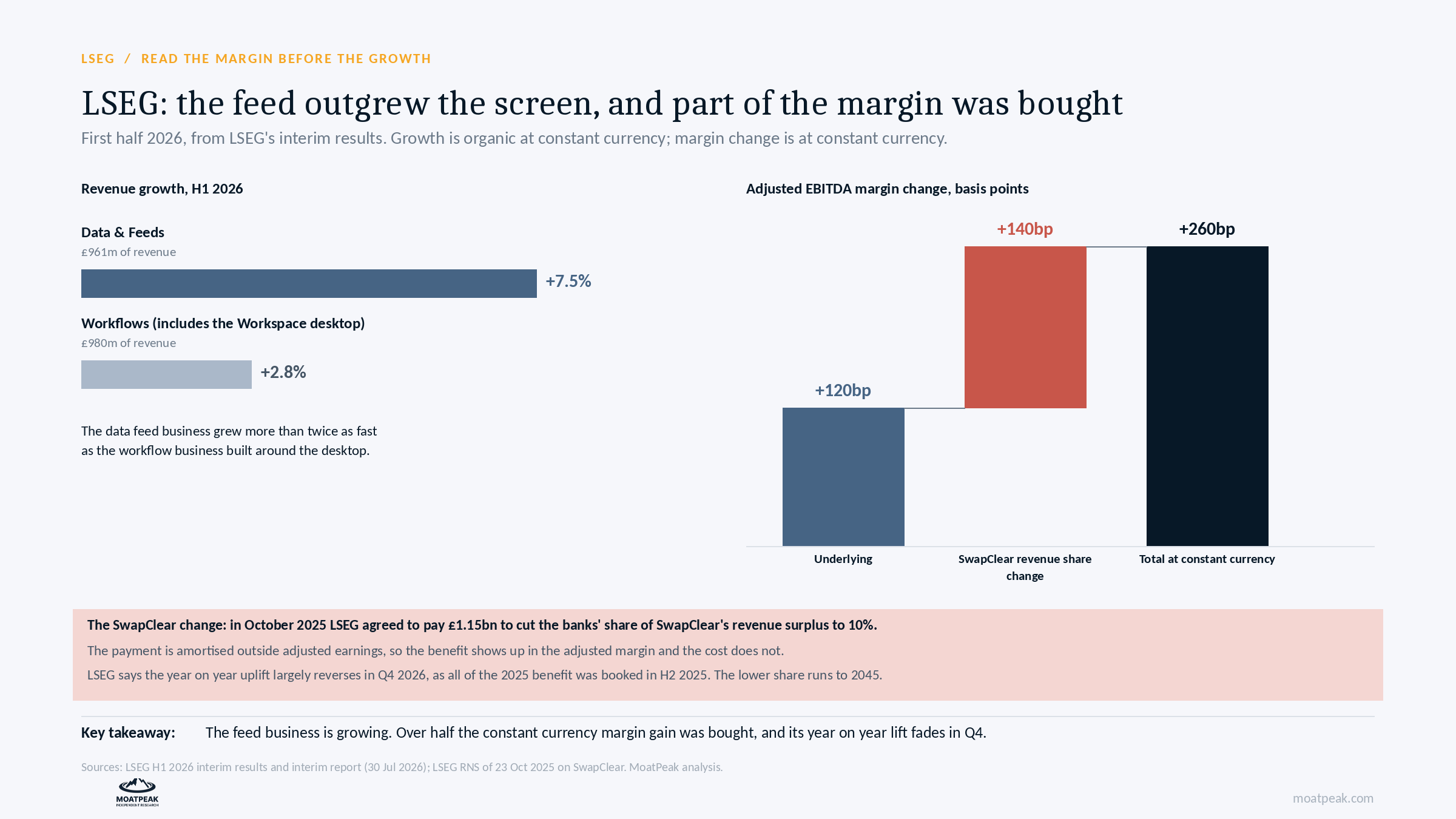
LSEG is the cleanest test of the layer argument. In the first half, organic revenue in Data & Feeds grew 7.5 percent. Workflows, the business built around its Workspace desktop, grew 2.8 percent. The feed outgrew the screen.
The margin needs more care. Adjusted EBITDA margin, the share of revenue left as operating profit before depreciation and one-off items, rose 260 basis points at constant currency, which strips out exchange rate moves. LSEG itself says 140 of those came from a change to its SwapClear revenue share. In October 2025 it agreed to pay £1.15bn to cut the banks’ share of SwapClear’s revenue surplus to 10 percent. That payment is amortized outside adjusted earnings, so the benefit shows up in the adjusted margin and the cost doesn’t. LSEG’s interim report says the year-over-year uplift will largely reverse in the fourth quarter, because the benefit for all of 2025 was booked in the second half of 2025. The lower revenue share itself runs to 2045.
What the full report does
The report values each of the three companies on three scenarios, including one in which AI wins outright. It sets out what we think each company is worth, and the single result in 2027 that would tell us the framework is wrong. Those stay in the report.
Three things to check by 22 October
FactSet, 30 September. Does user growth hold near 12 percent and organic subscription growth near 7 percent now that OpenAI has a banking product? Does the company say anything about AI revenue, and how it is priced?
MSCI, 20 October. Watch the fee on each dollar of ETF assets. If assets keep rising while the fee keeps falling, the index business is growing on volume and markets rather than on price.
LSEG, 22 October. The trading statement covers revenue only. When margins come back with the full-year results, take the SwapClear change out before you compare.
Educational research only. Not personalized investment advice. MB “MoatPeak Group”.