


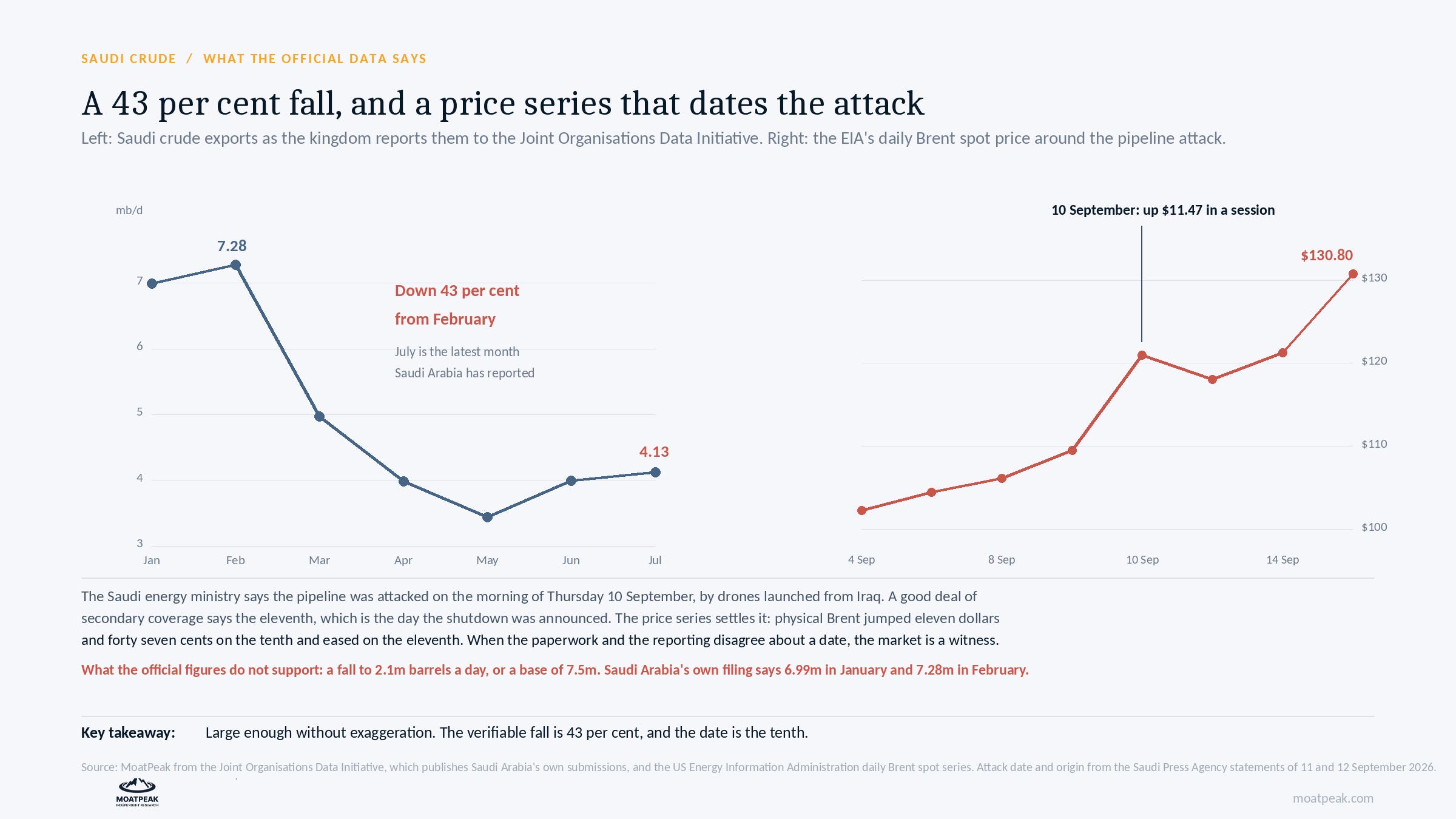
Saudi crude oil exports have fallen by 43 percent, a figure which represents a considerable change. Although certain reports refer to a drop of 70 percent and get the date wrong, examination of the price data puts the mistakes right.
This week certain reports state that Saudi oil shipments had decreased by more than 70 percent, falling from seven and a half million barrels per day at the beginning of the year to just two point one million by mid-September.
All morning we had tried to verify those figures but could find no evidence to back them.
Instead, we found a genuine and considerable decrease of 43 percent, a data error that price charts can correct, and a workaround that shows more than the headlines suggest.
Start by looking at the official report from Saudi Arabia.
Saudi Arabia sends its oil figures to an international statistics group each month, who then make them available free of charge. The figures in question are not estimates or ship tracking figures but are the country’s own data: 6.99 in January, 7.28 in February, 4.97 in March, 3.99 in April, 3.44 in May, 3.99 in June, and 4.13 in July, which is the most recent month for which figures have been reported.
Exports are down 43 percent from the February peak.
Exports never reach 2.1 million and they never begin at 7.5 million; the production figures show the same pattern, falling from 10.88 million barrels per day in February to 8.14 in July, and the energy agency gives the figure for August as 5.97 million.
A 43 percent decrease is already considerable. There is no point in exaggerating it to 70 percent, since that would draw attention away from the real issue and toward arguments about the sources.
The date, and why a price series settles it
While most reports state that the pipeline from east to west was attacked on 11 September, the statement by Saudi Arabia’s energy ministry is more precise in that it says the pipeline “was the object of a number of attacks in the morning of Thursday, 10 September 2026“ and was closed as a precautionary measure, resulting in injuries. Two days afterwards, the foreign ministry claimed the drones had been “launched from Iraq”.
The shutdown was announced on the eleventh, which is why there’s confusion about the date.
What stands out is that you don’t have to rely solely on the ministry’s statement; an independent source maintains timestamped records and has no stake in the matter.
The daily physical Brent price is published free of charge by the American energy agency. On 9 September it was $109.51, rose to $120.98 on 10 September, which was an increase of $11.47 in a single day, and then fell back to $118.06 on the eleventh.
On the tenth, the market responded to the attack, and buyers learned about it before the news was made public.
If there is a discrepancy between the official records and the news reports regarding a date, price data can be used as a reliable source to check on it.
The workaround, which is the actual news
We made it clear on 15 September that when the pipeline is blocked the alternative route is the strait which the pipeline was intended to avoid; the way to deal with a restricted strait is to use that strait itself.
This is currently happening along a definite route and at a certain volume.
Aramco has sold about sixty million barrels of oil, loaded at Ras Tanura on the Gulf coast, and transferred at sea to larger tankers at the Omani port of Sohar this month and next. The buyers are refineries in China, South Korea, India, and Japan. Gulf exports have now recovered to between one and one and a half million barrels per day, similar to the figure for August.
It is more than just a headline; Saudi Arabia has built a pipeline over 1,200 kilometers long across its own territory so its oil does not have to pass through the Gulf. Nowadays, since the pipeline is no longer in use, the oil goes through the Gulf, is loaded onto one ship, sails to Oman, and is then transferred to another ship.
All of these steps increase cost and risk; traffic data indicates fewer ships are now using the corridor, with only seventeen commodity vessels passing through the strait over the weekend, compared with thirty-seven the week before.
The terminal at the far end of the pipeline has also come under attack. On 19 September the Houthi movement stated that strikes had been carried out on facilities in Riyadh and at Yanbu belonging to Aramco. The Saudi-led coalition asserts that these attacks were averted and that a missile directed at Riyadh was intercepted, with no casualties recorded. We have included both the claim and the denial since that is what the record indicates.
What we are watching, and one of them is today.
The Brent spot price series, which we referred to earlier, ends on 15 September at $130.80, with the next update scheduled for today, 23 September.
This matters because, as we pointed out on 18 September, the actual Brent price and the frequently quoted futures contract were twenty-two dollars apart that day, and anyone can check today’s update free of charge to see whether that difference is narrowing.
If the physical price is the same as the futures price, then the gap was merely the result of one outage over two weeks, and we will state that. However, if the physical price remains considerably higher, this shows the market still lacks barrels, regardless of what the futures indicate.
Another thing to watch is the August exports figure, since it will be included in the next report. If it falls below three million barrels per day, then the situation is more serious than we have described. If it goes above five million barrels, the pipeline is performing better than the traffic data shows.
The honest other side
Exports were already falling before the pipeline was attacked, with data showing a decline from seven million and a quarter to under four million between February and May, long before these events. Since the attack hit a system that had already lost most of its volume for other reasons, it is just as incorrect to attribute the entire drop to a single strike as it is to claim the figure was seventy percent.
Starting in mid-September, the trend has turned, and exports have begun to increase. Gulf loadings have recovered, and satellite data indicates that tankers are now gathering at Gulf terminals at the highest level seen since at least June. Saudi Arabia is clearly taking action to deal with the problem.
What we want to make clear is that the figure is 43 percent, not 70 percent; the right date is the tenth, not the eleventh; and the new route is more expensive and more vulnerable than the original one.
Educational research only. Not personalized investment advice. MB “MoatPeak Group”.