


On Sunday, we shared a chart showing that the five biggest cloud companies have signed $1.09 trillion in leases that have not started yet. Of these, $285 billion are on their balance sheets. For Meta, the number was $278.99 billion.
A reader quickly told us that we were understating the situation.
He was correct, and we stated that at the time. The Wall Street Journal, two days later, ran its own calculation covering nine companies and gave Meta a figure of $347 billion.
Really, this is a quick lesson in how to read a company’s reports, and that lesson is more valuable than either number.
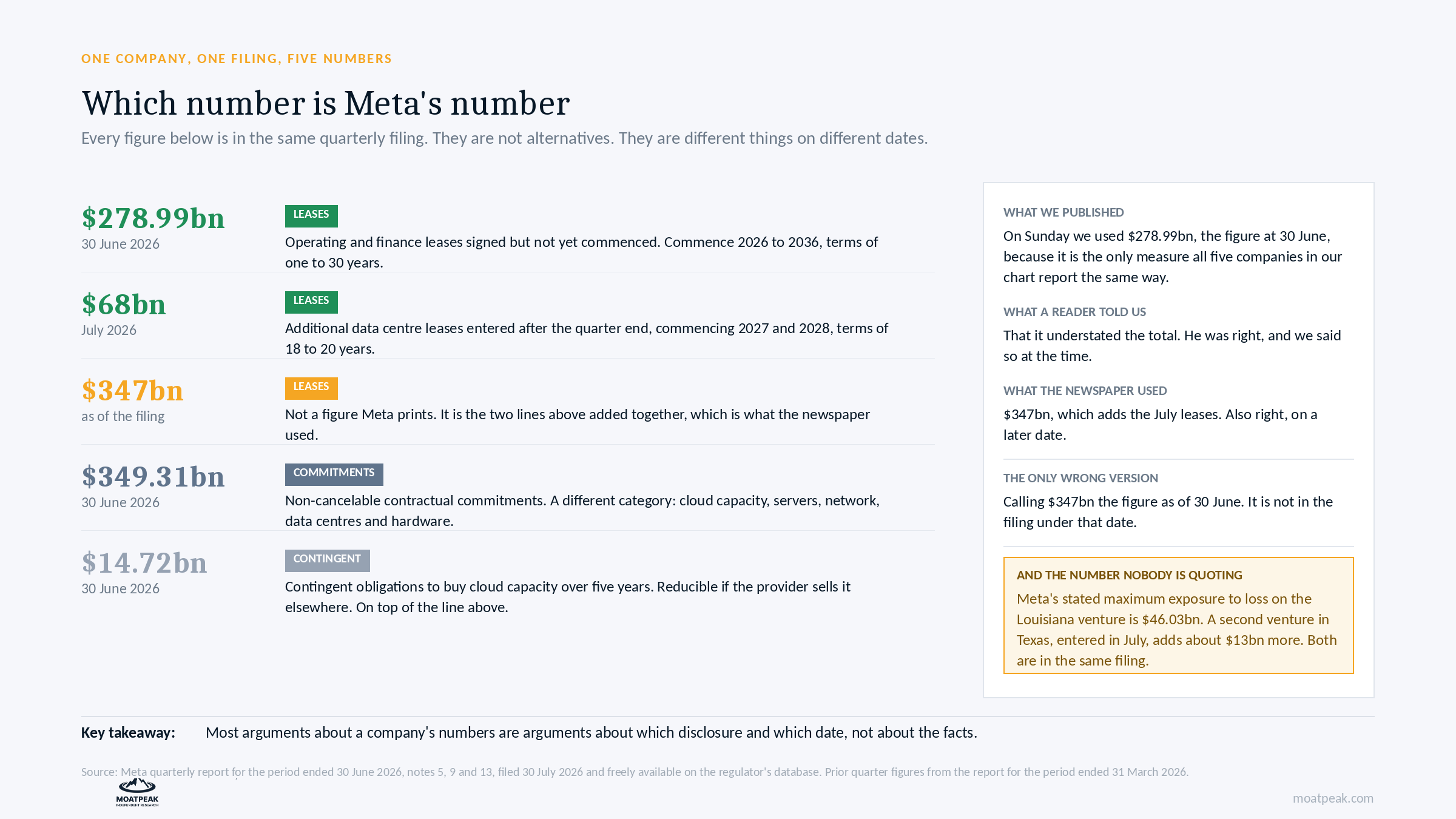
The five numbers and what they mean
You can find this information in Meta’s quarterly report for the period ending June 30. The notes are brief, and the report is free to access.
$278.99 billion: This is the amount of operating and finance leases Meta had signed but not yet started as of June 30. These leases will begin between now and 2036, with terms from one to thirty years.
$68 billion: Additional data center leases signed in July, after the quarter ended, are also mentioned. These leases start in 2027 and 2028 and last from eighteen to twenty years.
$347 billion: Meta does not list this number anywhere. It is the total of the two amounts above. The newspaper used this figure, setting its chart to July instead of June 30, so it is accurate.
$349.31 billion: This is a separate category for non-cancelable commitments related to third-party cloud capacity, servers, network infrastructure, data centers, and consumer hardware. These are not leases.
$14.72 billion: These are extra contingent obligations to buy cloud capacity over five years. They are “in addition” to the previous obligation and can be reduced if the provider sells that capacity to someone else.
So, who got it right?
All of us, in fact.
We picked the narrowest measure because it is the only one all five companies in our chart report the same way. This lets us compare them. The reader was right that this is not Meta’s total exposure. The newspaper was also right to include the July leases, since it used the filing instead of the quarter’s end.
The only wrong version is the one now being shared, which says the June 30 figure is $347 billion. That amount is not in the filing for that date.
Two details in the same filing that no one is mentioning
This is why it is better to read the notes yourself rather than rely on a summary.
Meta says its maximum possible loss on the Louisiana venture is $46.03 billion. That number is in the document, but we have not seen it mentioned in any article.
There is another one: in July, a similar deal was made in Texas, adding about $13 billion in residual-value-guarantee exposure.
While people online debate which lease figure is correct, another data center venture in the same filing has gone unnoticed.
A correction that matters more than the numbers
Another part of the report needs correction. It is being repeated everywhere, but it is wrong in a way that changes the meaning.
Some claim that Meta has promised bondholders the full amount, provided the bonds do not remain outstanding for the entire term.
Meta’s disclosure is more limited in three ways. The guarantee is for the joint venture, not the bondholders. It only covers shortfalls, meaning it pays the difference between the property’s value and a certain threshold, not the full amount. That threshold also goes down over time. Meta calls it “a capped cash payment to the joint venture”.
It is still a real obligation and worth knowing about. It just is not the issue being discussed.
What we can learn from all this
Most debates about a company’s numbers are not about the facts themselves. Instead, people disagree about which disclosure to use and which date to pick, since each person has read a different one.
There might be a habit that appears dull, yet it is effective. When somebody gives you a number, ask yourself two questions at first: which line in which document and as of what date? In this instance, asking those two questions resolved a three-day argument in around ninety seconds.
If a reader says your number is wrong, check it before defending it. In our case, the range was too narrow for the purpose, and admitting that cost us nothing.
You can find a full explanation of what these commitments mean for each company, and which ones we think the market is mispricing, at moatpeak.com.
This content is based solely on educational research and does not provide personal investment advice. MB “MoatPeak Group”.
The important point is not which number is highest, but what each number actually represents. Mixing leases, commitments and contingencies can make the underlying exposure look very different.