


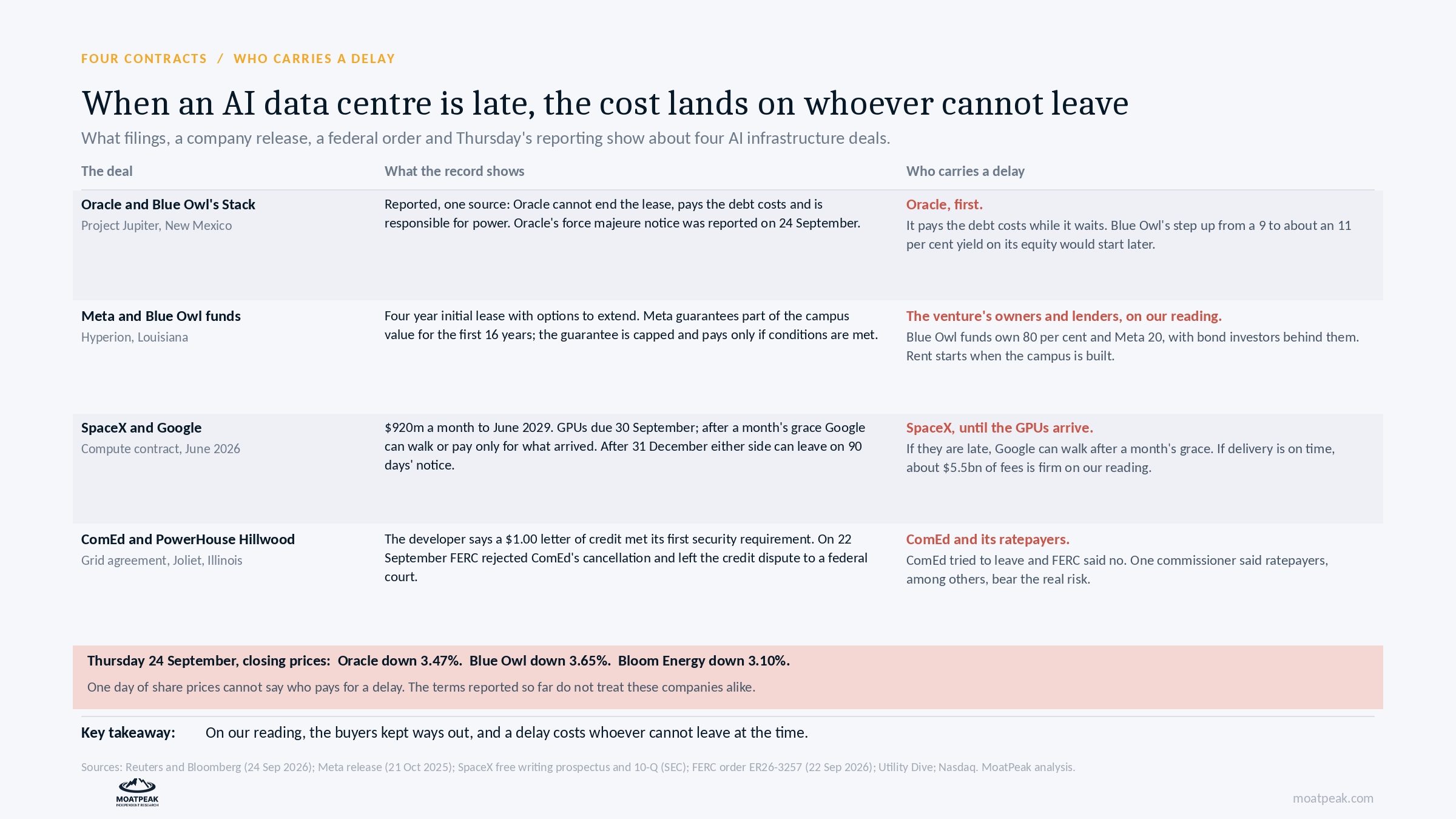
On 24 September, the day Oracle’s force majeure notice was reported, three companies tied to its New Mexico campus fell. Oracle, the tenant, closed down 3.47 percent. Blue Owl, which owns the developer building the campus, closed down 3.65 percent. Bloom Energy, which is meant to power it, closed down 3.10 percent. The S&P 500 barely moved. Oracle and Blue Owl had also fallen about 3 percent the day before the report.
To find out who pays if a data center runs late, you have to read the contracts. We took what has been reported about this one and put it next to three other AI infrastructure deals whose terms are public, in company filings, a company announcement or a federal order.
On our reading, all four deals point the same way: when an AI data center is late, the cost lands on whoever can’t leave.
What the notice does
A force majeure clause excuses a party when something beyond its control stops it doing what it promised. Think of a war, a flood, or a government refusing a permit.
On 24 September Bloomberg reported that Oracle had sent one to the developer of Project Jupiter, its planned campus in Doña Ana County, New Mexico. The developer is Stack Infrastructure, which Blue Owl owns. Reuters then reported the terms that matter, from a person familiar with the matter.
According to that person, securing power for the site is Oracle’s responsibility, and Oracle cannot terminate the lease under any circumstances. Blue Owl has about $3 billion of equity in the project, and Oracle pays the debt costs. During construction, Blue Owl earns a 9 percent yield on that equity. After completion, the levered yield is expected to be about 11 percent.
By invoking force majeure, the same person said, Oracle extends the period in which it pays the lower rent. Blue Owl still gets the higher rent for the full planned term. It just starts later.
So Oracle isn’t walking away. Under this lease, as that person describes it, it can’t. It is arguing that the clock on the full rent shouldn’t start if the power is late.
Why the power is the risk
In April Oracle switched Jupiter’s power plan to up to 2.45 gigawatts of Bloom fuel cells, replacing the gas turbines it had planned. Fuel cells still need gas.
The pipeline meant to deliver it, proposed by a subsidiary of Energy Transfer, had a target in-service date of 15 August. After repeated refusals from New Mexico’s State Land Office, the operator’s filing now says 1 February 2027. An analyst at Energy Aspects told Bloomberg that date is probably not realistic, expects the second half of 2027 at the earliest, and sees a risk of cancellation if progress stalls. In May, Oracle itself told federal regulators that time was of the essence for that pipeline.
So the part of the project most at risk of running late is the power, and power is Oracle’s job, according to Reuters’ source. Oracle says the campus remains on its planned schedule. The pipeline is already behind its own target.
That’s why the notice matters. A delay that is the tenant’s own doing would normally be the tenant’s cost. A delay caused by a state agency refusing a pipeline route is the kind of event force majeure clauses are written for. Whether that argument holds depends on a contract nobody outside the parties has seen.
Who carries the months
Put the reported terms together and the three companies are in very different positions.
Oracle carries the largest share of any delay. It pays the debt costs on a campus that earns it nothing yet, and if the notice fails, it starts paying the full rent sooner. The brokerage William Blair noted that Jupiter contributes no revenue to Oracle this fiscal year, so the near-term accounts barely change. The cost shows up as cash going out before any cash comes in.
Blue Owl’s cost is smaller. On the reported figures, a year of delay postpones a step up of about two percentage points on about $3 billion of equity, roughly $60 million a year on our arithmetic. Bloomberg reported that funds Blue Owl manages committed the equity, so on our reading most of this falls on the investors in those funds, and Blue Owl’s shareholders feel it through the firm’s fees. The higher rent still runs for the full term, so the money is postponed, and the $60 million a year is the price of waiting.
The lenders, about 20 banks behind an $18 billion loan, are owed debt costs that Oracle pays, according to Reuters’ source. Bloomberg reported, citing a person familiar, that the notice is not an event of default (the kind of breach that lets lenders demand their money back), and that the debt was already trading below 90 cents on the dollar. A gauge of Oracle’s credit risk hit a record on 24 September. On our reading, with Oracle paying the debt costs, the loan is largely a bet on Oracle’s credit. We haven’t seen a loan price since the notice.
Bloom Energy is the one we can say least about. Its fuel cells need the gas line, and its terms with Oracle aren’t public. Bloom said on 24 September that Oracle remains committed to its contract.
One day of share prices can’t sort any of this out, least of all a day when long Treasuries also fell about 1.3 percent. Our concern is wider than this notice. Oracle itself calls notices like this commonplace, so we doubt it will be the last.
How big buyers write their contracts
Now look at deals where the terms are public.
On 5 June SpaceX signed a contract to supply Google with computing capacity built on about 110,000 Nvidia GPUs. SpaceX’s filing with the SEC sets the fee at $920 million a month from October through June 2029. Add that up and the headline is about $30 billion.
Two clauses change what it’s worth. If SpaceX hasn’t delivered the committed GPUs by 30 September, then after a one-month grace period Google can walk away, or keep what has arrived and pay less. That exit is Google’s alone. The second clause runs both ways: after 31 December either side can end the contract on 90 days’ notice. SpaceX’s own quarterly report says its cloud contracts generally work like this.
On our reading, if SpaceX delivers on time, the part neither side can escape is about six months of fees. That’s roughly $5.5 billion, against a headline near $30 billion.
If Google uses that exit, it stops paying, and the capacity goes back to SpaceX to use itself or rent to someone else. Until the GPUs are delivered, though, only Google can walk.
Meta took a similar approach at Hyperion, its campus in Louisiana. Funds managed by Blue Owl own 80 percent of the joint venture that owns the campus, Meta owns 20 percent, and part of the money came from bond investors. Meta’s lease has a four-year initial term with options to extend, which Meta’s announcement said gives it “long-term strategic flexibility”. To balance that flexibility, Meta guaranteed part of the campus value for the first 16 years. The guarantee is capped and only pays out if certain conditions are met.
On our reading, both buyers kept a way out: Google if the capacity is late, and Meta if it no longer needs the campus after four years, at the price of a capped guarantee. Google’s other exit, 90 days’ notice after 31 December, is one SpaceX holds too. Now notice where Blue Owl sits. At Hyperion its tenant can leave after four years. At Jupiter, as reported, its tenant can’t end the lease early. Same manager, opposite ends of the risk.
What Oracle signed
Oracle is the other kind of company in this story. It sells computing capacity to customers such as OpenAI, and it leases buildings to do it.
Its quarterly report for the three months to 31 August shows $288 billion of data center leases that are signed and haven’t started. They run for 15 to 19 years and are generally expected to start between now and Oracle’s fiscal 2029, which ends in May 2029. In May 2024, when the figure covered operating leases only, it was $22.9 billion.
For scale, every remaining payment on the leases Oracle has already started adds up to $63 billion. The pile waiting to start is more than four and a half times that.
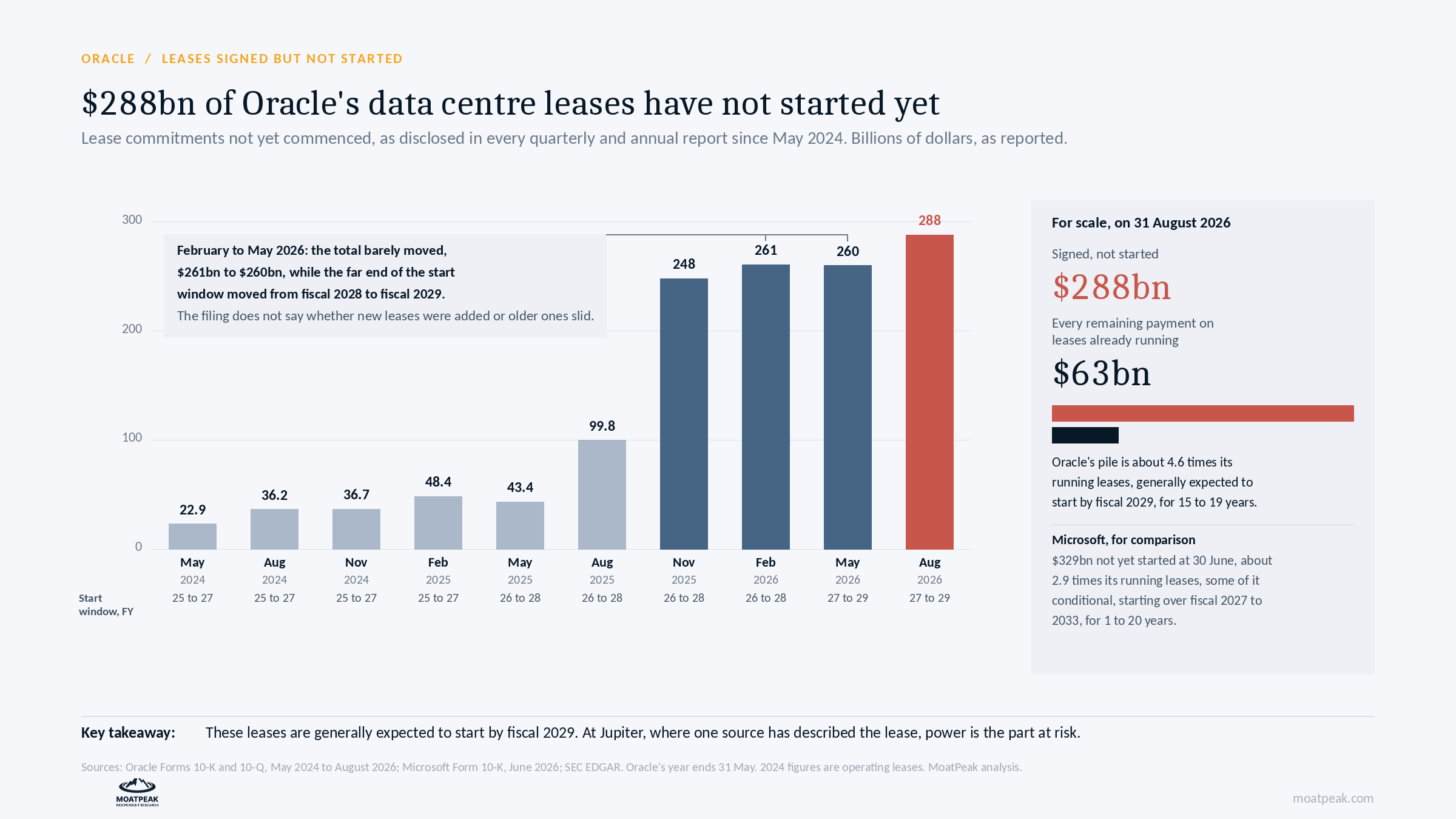
Big signed pipelines aren’t unique to Oracle. Microsoft reported $329 billion of leases not yet started at the end of June, some of them subject to conditions, with terms of up to 20 years. The differences are proportion and timing. Microsoft’s pile is about three times what it still owes on its running leases, and it starts over fiscal 2027 to 2033. Oracle’s is more than four and a half times, and it is generally expected to start by the end of May 2029, less than three years away.
Set that against what Oracle has sold. Its contracted revenue still to be delivered is $664 billion, and it expects to recognize about 84 percent of it within five years. About 16 percent, roughly $106 billion, falls after that. The leases waiting to start run 15 to 19 years from their start dates. New contracts may well fill those later years. The rent for them is already signed.
There’s one more detail worth watching. Between February and May this year the total barely moved, from $261 billion to $260 billion. Over the same three months, the far end of the window in which those leases are generally expected to start moved from fiscal 2028 to fiscal 2029. The filing doesn’t say whether new leases were added or older ones slid. It’s the right question to ask in December.
And one line has gone. In February, Oracle’s quarterly report said one of these leases came with an Oracle guarantee of up to $2.2 billion of the landlord’s borrowing, maturing in September 2026. By May the annual report put it at up to $3.3 billion. The August report doesn’t mention it. We don’t know which lease it is, and we’ll look for what happened to that loan.
The grid has the same problem, with one dollar in it
The same fight is happening one layer down.
PowerHouse Hillwood is developing a 1.8-gigawatt, $20 billion data center campus in Joliet, Illinois. Its agreement with ComEd, the Exelon utility, covering the transmission work requires credit support. A letter of credit is a bank’s promise to pay if its customer doesn’t. The developer says a letter of credit for $1 met its first credit requirement.
ComEd tried to cancel the agreement. On 22 September FERC, the federal power regulator, rejected the cancellation and declined to decide the credit dispute, which is before a federal court. Four commissioners added concurring statements, two of them jointly. One called the idea that $1 is appropriate security “an embarrassing legal fiction”, and said ratepayers, among others, bear the real risk of the project. Another said agreements like this exist so that project risk stays with the developer, not the public.
So far, the utility has tried to leave and been refused. For now, the security behind a gigawatt-scale grid agreement is one dollar, and whether that’s enough is for the court to decide. Grid operators have until mid-November to answer FERC’s June orders on how very large users connect to the grid, and those answers will shape how future agreements are secured.
The rule we take from this
Four deals, one pattern on our reading. The buyers kept a way out: Google can walk if its GPUs are late, and Meta signed a four-year first lease. The other side carries the wait: Oracle with a lease it reportedly can’t end, a developer waiting on its step up, SpaceX until its GPUs are delivered, and a utility that tried to leave and was told no by FERC, with ratepayers behind it.
When a data center is late, someone still pays: whoever can’t leave.
Three practical things follow.
Read the exit before the headline. On our reading, if the GPUs arrive on time, this $30 billion contract is about six months of committed fees plus an option on the rest, and both sides hold that option.
Read both sides of a backlog. Oracle’s $664 billion of contracted revenue arrives as capacity is delivered, mostly within five years. Its $288 billion of leases are generally expected to start by fiscal 2029 and then run 15 to 19 years. At Jupiter, on the reported terms, Oracle pays the debt costs and a lower rent while it waits, so a late building costs it money before any revenue arrives.
Watch the dates. The next ones are public.
30 September: the delivery date in the SpaceX and Google contract, with a month’s grace to the end of October.
Mid-November: grid operators answer FERC on connecting very large users.
23 November: New Mexico’s deadline to decide Jupiter’s air permit.
Mid-December: Oracle’s next quarterly report.
31 December: after this date either side of the SpaceX and Google contract can give 90 days’ notice.
1 February 2027: the pipeline’s target in-service date.
What would make us wrong
Oracle calls notices like this commonplace in developments of this scale, says Jupiter remains on its planned schedule, and says such notices do not, by themselves, establish a project delay. Blue Owl says the notice doesn’t change the financial commitments to the project. Bloom says Oracle remains committed to its contract. On 17 September New Mexico’s Supreme Court turned away two challenges and let permitting resume.
Oracle’s $664 billion is contracted revenue, which is a much stronger thing than a headline deal value, and it grew from $455 billion a year earlier.
Microsoft’s signed pile is larger than Oracle’s. Big lease commitments are how this industry builds. On their own they aren’t a warning.
The $1 letter of credit may be exactly what the agreement allowed at this stage. The developer’s case is that $1 met the initial requirement. FERC didn’t rule on it.
And SpaceX can leave the Google contract on 90 days’ notice too.
The test we will score
In Oracle’s next quarterly report, due around mid-December, we will print one paragraph: the total of leases signed but not started, the window in which they are generally expected to start, and whether Oracle still guarantees any landlord’s borrowing.
We’ll read it four ways, set out now.
More than 5 percent below $288 billion, with payments on running leases up by at least half the fall: buildings are being handed over.
More than 5 percent lower without that rise: leases may have been cut or renegotiated, and we’ll say so.
More than 5 percent higher: Oracle is still signing, and we’ll report the new window.
Within 5 percent either way: if the far end of the window has moved to fiscal 2030 or later, that’s the February to May pattern again, and we’ll read it as starts moving later while saying the filing can’t prove it. If it hasn’t moved, we’ll call it no change.
Whichever it is, we’ll also report whether any landlord guarantee is disclosed.
We’ll print the paragraph whichever way it reads.
Educational research only. Not personalized investment advice. MB “MoatPeak Group”.