


The market’s shut for the long weekend, so here’s a piece of investing wisdom that has nothing to do with today’s price. Start with a puzzle from the past week. A maker of memory chips reported what may be the best quarter in its history: revenue up enormously, margins near the highest the industry has ever seen, guidance pointing higher still. Numbers that, on paper, ought to end every argument. And plenty of experienced investors looked at them and felt not excitement but a small, familiar unease.
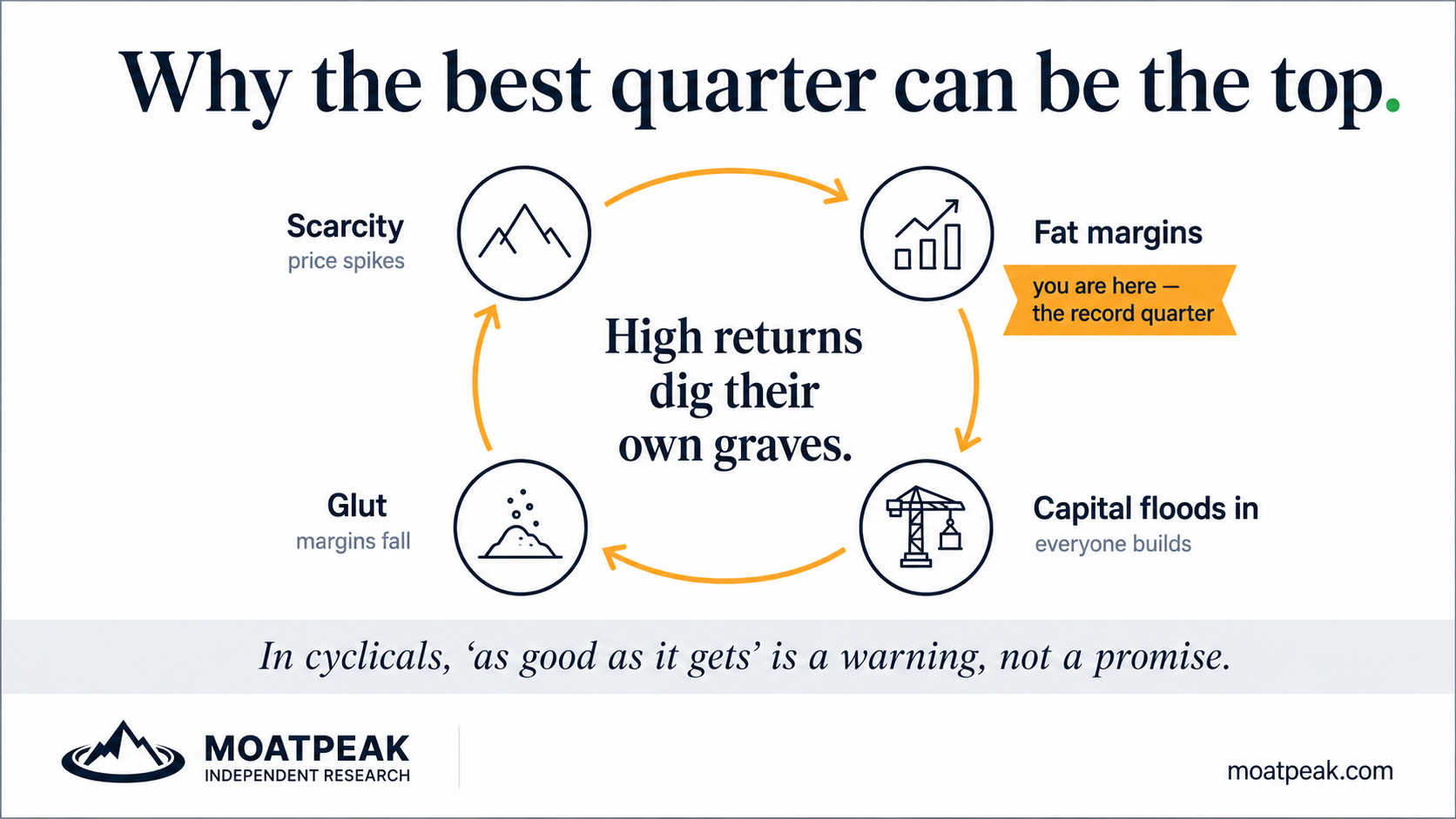
The reason has a name: the capital cycle. It goes like this. When something turns scarce and its price spikes, the companies that make it earn fabulous margins. Those margins are a signal — and not only to shareholders. They’re a flare fired over every competitor, every boardroom, every rival with access to capital: there is a fortune being made over here. So money pours in. Factories get planned, rivals expand, new entrants shove their way to the trough. And that stampede, the one the high prices summoned, is precisely what eventually builds too much supply, drives the price back down, and competes the fat margins away. High returns dig their own graves.
That’s why a record quarter, in a deeply cyclical business, can be a warning rather than a green light. The sheer perfection of the numbers is itself the information: it usually means you’re nearer the top of the cycle than the bottom. A near-record margin isn’t a new law of nature. It’s the peak — the moment of maximum optimism, and the exact moment the most capital is rushing in to erode it. The market at its cleverest refuses to pay full price for peak earnings, because it knows peak earnings are the ones least likely to survive.
The mirror image is the genuinely useful bit. The best time to get curious about a cyclical business is often when the numbers look dreadful — when margins are thin, plants sit idle, and everyone’s given up. That’s when capital flees, supply gets cut, and the next upswing is quietly being set. Misery plants the seeds of high returns. It feels backwards, because instinct says buy what’s obviously working and avoid what’s clearly struggling. In cyclicals, instinct is often upside down: the thrilling top is the dangerous part, and the miserable bottom is the opportunity.
None of which means selling every company that just had a great quarter. Some businesses post fat margins year after year because they own a real moat — a genuine wall that keeps the competition out — and those are a different animal entirely. The whole skill is telling the two apart: a durable wall, or just a good season in a cycle that always turns. So the next time you meet a record-breaking, everyone’s-cheering quarter, don’t ask how to get in. Ask what part of the cycle you’re standing in, and who’s already loading up the trucks to compete it away. Then go enjoy the long weekend.
Free weekly letter and explainers like this; the daily research, levels and the Daily Compass are at moatpeak.com.
Educational research only — not investment advice. MoatPeak Group, UAB.