


Nuclear power keeps winning. On 29 October, the microreactor company Radiant said the Department of Energy had approved the safety analysis for its Kaleidos reactor. That clears the way for the department’s readiness review, the last step before the reactor can be fueled and tested at full power at the Idaho National Laboratory.
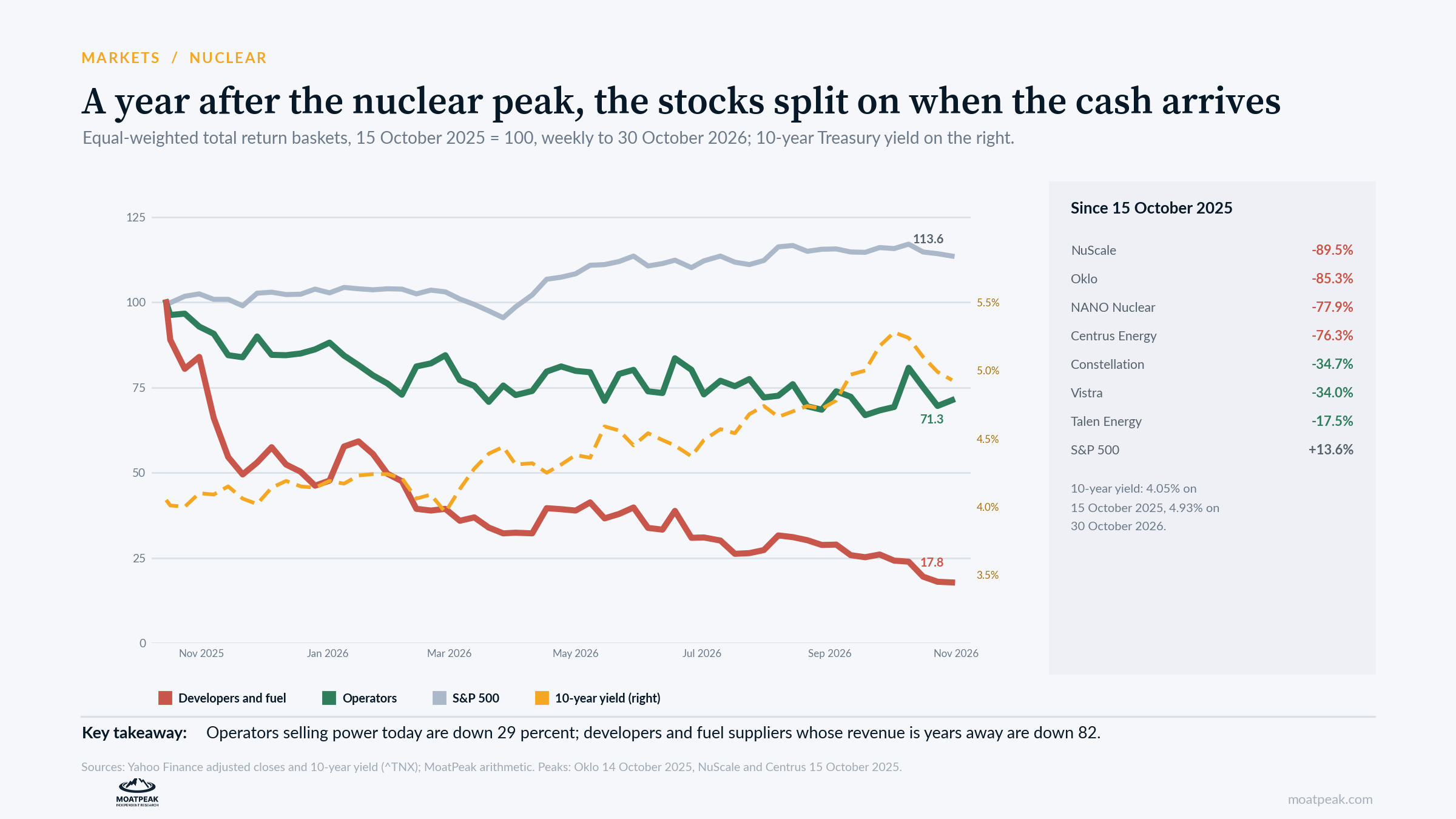
Nuclear stocks keep losing. Since the sector peaked in mid-October 2025, NuScale has fallen 89.5 percent, Oklo 85.3 percent, NANO Nuclear 77.9 percent and Centrus Energy 76.3 percent. X-energy, which listed in April, is 70 percent below its first-week high. Over the same period, the S&P 500 rose 13.6 percent. Radiant, the company with the year’s biggest milestone, is private.
Two baskets
The selling has not hit the sector evenly. We split it into two equal-weighted baskets. The first holds developers and fuel suppliers whose revenue lies mostly in the future: Oklo, NuScale, NANO Nuclear and Centrus. The second holds operators that sell power from reactors running today: Constellation, Vistra and Talen. From 15 October 2025 to 30 October 2026, with dividends counted, the developers lost 82 percent and the operators 29 percent.
October showed the pattern again. The 10-year Treasury yield reached 5.31 percent on 5 October, its highest close of the year. Over the month, the developers fell between 26 and 32 percent. Constellation rose 3.3 percent, Vistra finished flat and Talen gained 9.7 percent.
Why the timing of cash matters
An operator’s value rests on cash it earns now. A developer’s rests on cash it hopes to earn in the 2030s. That makes developers similar to long-dated bonds, which lose the most value when discount rates rise.
Our arithmetic shows the gap. At a 10 percent discount rate, $1 earned 10 years from now is worth about 39 cents today. At 11 percent, it is worth 35 cents, 9 percent less. A dollar earned next year loses less than 1 percent. The 10-year yield rose from 4.05 percent at the sector’s peak to 4.93 percent on 30 October, after touching 5.31 percent.
Rates explain October. They do not explain an 85 percent fall. Most of that is the unwinding of the price investors paid at the top for revenue that is still years away.
The bubble paid for the runway
The high prices had a lasting benefit, though: they let the developers raise money cheaply, and much of it is still in the bank.
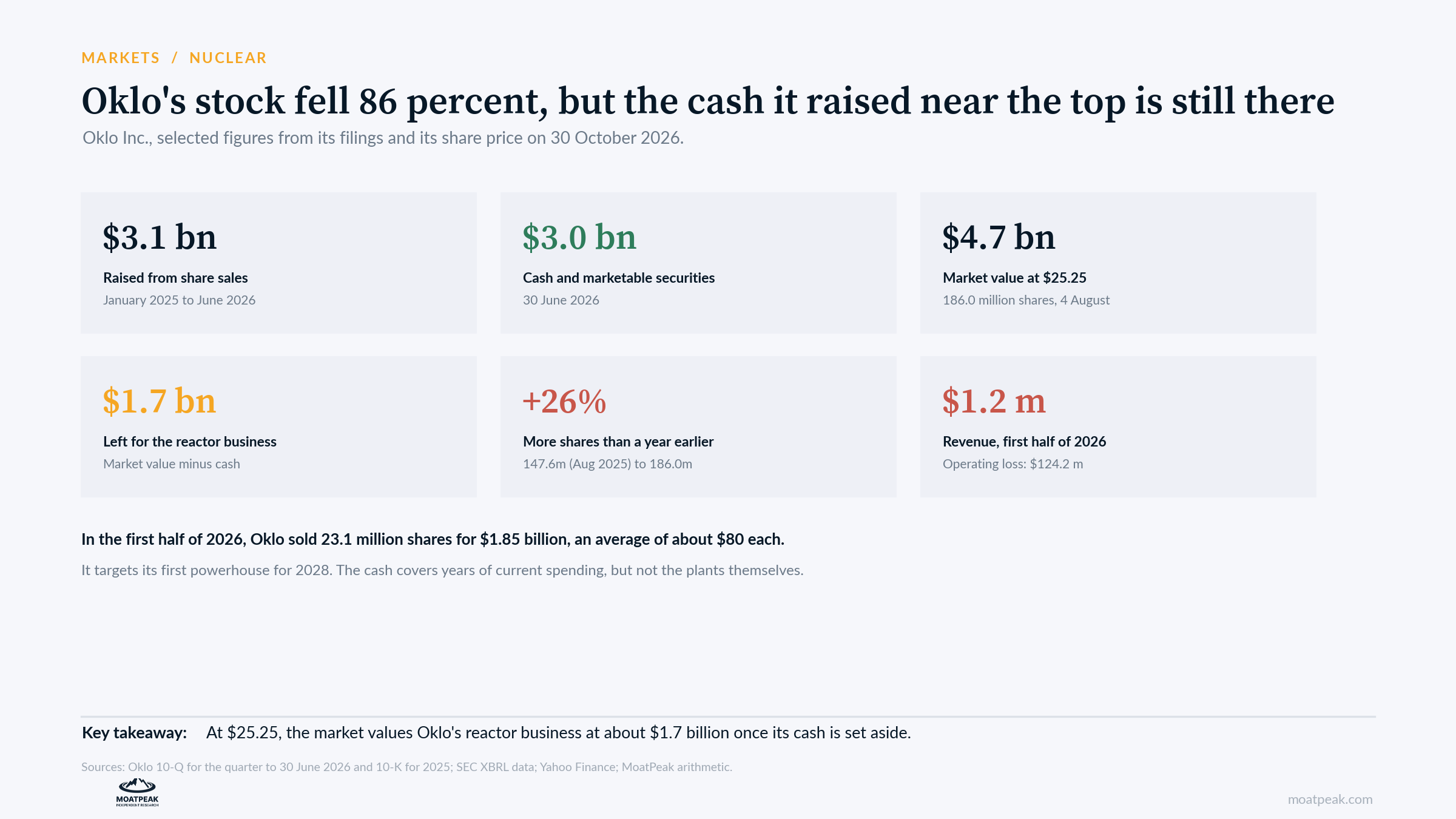
Oklo sold $1.26 billion of shares in 2025 and $1.85 billion in the first half of 2026, the latter at an average of about $80 a share. As of 30 June, it held $3.0 billion of cash and marketable securities, against an operating loss of $124 million in the first half. Its share count rose 26 percent over the year.
At $25.25 and its latest reported share count, Oklo’s market value is about $4.7 billion. Set aside the cash, and investors value the business itself at about $1.7 billion. That business targets its first powerhouse for 2028 and had $1.2 million of revenue in the first half of 2026. Shareholders who bought near the top financed the company for the next several years.
Our read
Investors have not given up on nuclear power. They have changed what they pay for. Megawatts that exist and are sold today have held most of their value. Megawatts promised for the 2030s are priced like a long bond in a world of 5 percent yields, with dilution on top.
That makes the next move in the developers a rates trade as much as a nuclear one. Their cash buys time, but each year of delay costs value, and each new share sale lowers what existing holders own of the eventual plants.
The case against us
Falling yields would flip the arithmetic. The same duration that hurt the developers in October would help them if long-term yields fell sharply.
Operators carry their own risks. Power prices, regulation and the terms of their contracts with data center buyers all matter, and the operators’ basket still fell 29 percent.
Milestones can move the developers quickly. A first binding order, a construction license or a successful full-power test could change the market’s view of how far away the revenue is.
What it means for your money
Pay for megawatts you can count. Operators with running reactors and contracted output have held up best, although they too fell sharply from their 2025 peaks.
Treat developers as long-dated options. Their value depends on long-term interest rates and on how many more shares they sell before revenue arrives.
Check cash against market value. At Oklo, cash is about two-thirds of the market value. The rest is the price of the plan.
What we are watching
The coming weeks: third-quarter results from Oklo and NuScale, with their cash use and share sales since June.
Radiant’s next steps: the Department of Energy’s readiness review and the full-power test in Idaho.
The 10-year Treasury yield: at 4.93 percent, the swing factor for every valuation that rests on the 2030s.
Educational research only. Not personalized investment advice. MB “MoatPeak Group”.
Oklo's Q3 10-Q (Nov 6) moves its cash further out, which fits your discount-rate arithmetic. The Q2 10-Q said the target was "deploying our first powerhouse in 2028"; the Q3 filing says "in 2028-2029". On the cash point, the $3.13B of cash and securities at Sept 30 came largely from ATM sales this year: 32.6M shares for $2.29B gross, at average net prices of $96.95, then $55.64, then $39.30 on the program opened in September. So the first half was raised near the top and the newest money costs about 2.5 times as many shares per dollar. Data: Oklo 10-Q filings, processed by Equibles.